
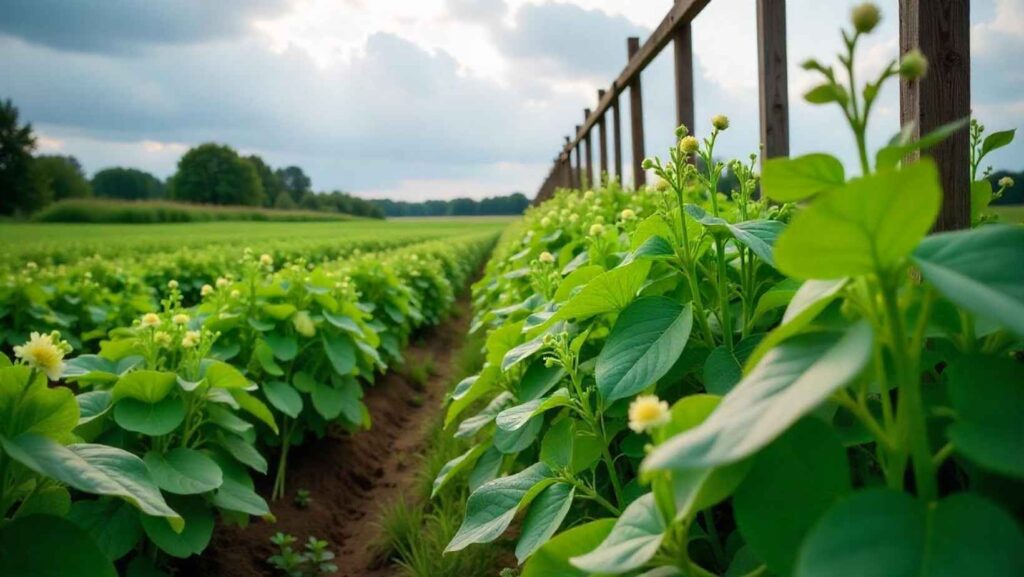
Would you want to know when to harvest snow peas? My experience has shown me that peas should now be picked while the pods are young, soft, and flat before the peas within start to thicken and enlarge.
This usually happens ten days after flowering or ten weeks after seeding. It is best to harvest before the pods are bitter and stiff.
Generally speaking, snow peas can be picked ten weeks after seeding or ten days after blossoming. When the pods are young, flat, and sensitive, choose them.
The peas inside the pods may turn quite bitter and harsh as they start to expand. But that’s not all; I’ll explain more about the topic as you continue reading.
Now, let’s get started.
When to harvest snow peas
Snow peas are harvested when the peas within the pods are still very little and immature. Snow pea pods are crisp and flat after harvesting.
When the pea pods are approximately two inches in length and large enough to be picked, we begin the process of harvesting snow peas.
Take the time to study the description of the variety thoroughly so that you may enjoy the peas at their highest possible quality.
Some types, such as Oregon Giant, have pods that can grow to be as long as five inches.
How do I know when to harvest snow peas
Before the peas inside the pods begin to expand, snow peas should be harvested when the pods are flat and around 7-10 centimeters in length.
By picking the plants on a regular basis, you stimulate them to produce additional pods. If you want to prevent injuring the vines, you should use scissors or a sharp knife.
When they are still crisp and fresh, snow peas are at their peak when they are collected early in the morning.
You will be able to start harvesting snow peas anywhere from six to ten weeks after planting them, although this may vary depending on the kind of snow peas that you have produced.
When the pods of snow peas are smaller, and the peas that are contained within the pods are not too bloated, the snow peas are at their most sensitive and delicious.
When you need pods, harvest them and consume them either raw or cooked.
Snow pea blooms, tendrils, and shoots are all edible parts of the plant that may be used to garnish salads with a fragrant and delicious snow pea taste.
How do I store harvested snow peas
The snow peas that have been collected recently can be kept in the refrigerator for up to a week on average.
To ensure that the moisture is not lost, place them in a plastic bag or container.
To extend the amount of time that the pods may be stored, blanch them in boiling water for a few minutes, then chill them in ice water, and then freeze them.
The peas’ flavor and quality may be preserved if they are stored appropriately.
Store newly gathered peas properly to maintain their freshness and flavour.
For optimal results, follow these steps:
Gardens of peas – The sugar content of garden peas begins to convert to starch quite fast; thus, it is important to shell them as soon as possible after collecting them.
It is possible to freeze peas that have been blanched for up to a year, while fresh peas may be stored in the refrigerator for three to five days in a plastic bag that has gaps in it.
Snow and snap peas – Snow and snap peas may be stored in the refrigerator for up to one week if they are not cleaned and placed in a plastic bag with perforations.
You may blanch them and then freeze them for up to a year to save them for longer periods.
In addition, peas may be dried for long-term preservation, which is another option. It is recommended to shell garden peas and then put them out on a screen or tray in a dark and well-ventilated spot.
After being completely dry, please place them in an airtight container and keep them in a cool, dark area.
Where & When to Grow
During the growth season, peas want temperatures between 12 and 20 degrees Celsius (55 and 70 degrees Fahrenheit), as they are a cool season crop.
It has been suggested that the term “snow pea” originates from the fact that snow peas are able to tolerate a moderate amount of snow and frost.
This assertion is largely accurate since snow peas are able to survive temperatures as low as -2 degrees Celsius (28 degrees Fahrenheit).
During the winter months, the temperature is just about right for snow peas to thrive in the humid subtropics where I dwell.
We start planting in the middle of late fall, when the humidity and summer rain has subsided, and continue doing so until around July.
This allows the last harvest to develop in late spring, which is when it gets too hot for them to survive.
The cultivation of peas is possible in any garden bed. As long as the soil is decent, they will do just as well in containers, in raised beds, or in the ground as they would in any other environment.
There is no better trellis for producing snow peas than one that is made of sturdy metal and can be accessed from all sides.
Not only does it make plucking the peas easier, but it also enables the peas to develop robustly and rapidly by anchoring themselves to it with their tendrils.
How many times can you harvest snow peas
For many weeks, snow peas can be picked more than once. After planting, you may usually harvest them 8–10 weeks later.
Harvesting should start 8–12 weeks after planting or around 10 days after blossoming. When the pods are 7.5 to 10 cm long, flat, and seedless, you will pick them.
As long as the plants keep yielding fresh blooms and pods, harvesting may go on.
Here’s a more thorough explanation:
Harvesting begins 8–12 weeks after planting or around 10 days following blossoming.
Harvesting Period: May go on for eight to ten weeks or longer if circumstances allow.
Harvesting Frequency: Look for pods every few days and select the young, flat ones.
When to cease: If the weather gets too hot or the plant stops bearing new blooms and pods, you will cease harvesting.
An acre may yield 400 kg of fresh snow peas per week for at least 13 weeks; however, actual yields may differ.
Therefore, you should harvest frequently if you want to have an abundance of snow peas. The plant must produce more peas since when you pick them, they won’t grow into new seeds.
To collect as many peas as you can, harvest a little bit frequently! When the snow peas are big enough, I harvest them again.
Final thought
Now that we have established when to harvest snow peas, Snow peas are taken before they develop into gigantic peas, but before you can feel the peas getting a little bigger within the pods.
The pods ought to remain flat. Check the plants at least every other day as they mature since the pods develop quickly. To ensure that the plant keeps producing, harvest the snow peas often.
Using one hand, hold the vine while using the other to cut off the pod with scissors or gently snap it off the plant.
As soon as the young plants appear, pea shoots should be picked.