
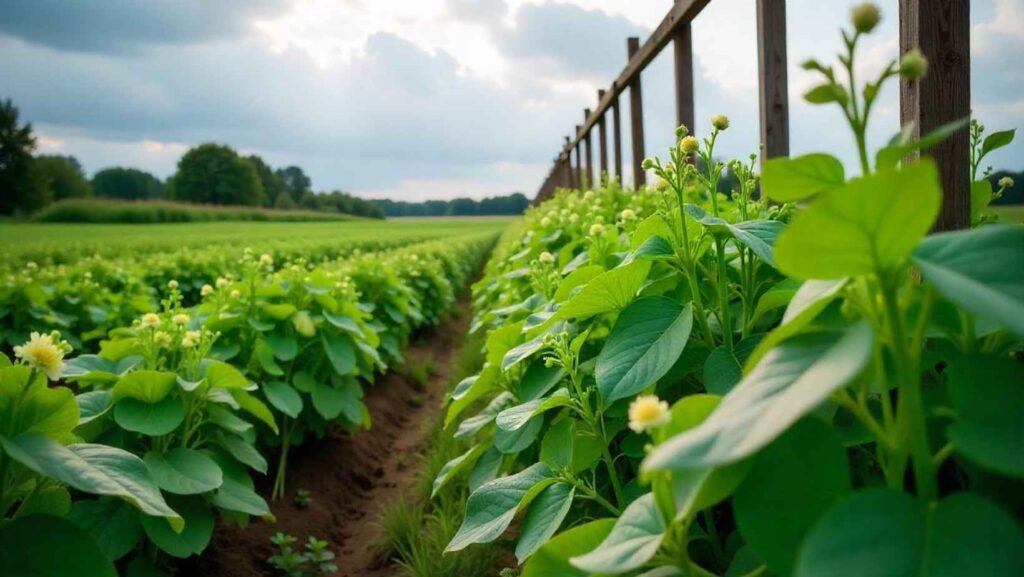
Would you want to know where snow peas come from? My experience has shown me that snow peas, often called sugar peas or mangetout, are a kind of garden pea that is usually picked when the pod is still flat, and the peas within have just begun to mature.
They belong to the pea (Pisum sativum var. saccharatum) family and are produced as annual vegetables from seeds.
Since snow peas are said to have originated in Southwest Asia, they are often referred to as Chinese pea pods.
They include tiny peas and are flat. They are really picked before the peas in the pod are completely grown. However, that is not all; as you continue reading, I will provide further information on the topic.
Now, let’s get started.
Where are snow peas grown
Snow peas are grown in a number of countries throughout the world, including Japan, specifically in the Wakayama Prefecture, and the United States of America, particularly in the state of California, India, China, England, and Hungary.
In addition to being cultivated for commercial purposes, peas are also grown in personal gardens all over the world.
Within the United States, snow peas are sold at local markets, grocery stores, and through distributors.
Additionally, snow peas are shipped to countries that are nearby.
A significant portion of the history of snow peas is unknown, despite the fact that they have been farmed since ancient times.
It has been suggested by specialists that the Mediterranean, the Middle East, or Central Asia might be the probable genesis places.
Through the use of trade routes, snow peas were disseminated across Europe and Asia.
It is believed that they were brought to China and Japan as early as the seventh and eighth centuries.
It was during the Edo period in Japan, which lasted from 1603 until 1868 when snow peas were grown in large quantities and used as a primary element in Japanese cuisine.
Additionally, snow peas were brought to the New World by people who were migrating, and once they arrived, they were a popular crop for growing in gardens.
How to grow snow peas
It is during the cooler months that snow peas thrive in the majority of regions.
Because frost can cause harm to seedlings and have an effect on pods that are forming, it is best to wait until the possibility of frost has gone before planting or sowing in colder regions.
Because they are not heat resistant and will cease producing if they are grown during the warmer months, you should avoid doing so.
Look for an area in the garden that gets enough sunlight, has soil that drains well, and is enriched with compost.
Put the seeds in the exact spot where they will develop, cover them with dirt, and make sure to water them thoroughly.
There is a risk of the seeds rotting if you continue to water them after they have germinated.
Avoiding root ball disturbance and watering seedlings with diluted seaweed solution reduces transplant shock.
A useful piece of advice is to cultivate seeds in Jiffy pots and then put the seedlings out in the same container as the pot itself. This will prevent the roots from being disturbed.
What do you need to grow your snow peas
Specifically, a thirty-by-thirty-centimeter plot that contains snow pea seeds and a nutrient-rich soil mix
snow peas need a location that receives at least four hours of sunshine each day, as well as a trellis that they can climb on.
Utilizing the MM-Mix makes it quite simple to cultivate your snow peas.
It is almost certain that you will fall short of your expectations if you cultivate in potting soil of poor quality. Therefore, do not scrimp on the soil mix; instead, strive for the finest.
What you need to know about snow peas
Categorized as Pisum sativum var. macrocarpon, snow pea, Chinese pea, and Chinese pea.
Height ranges from 1.8 to 2 meters, with dwarfs typically measuring approximately 0.6 meters.
Yearly plants are the kind.
Arid and semi-arid climates, subtropical climates, tropical climates, and warm and chilly temperate climates.
Full sun is the position.
There are white blooms, and then there are green pods that are flat and green in color.
Silky, waxy, and ovate (egg-shaped) in form, the foliage is characterized by prominent venations.
Attached to the vine in pairs along its length.
Feeding: organic debris that has decomposed completely prior to sowing.
Watering: watering the soil on a regular basis will keep it wet.
How to cook & serve snow peas
Sautéed: Cook your snow peas in a skillet with a little oil or butter for a few minutes until they are brilliant green and just beginning to soften.
For added taste, you can add some ginger, chopped garlic, or a little soy sauce.
Stir-Fried: Perfect for Asian-style recipes, stir-frying snow peas with other veggies, protein (such as shrimp, chicken, or tofu), and a tasty sauce produces a filling and speedy supper.
Stir-fries go well with the crunchy texture of snow peas.
Blanching: Put snow peas in a saucepan of boiling water and simmer for one to two minutes or until they are brilliant green and crisp-tender.
To maintain their crispness and brilliant color, immediately submerge them in ice water. They make a crisp side dish or can be served cold in salads.
Steamed: For two to three minutes, steam snow peas until they are soft but still firm. For a quick and nutritious side dish, drizzle them with lemon zest, a little olive oil, and sea salt.
Snow peas provide a little bite to salads and go nicely with shellfish like shrimp or scallops because of their slight sweetness.
Serve them with grilled fish or chicken after blanching or steaming them for a quick and healthy side dish.
Final thought
Now that we have established where snow peas come from, there is a natural population of snow peas in the Mediterranean area.
Throughout the 19th century, they had widespread popularity across Europe.
The popularity of these foods quickly extended across Asia, and they quickly became an indispensable component of meals from Oriental cuisine.