
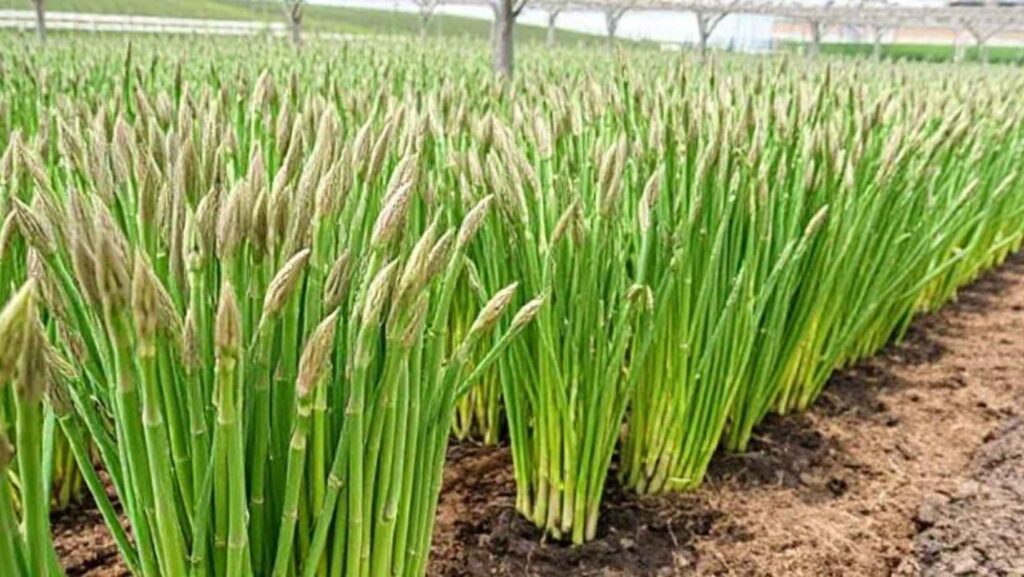
Would you want to know the Best climate for growing asparagus commercially? During the harvesting process, the optimal temperatures for asparagus are between 55°F and 65°F at night and between 78°F and 85°F during the day.
This is based on my own experience. The asparagus plant requires a lengthy time of rest, also known as dormancy, in order to be productive.
Adverse weather conditions, such as severe winter temperatures or prolonged droughts, can accomplish this.
However, that is not all; as you continue reading, I will provide you with further information on the topic matter.
Now, let’s get started.
What climate does asparagus grow best in
Asparagus may be cultivated throughout a broad spectrum of climates; for instance, it thrives in the Imperial Valley of Southern California, where temperatures may soar to 115 degrees Fahrenheit,
and it is also viable in Minnesota, where temperatures can plummet to -40 degrees Fahrenheit.
This plant, native to the Mediterranean region, thrives in sandy dunes near the sea due to its excellent salt tolerance.
During a recent trip to Portland, Maine, I observed some of these plants growing in the rocky crags.
What a waste of rich loam; it just functions more effectively in loamier soil, which is not “damp” but rather wet.
Please place it in a location where you don’t mind it being there for all of eternity. That’s right.
In the same way, as parrots are considered generational gifts, these patches should be as well.
Where is asparagus grown commercially
The production of asparagus in the United States is mostly focused in three states: California, Michigan, and Washington.
Asparagus is a nutritious and tasty vegetable that thrives in areas where the soil freezes during the winter or in locations with dry seasons.
In 2021, the United States produced approximately 27.5 thousand metric tonnes of asparagus; however, this amount is relatively low compared to the total amount produced worldwide.
In that particular year, China produced 7.3 million metric tonnes of asparagus, making it the country with the biggest production volume.
In addition to Germany, Peru, and Mexico are significant producers of asparagus.
Vegetable consumption in the U.S.
Because the average American consumes only two pounds of asparagus per year, it is considered one of the most frequently consumed vegetables in the United States.
What are the best conditions for growing asparagus
When grown in soil free from other roots, rocks, and weeds, asparagus thrives in loose, well-drained soil. Locate a spot that receives a minimum of eight hours of continuous sunlight.
A soil pH that falls between 6.5 and 7.0 is ideal for asparagus. Before planting your asparagus, make sure to incorporate compost into the soil at a deep level.
The ideal planting location for asparagus receives full sunlight; however, it may also thrive in partial shade.
Most soil types are suitable as long as they drain well. If you have thick soil, a raised bed helps increase drainage.
Lime can raise soil pH to the ideal range of 6.5–7.5.
What are the Asparagus Growing Requirements
Growing zones 3 to 8 are ideal for most asparagus varieties.
Take the selection of where to plant your asparagus very seriously, and do not rush into it.
The production of asparagus can continue for up to twenty years after it has been planted, despite the fact that it takes several years to become established.
It is in your best interest to avoid moving it during that time; thus, exercise caution while selecting a location for your asparagus patch.
In the event that you intend to plant asparagus crowns, it is highly recommended that you prepare the soil in the autumn.
This will allow the crowns to be planted outside in the spring as soon as the soil can be worked to a depth of 18 inches.
If I were to plant asparagus crowns, the best time for me to do so would be at the end of April, as I live in Zone 3 in Calgary, Alberta.
When grown in soil free from other roots, rocks, and weeds, asparagus thrives in loose, well-drained soil.
Locate a spot that receives at least eight hours of continuous sunlight. A soil pH that falls between 6.5 and 7.0 is ideal for asparagus.
Before planting your asparagus, make sure to incorporate compost into the soil at a deep level.
It is common practice to cultivate asparagus in a garden that is planted directly into the ground; however, it is also possible to grow asparagus on a raised bed (provided that the raised bed is linked to the ground).
When growing asparagus in a raised bed, it is crucial to mulch it in the fall with a layer of straw or leaves approximately four inches thick.
It will be protected from the winter elements with the aid of the mulch.
What is the best asparagus fertilizer
In the early spring, before the spears appear, asparagus can be fertilized to stimulate growth.
For a 100-square-foot garden, an application of one to one and a half pounds of all-purpose garden fertilizer, such as 10-10-10, should be sufficient.
Fertilize asparagus after the June harvest to boost growth. Nitrogen fertilizer is advised.
10 pounds of nitrogen in its real form per one hundred square feet.
An application of 0.3 pounds of ammonium nitrate (34-0-0) per 100 square feet, for instance, will give the required amount. The real nitrogen content is ten pounds.
A Balanced Fertiliser is a type of fertilizer consisting of:
A combination of nitrogen, phosphorus, and potassium, all of which are necessary for the growth of asparagus, are provided by these seeds.
As an illustration, 5-10-10 or 8-24-24
The use of organic fertilizers, which are produced from natural sources, has the potential to restore soil health over time.
Compost, manure after it has been composted, blood meal, bone meal, and seaweed are other examples.
When it comes to fostering vegetative growth, nitrogen fertilizers are of utmost significance, particularly after harvesting activities have been completed.
Consider the following: ammonium nitrate (34-0-0)
When to Spread Fertiliser:
Prior to the Planting:
Before planting asparagus crowns, mix compost or decomposed manure into the soil to enrich it.
It is essential to apply a well-balanced fertilizer in early spring before the spears emerge.
Final thought
Now that we have established the Best climate for growing asparagus commercially, Depending on the time of year, you may often begin cutting spears around the middle of April and continue doing so until about Father’s Day, which occurs in mid-June.
In the middle of June, harvesting should always be stopped, and the crowns should be allowed to mature and accumulate reserves for the next season.
An excessively thin spear might be the result of overcropping.
When the spears are 12-18 centimeters (5-7 inches) above the ground, harvest them by cutting them with a sharp knife around 3 centimeters (1 inch) below the surface of the earth.
There is a special knife designed specifically for asparagus, but in times of extreme desperation, I have been known to use scissors or secateurs instead, and they work effectively.
Be careful not to cause any harm to the other shoots that are emerging.
This is easy to do, and I’ve mistakenly sliced off a spear next to the one I’m cutting, which is a bittersweet experience.