
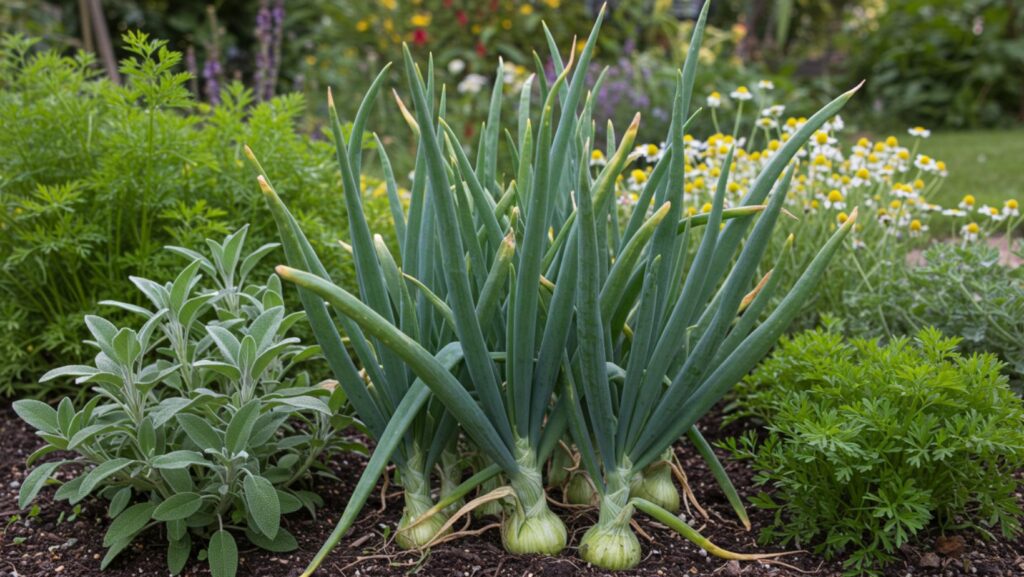
would you want to know about onion companion plants? My experience has shown me that onions may be companion plants for a variety of other crops since pests are repelled by their powerful scent.
Beets, spinach, alliums, brassicas, tomatoes, peppers, eggplant, strawberries, potatoes, lettuce, parsnips, carrots, chamomile, parsley, dill, savory, marigolds, and roses are just a few of the numerous fruits, herbs, and flowers that onions make excellent companion plants for.
Here’s a surprising turn of events. You would assume that other allium plants, like garlic and leeks, would make excellent onion companions, but they don’t.
Combining them is not recommended since they have comparable nutritional requirements and draw the same pests.
To be clear, companion planting is more than simply sowing seeds and crossing our fingers.
The requirements for shade, nutrients, and spacing must be carefully considered. But that’s not all; I’ll explain more about the topic as you continue reading.
Now, let’s get started.
What are the Great companion plants for onions
Growing close to onions is beneficial for many plants, but some plants are also helpful to onions. A quick summary of some of such plants is provided here.
1. Chamomile
An excellent plant to have in your yard to protect against fungus is chamomile. Onions that suffer from fungal problems benefit from its amazing antifungal qualities.
Chamomile will significantly reduce your chance of developing these illnesses if you reside in a more humid climate.
Additionally, they draw helpful insects rather than pests to the area. Onions are also reported to taste better when chamomile is added!
2. Beets
Onions may be used to repel aphids and flea beetles from your plants. The onions’ aroma repels these bugs!
Additionally, they aid by discouraging bigger predators such as rabbits and deer. Plant onions close by to protect your beets.
Together, they form excellent companion plants. To confuse the insects, put them in different places!
3. Dill One of the few edible plants that thrive when planted next to dill is onions. Onions are not badly impacted by neighboring dill, but other vegetable plants can.
In fact, the dill often attracts a lot of helpful insects and pollinators to the region!
4. Carrots
When they attack carrots in your garden, carrot rust flies are a bothersome nuisance. To help keep these flies away, grow onions in between carrot plants.
Since these crops tend to consume water and nutrients from various soil layers, it’s great that they may be planted together without competing for resources.
While most onions only reach a few inches below the soil’s surface, carrots have roots that go deep.
5. The lettuce
Planting lettuce and onions together has the advantage of preventing nutritional competition. Onions have somewhat deeper roots than lettuce, which have shallow ones.
Additionally, the onions will keep flea beetles and aphids away from your lettuce.
6. Melons
Numerous bugs eat melons and their leaves or vines. If you plant onions close by, the pests will be repelled, and your melons will grow well. They are excellent onion companion plants.
What are the Ideal Companions for Long Green Onion
Carrots: Long green onions and carrots work together as garden partners, providing mutual defense.
This is how they collaborate:
Onions repel carrot flies, while carrots repel onion flies.
By encouraging better soil, this dynamic pair lowers the likelihood of common pests.
Spinach: Long green onions and spinach are not limited to the garden bed. Their identical water requirements, which make maintenance procedures easier, are one way they complement one another.
In order to maximize space efficiency, onions can seek light while spinach grows down.
Together with Long Green Onions, lettuce adds a pop of green and provides aesthetically pleasant variety.
Water and light needs are shared, which simplifies garden maintenance.
Chives: In addition to adding flavor to food, chives also promote the growth of long green onions.
Their presence can enhance the onions’ overall flavor character.
As a living repellant, chives naturally ward against pests.
Tomatoes: In the struggle for development and health, tomatoes and long green onions help one another:
The pungent aroma of onions protects tomatoes from pests.
They all work together to create a diversified and well-balanced garden environment.
What are the enemy plants of onion
The growth of your plant will suffer greatly if you place these plants near to onions.
In addition to changing the taste of the grown plant and even eating all of the nutrients and water from your onion, growing enemy plants might attract harmful insects.
We do not advise growing the plants below adjacent to your onion because of these adverse consequences.
Beans
Beans are leguminous marvels that thrive in well-drained soil and receive enough of sunlight. They also add nitrogen to the soil, which makes their botanical partners more vibrant.
As reliable sources of food and greenery, beans are the embodiment of garden plenty and life.
Onions and beans don’t get along. While beans occupy the space and resources that onions require, onions emit substances into the soil that can inhibit the growth of beans.
To let both to accomplish their jobs without hindrance, it is better to place them widely apart.
Asparagus: A mainstay sentry in the world of companion planting, asparagus is prized for its delicate spears and nutritional value.
This perennial favorite prefers sandy, well-drained soil and lots of sunshine, and it grows best in climates with cold winters and mild summers.
As a symbol of elegance and culinary beauty, asparagus enhances the garden’s aesthetic appeal and embodies the spirit of green life.
Onions dislike competition, while asparagus plants are big feeders.
If you keep them together, your onions may end up little and suffering since both plants require a lot of nutrients to flourish properly. For optimal effects, please place them in different areas of the garden.
Garlic: This versatile and resilient plant thrives on rich, well-drained soil with a pH range of 6.0 to 7.5. Strong growth and bulb development are supported by regular hydration and enough sunshine.
By serving as a natural fungicide against soil-borne illnesses and discouraging pests with its strong scent, garlic offers nearby plants priceless advantages.
Despite their apparent compatibility, onions and garlic are actually too similar for their good.
Since they are both members of the allium family and require the same nutrients, they will ultimately compete with one another rather than aid one another.
Why does companion planting work
The following interrelated variables make companion planting effective:
Control of pests: Some plants release natural compounds or fragrances that prevent pests, which serves as a natural deterrent for other plants in the vicinity.
This promotes a more balanced ecology and lessens the demand for chemical pesticides.
Helpful Insect Attraction: Certain companion plants draw helpful insects that prey on common garden pests, such as hoverflies, ladybirds, and predatory wasps.
This helps preserve ecological balance and produces a natural method of pest management.
Enhancement of Soil: The root systems and nutritional needs of various plants differ. By lowering soil erosion, controlling weeds, and enhancing nutrient absorption, companion planting can improve soil health.
Leguminous plants, for instance, help nearby plants that need nitrogen to develop by fixing nitrogen in the soil.
Competition Reduction: By using plants with complimentary growth patterns and root systems, companion planting can lessen competition for resources like water, sunshine, and nutrients. This enables healthier plant development and more effective use of resources.
Resilience and Biodiversity: When different species are planted together, the garden’s biodiversity rises, which can improve the strength of the ecosystem.
Compared to monocultures, a diversified ecosystem is more resilient to environmental pressures, diseases, and pests.
Making the Most of Space: By intercropping plants with varying growth patterns and rates of maturity, companion planting enables gardeners to maximize the restricted amount of space.
This encourages effective land use and optimizes production per square foot.
Companion planting makes use of the organic synergies that exist between plant species to produce a vibrant and long-lasting garden ecosystem.
What are the Benefits of Companion Planting to onion
Pest control: Some plants can deter dangerous insects or draw in their predators, protecting other plants in the process.
For instance, marigolds help plants that are vulnerable to nematodes by releasing a chemical that discourages them.
Better Soil Health: Certain plants, such as legumes, fix nitrogen in the soil, which can help nearby plants.
Plants with shallower roots can get nutrients from lower soil layers thanks to the deep roots of others.
Increased Plant Growth and Flavour: Some plant combos can boost flavor and even improve one another’s health. For example, planting herbs next to onions might occasionally enhance their flavor.
Effective Use of Space: Garden space may be used effectively with companion planting. While ground-cover plants can inhibit the growth of weeds, taller plants can shade lower-growing, shade-tolerant plants.
Helpful Insect Attraction: Pollinators and helpful insects that help with pollination and pest management are drawn to flowers and some herbs.
What are the Benefits of Companion Planting with Onions
When it comes to companion crops, onions provide the following advantages:
The pungent odors of onions might help keep plant pests away. The odor has the potential to conceal and conceal other crops, or it may simply cause pests to flee.
Since onions have a small footprint, they are an excellent choice for filling up places that are limited in size.
When there are a lot of plants in the garden, onions grow well, which makes it simple to choose a spot for them.
Final thought
Now that we have established onion companion plants. Generally speaking, the Cabbage family, which includes everything from Brussels to Broccoli, is the ideal choice to cultivate with the majority of onion species.
Chamomile is still another excellent choice, as this flower not only improves the flavor of the onion but also enables it to develop more quickly.