
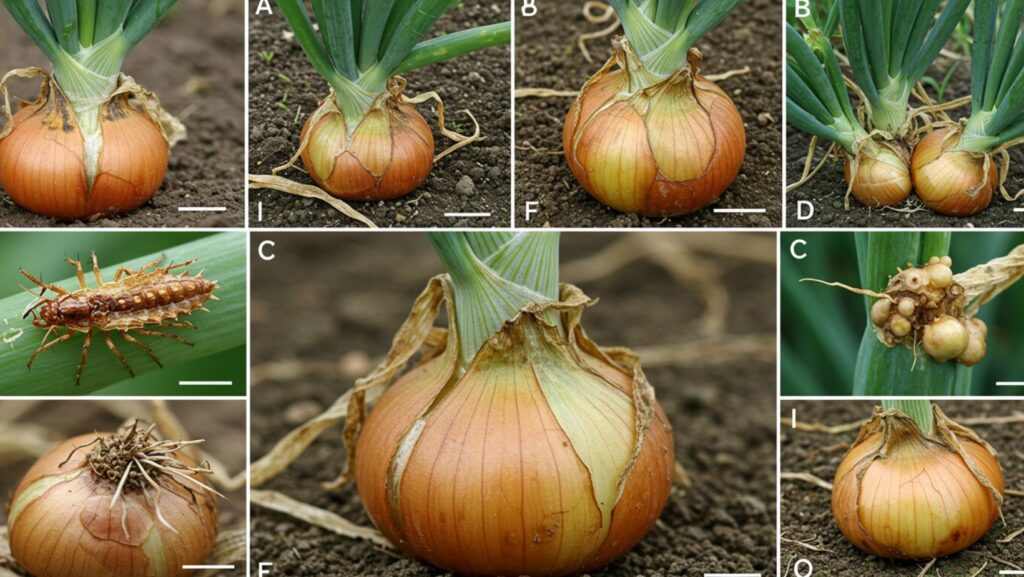
would you want to knpw about onion pests and diseases? Onions are susceptible to a variety of parasites and ailments, including thrips, leaf blight, and other rots, according to my understanding.
There are a number of diseases and pests that can have a substantial influence on the output and quality of onions, despite the fact that onions are a crop that is extensively farmed and offers a wide range of applications.
For onion farming to be successful, it is vital to be aware of these possible dangers and to have a solid grasp of how to recognize, prevent, and deal with them correctly.
Within the purview of this comprehensive book, we will examine the common illnesses and pests that affect onion cultivation and the methods that can be employed to manage these diseases and pests.
Now let get started
What are the Common Onion Diseases
Peronospora destructor, also known as Downy Mildew, is characterized by the presence of yellow-green spots on the leaves, purple-gray fuzz on the undersides, slowed development, and a reduction in the size of the bulb.
Onion cultivars that are resistant to disease should be planted, crop rotation should be practiced, suitable spacing should be provided to provide enough ventilation, and fungicides should be used as necessary.
Sclerotium cepivorum, often known as white rot, is characterized by the following symptoms: wilting, yellowing, and rotting of the leaves; brown lesions on the bulbs; and white fungal growth.
Management: Use disease-free sets and seeds, practice crop rotation with crops that do not include alliums, remove and destroy sick plants, and prevent excessive watering.
Yellowing, wilting, and death of outer leaves are the symptoms of Fusarium Basal Rot, which is caused by Fusarium oxysporum.
Additionally, brown staining at the base of bulbs and bulb decay are other symptoms of this disease.
To minimize the spread of disease, it is important to implement management strategies such as planting disease-resistant types, rotating crops, ensuring adequate drainage, avoiding overwatering, and sterilizing equipment.
Botrytis Leaf Blight, also known as Botrytis squamosa, is characterized by water-soaked sores on the leaves, fuzzy growth that is grayish-brown in color, the death of the leaves, and an infection of the bulb.
Fungicides should be used as required, crop rotation should be practiced, infected plant debris should be removed and destroyed, and proper ventilation should be maintained consistently.
What are the Common Onion Pests
Onion Throats, also known as Throps tabaci:
A silvery-gray speckling and curling of the leaves slowed development, and a reduction in the size of the bulb are observed as symptoms.
In order to manage the situation, you should make use of yellow sticky traps, rotate your crops, use reflecting mulches, and apply the right pesticides.
Onion maggots, also known as Delia antiqua, are characterized by the following symptoms: wilting, yellowing, and stunted development of plants; roots that are bloated and discolored; and tunneling among bulbs.
For management, it is recommended to make use of floating row covers, engage in crop rotation, refrain from applying an excessive amount of nitrogen fertilizer, and apply pesticides as required.
Hylemya antiqua and Hylemya platura are the two species of onion flies.
The symptoms of onion flies include the yellowing and withering of the leaves, maggots feeding on the roots and bulbs, and the death of the plant.
Applying the right pesticides, rotating crops, using sticky traps, covering seedlings with screens or row covers, and rotating crops are all effective methods of pest management.
Onion thrips, also known as thrips tabaci, are characterized by the following symptoms: silver-gray speckling and curling of the leaves and a reduction in the size of the bulb.
In order to manage the situation, you should make use of yellow sticky traps, rotate your crops, use reflecting mulches, and apply the right pesticides.
What are the Fungal Diseases in Onion
Because onions are susceptible to fungal infections, Indian onion growers should educate themselves about common fungi and treat their crops appropriately.
Onions are susceptible to many fungal diseases.
Basal rot caused by Fusarium:
Reasons for this: The Fusarium oxysporum f. sp. cepae fungus is the principal agent responsible for the
Fusarium basal rot that occurs in onions. Additionally, the fungus is able to endure in the soil for lengthy periods of time.
Yellowing and withering of the lower leaves, together with brown staining and rotting at the bulb base, are the symptoms that onion plants that have been infected with the disease display.
It is possible for the rot to progress upwards into the bulb in more severe situations.
Reducing the risk of Fusarium basal rot can be accomplished by the implementation of crop rotation practices, the avoidance of excessive nitrogen fertilizer, and the maintenance of adequate drainage.
It is possible that treating onion seeds with fungicides before planting them would also be advantageous.
Dry, downy mildew:
The fungus known as Peronospora destructor is responsible for the development of downy mildew in onions.
The ideal circumstances for its growth are chilly and humid.
Infected leaves have lesions on the upper surface that range from a light green to a yellowish color, and the underside of the leaves has a white or grayish fuzz that corresponds to the lesions.
In the long run, the leaves of the onion plant can deteriorate and perish.
In order to prevent the spread of downy mildew, it is important to adhere to proper field cleanliness practices, which include the removal of onion crop detritus.
In accordance with the recommendations on the label, fungicide treatments may be performed at regular intervals when the weather conditions are favorable.
What are the Bacterial Diseases in Onion
Fungus illnesses are not the only kind of diseases that can affect onions; bacterial infections can also affect them.
It is imperative that farmers have a keen eye to identify any bacterial illness in order to prevent the collapse of their onion crop.
A leaf stripe and decay in the bulb:
Reasons for this: The presence of bacteria in plants, notably onions, can lead to the development of leaf streak and bulb rot.
There are two possible entry points for the bacteria inside the onion plant: wounds and natural holes.
Infected onion plants can exhibit symptoms such as the yellowing and browning of their leaves, the development of elongated lesions, and the rotting of their bulbs due to the infection.
There is a possibility that the illness will impede the quality and yield of onion crops.
Prevention: It is essential to maintain a high level of sanitation in the field. The removal of sick onion (Pyaaj) plants and the avoidance of excessive wetness and overhead watering are also required steps in this process.
The virus that causes yellow dwarf onion:
Reasons for this: The Dwarf onion yellow dwarf virus is something that is caused by a bacteria that attacks onions. To a large extent, aphids act as vectors for the spread of these diseases.
Onion plants that have been infected will exhibit signs such as stunted growth, yellow leaves, and a decreased bulb size during the infection.
Depending on the severity of the illness, the output of onions could be significantly impacted.
The use of onion seedlings that are free of illnesses, the implementation of crop rotation techniques, the control of aphids through the use of pesticides or the encouragement of the presence of natural predators, and the maintenance of appropriate field cleanliness are all examples of preventative efforts.
What is the Onion disease’s chemical control
Fungicides, insecticides, and seed treatments are examples of chemical control methods for onion diseases.
fungicides
Metalaxyl: For downy mildew management, it can be used as a bulb dip or foliar spray.
Mancozeb: May be used as a soil drench or seed treatment to prevent onion diseases.
Leaf blight can be managed using chlorothalonil.
Leaf blight can be managed using carbendazim.
Leaf blight can be managed using captan.
It is possible to manage stemphylium leaf blight using azostrobin.
Difenoconazole: May be used to manage leaf blight caused by stemphylium.
Boscalid: Effective in preventing stemphylium leaf blight
Using pyraclostrobin can help manage stemphylium leaf blight.
To manage stemphylium leaf blight, use iprodione.
To manage stemphylium leaf blight, use Prochloraz.
Treatments for seeds
Thiram: Effective against infections of onions
Downy mildew can be managed using thiophanate methyl.
Additional controls include rotation of crops using cereal crops, use of heat treatment, and biocontrol agents such as Trichoderma viride.
Which insecticide is best for onions
The sort of bug you’re seeking to manage will determine which pesticide is ideal for onions.
Onions are frequently treated with pyrethroids, methomyl, spinosad, clothianidin, imidacloprid, and spinetoram, among other pesticides.
Thrips
Using Lannate, a broad-spectrum pesticide, thrips populations can be controlled.
One pesticide that can be used to control onion thrips is spinetoram.
A diamide called cyanantranilipore is useful for managing thrips.
One pesticide that can be used to manage thrips is called Spirotetramat.
Maggots
The spinosad
A pesticide that reduces the amount of onions that die from maggot feeding
Imidacloprid with clothianidin for
One way to reduce onion mortality from maggot feeding is to use a seed treatment.
Additional pests
One carbamate that may be used to onions is methomyl.
Final thought
Now that we have established onion pests and diseases, Diseases, and pests can have a major impact on onion production, resulting in lesser-quality food and lower yields.
However, growers may reduce the risks and guarantee a healthy onion crop by being aware of the various diseases and pests that harm onions and using efficient management techniques.
Diseases may be prevented and managed in large part by putting into practice basic agricultural practices such as crop rotation, keeping appropriate plant spacing, maintaining excellent cleanliness, and utilizing disease-resistant cultivars.
Pest damage may also be reduced by keeping an eye out for pests, putting cultural controls in place, and using targeted pesticides as needed.
Onion producers can protect their crops and produce onions in a way that is both successful and sustainable by remaining alert and proactive.