
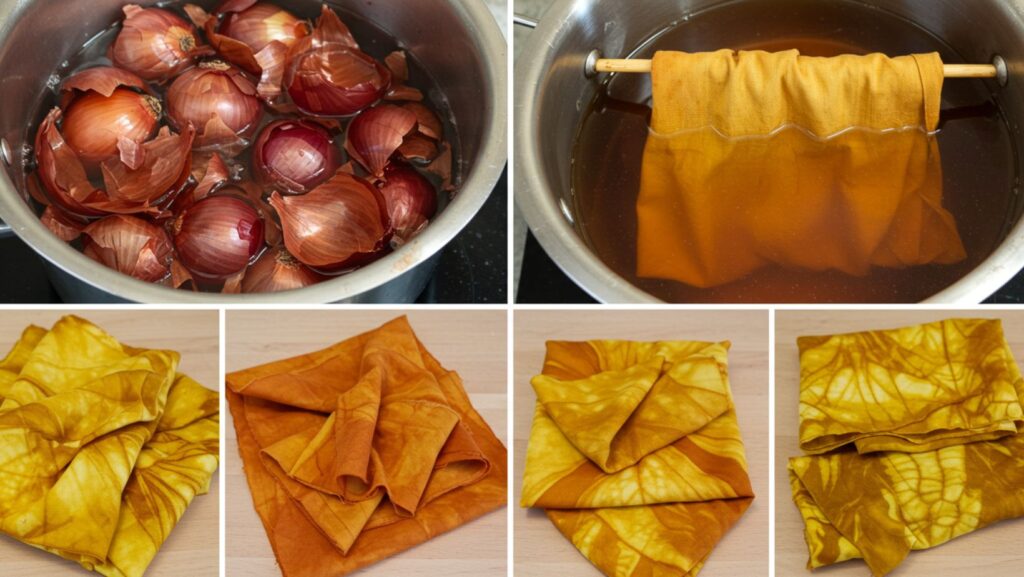
would you want to know about onion as a natural dye? Of course, onions may be used as a natural dye to produce a variety of colors, including yellow, brown, and green, according to my own experience.
Onion peels are frequently utilized in the process of discoloring textiles. Onion skins and water should be simmered, then let to cool.
If you want the color to be more intense, you can leave it overnight. If the water appears to be too light in color, add additional onion peels and bring the temperature back up.
Next, remove the onion skins using a strainer, and then add the cloth. Check to see that there is sufficient water in the pot so that the fabric can move about freely.
However, that is not all; as you continue to read, I will provide you with further information on the subject topic.
Now, let’s get started
How to make onion skin dye
1. While you are preparing your dye, wash your fiber with one tablespoon of any of the several types of soda crystals; do not use soap. After that, soak it in a basin of water.
2. Add the onion peels to the saucepan and fill it up to three quarters with water.
3. Once the water has reached a boil, immediately decrease the heat to a low simmer.
4. Allow the dye to simmer at low heat for at least an hour. After the water has undergone a color shift and the dye has been recovered, eliminate the onion skins by straining them through the strainer.
How to dye with onion skins
When it comes to natural dyeing, the skins of the yellow onion provide a wide variety of attractive colors, ranging from light yellow to deep gold and every shade in between.
To the same extent as avocado stones, the skins have a high concentration of tannin; hence, the color will adhere to the fabric even if a mordant is not taken into consideration.
In addition to improving the color and light fastness of your fiber, a mordant enables the color to bond to your fiber.
Yellow onion skins are an excellent natural dye to begin with since they are not only affordable but also simple to harvest and release their color in a very short amount of time.
If you are searching for a fun activity to do with children, you can also use them as a dye of exceptional quality.
Proceed with this step:
1. Clean the cloth by washing it with dish soap, baking powder, or baking soda.
2. Add onion skins to a saucepan that is just about three quarters full of water.
When it reaches a boil, decrease the heat to a simmer. 4. Continue to simmer for one to two hours.
Using a strainer, remove the onion skins.
Add the cloth to the saucepan, and then let it simmer for thirty to sixty minutes.
Allow to cool.
If you want darker colors, let the cloth soak for the whole night
Use a detergent that is kind to the environment and hang it up to dry.
How to dye fabric with onion skins
You’ll need:
• The peel from ten to twelve onions. Every time I cook with onions, I add mine to a bag I keep in the refrigerator.
• Half a cup of salt
• One teaspoon of either cream of tartar or alum (cream of tartar imparts a richer golden hue, whilst alum imparts a brighter one).
Alum is used for pickling; if you don’t have any, you should be able to acquire some in the grocery shop.
• Textile (natural fibre)
• A big water pot
Get the dye bath going.
Heat the alum or cream of tartar, salt, and onion skins until they boil. After lowering the heat to a simmer, add your damp cloth.
Don’t overfill the pot; instead, give your cloth enough space to move around in it.
With the exception of large pots, this works best with lesser quantities of cloth.
Tie the cloth, soak it, and then put it in the pot if you want to tie-dye it. Be careful not to use plastic ties, clamps, or anything else that can melt in the boiling water. Twine and wooden clothespins are useful.
Caution! Never disregard your project.
The cloth may rise above the pot and perhaps spill over it as a result of steam building up beneath it.
At least once per minute, stir the cloth.
Here, I boiled my clothes for ten to fifteen minutes. When the fabric is saturated, you will see that it begins to change colour and then remains that way.
Turn off the heat when you are satisfied with the color, then gently take the cloth (I used tongs) to a basin to cool before washing.
Since cold water might shock the cloth, I advise letting it cool for a few minutes to prevent burning yourself.
Use lukewarm water to rinse your clothes. Rinsing it several times will be necessary until the water flows clear.
This may need many minutes.
Hang your cloth to dry after removing any extra dye. Before using or stitching; I advise giving your cloth another wash in dark hues.
Do you need a mordant to dye with onion skins
A mordant is required for the majority of natural dyes in order to keep them bright and wash fast. Even with a mordant, there are those that are not particularly rapid.
Due to the fact that the dye from onion skin is easily absorbed by the fibers, dyeing with onion skin does not require the use of a mordant, even though the colour will disappear with time.
Through the use of a mordant, the brightness and wash fastness of a great number of natural dyes may be enhanced.
For instance, in order to get vibrant red or pink colours using Madder, you will, without a doubt, need to mordant the fabric in order to assist the dye in remaining on the cloth.
Before beginning the dyeing process, many dyers begin by applying oak gallnut tannin, then proceed to apply an aluminium mordant.
Final thought
Now that we have established onion as a natural dye, One of my favorite natural dyes is onion peels, which can be used to create a wide range of colors, from yellow when treated with alum mordant to deep rust and brown when treated with iron.
Typically, I combine all of them in a single dye bath…
Because I was interested in finding out whether or not the skins of red and yellow onions produce distinct colors when silk is dyed, I decided to conduct a test.
Following the separation of the red and yellow onion skins, I weighed out equal amounts of each.
After that, I boiled the onion skins separately in stainless steel pots for around one hour. Finally, I let the dye cool and set overnight.