
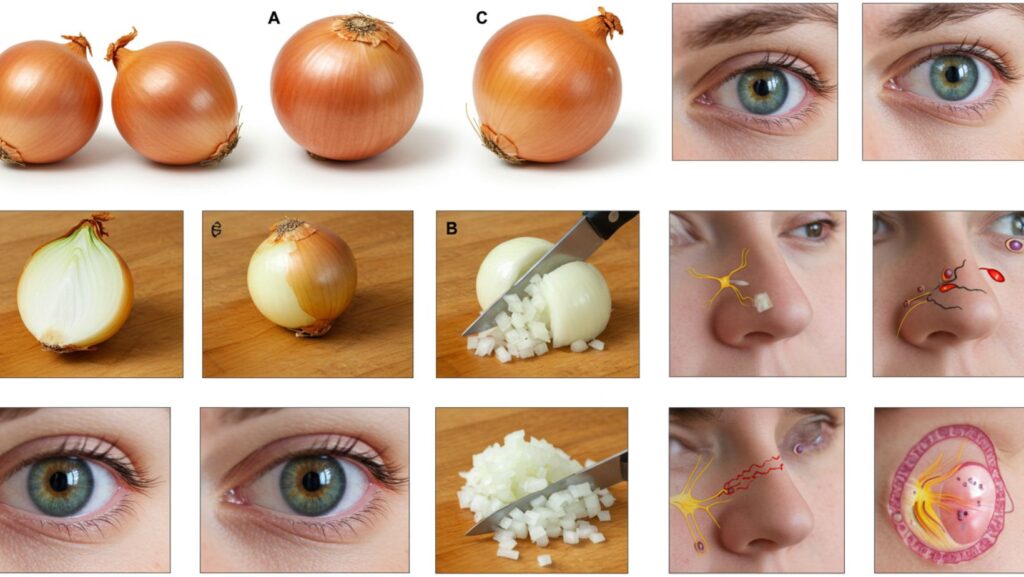
would you want to know why onions are spicy? According to my observations, onions are regarded as “spicy” because they contain sulphur compounds, particularly a substance known as “propanethial S-oxide,”
which is released when the onion cells are cut, giving the tongue a strong, sharp flavour. This is also why occasionally chopping onions can make you cry.
Additionally, A lachrymator is a substance that produces tears. This substance is known as propanethial-S-oxide, or PSO for short, and it gives onions their heat and burning flavour when consumed raw.
But that’s not all; I’ll explain more about the subject as you read on.
Npw leyt gets started
How To Make Spiced Onions
You should combine tomato ketchup, mango chutney, mint sauce, chilli powder, and salt in a mixing bowl.
The onions should be fully coated in the sauce once they have been added and stirred through.
Incorporate poppadoms into your handmade Indian fakeaway feast, and serve them alongside.
In certain instances, the spiced onions that are served at Indian takeaway restaurants will have a vibrant red colour. S
imple addition of a little bit of red food colouring is all that is required to accomplish this look in your own house.
It is possible to prepare the onions with spices in advance and then keep them in the refrigerator until they are finally needed.
It is possible to keep them in the refrigerator for up to seven days if they are stored in an airtight container.
Putting the onions that have been seasoned together in advance (for a few hours) can assist to slightly soften the onions.
What Makes Onions So Flavorful
There are hundreds of different types of onions. They can be sour or sweet, soft or crunchy, acidic or oozing with umami, and they can go either way.
Additionally, the freshness of an onion is a factor that determines the strength of its fragrance and flavour.
If you have ever had the experience of picking an onion straight from the ground, you might have been taken aback to discover that it did not impart any aroma.
What exactly is going on here?
The molecules that make up onions have a distinct chemical composition, since they include a significant amount of sulphuric compounds.
In addition to being responsible for flavour and odour, sulphur is also responsible for those annoying tears that appear whenever you slice an onion.
The thiosulfinates are the term given to this category of chemicals by the scientific community.
On the other hand, here is the truly fascinating part. Onions that are still raw and fresh do not contain these compounds.
They develop when an onion has been injured in some way, such as when it is chopped, sliced, or diced.
When an onion is cut, the cell structure is disrupted, which allows the molecules to be released.
During the course of thirty seconds or less, enzymes come into touch with the molecules, which results in the formation of thiosulfinates and the notably strong odour that they possess.
What determines the intensity of the aroma and flavour of your onion is the cultivar, or variety, of the onion, as well as the amount of sulphur that was present in the soil.
Whereas storage onions, which are gathered in the late summer and early fall, tend to have a more pungent flavour, spring onions, which are picked in the early spring, tend to have a more mild flavour.
Why are onions so strong
Because onions contain a high concentration of sulphur derivates, such as thiosulfinates and thiosulfonates, they have a pungent odour and taste.
There is a complicated chemical process that gets those sulphur derivates to the forefront, and it all begins with the cell wall of onions being damaged by chopping, crushing, and frying. This is the beginning of the process.
Onions that are older, meaning they are fully ripe and mature, have the maximum concentration, and as a result, older onions will smell and taste the most intense (spiciest).
We humans have a very great sensitivity to the smell and taste of sulphur, hence onions will have a very intense odour and flavour for us.
To a certain extent, it is comparable to the situation with broccoli, cabbage, and cauliflower.
Which Onion Goes Best With What
The common cooking onion is the yellow onion. When chefs commence cooking, they’re the preferred onion since they’re typically abundant and reasonably priced.
There is a subtle yet potent onion taste that isn’t overbearing. They hold up well when cooked, caramelise attractively, and frequently have a hint of sweetness.
This is the standard onion for most cooked foods, unless your recipe specifies different.
White Onions: a more potent, spicy, and acrid taste than yellow onions. For want of a better word, more oniony than yellow onions.
When cooked, they don’t hold up as well since they crumble easily.
Red onions are used in salads. Although it may be used in cooking, it is best suited for applications that call for raw onions because it is not as strong-tasting as white or yellow onions. As you boil them, the colour disappears.
Excellent on burgers, Greek salad, etc. One of our cooks described the onion as “a mild, colourful, wonderful onion.” less pungent and sweeter than white onions.
Sweet onions are a very different matter. The term “sweet onion” refers to a number of different types, and the degree of sweetness varies greatly depending on the kind and growing location. They are extremely sweet and delicious uncooked, as the name suggests.
Shallots: A popular among chefs. Very mild, a hybrid of a red onion and a yellow onion. The texture doesn’t break down easily, and they hold up really nicely when cooked. They taste like onions, although they’re not particularly strong.
They are the ideal choice for fine-dining applications when a chef wants a very finely chopped onion that serves as a foundational ingredient for a variety of dishes since their flesh is so tiny. Try working with them if you haven’t already.
They taste great sliced, pickled, or ringed, whatever you choose to cut them.
Are onions naturally spicy
The flavour profile of onions can range from sweet and mild to spicy and strong, depending on the type of onion.
Tip: If you have a hot one and wish to utilise it raw, you should not be afraid to do it on your own.
If you want to lessen the pungent, harsh, or aftertaste quality of a raw onion, chop it in the manner in which you intend to use it and then set it in a basin of cold water.
Allow it to sit there for at least one and a half hours, but overnight is the ideal option. Before usage, be sure to rinse.
Prepare the onions by placing them in a colander or sieve if speed is of the essence. At a minimum of one minute, the onions should be submerged in cold water.
How do you get the spicy taste out of onions
Once the onion has been marinated in the refrigerator for a longer period of time, the acid (lemon/lime juice, vinegar, etc.) will begin to soften it.
A couple of pinches of sugar or a squeeze of honey or agave can also be added to the mixture in order to make it more approachable.
Either that, or any other sweet item (such a fruit, such as mango, apple, pineapple, etc.) to counteract the flavour of the onion.
It is also possible. After soaking them for at least fifteen minutes (a longer period of time is much more helpful), drain them thoroughly, and then eat them!
The acute and harsh bite that the raw onion has can be removed by submerging them in cold water.
When onions are exposed to cold water, the enzyme that is responsible for their strong flavour is able to more easily drain out.
Final thought
Now that we have etsbalished why onions are spicy , This procedure leaches away the enzymes that are responsible for the pungent flavour, leaving behind a softer onion taste.
If you want to minimise the spicy taste of onions, just soak chopped onions in cold water for at least 15 minutes before using them.