
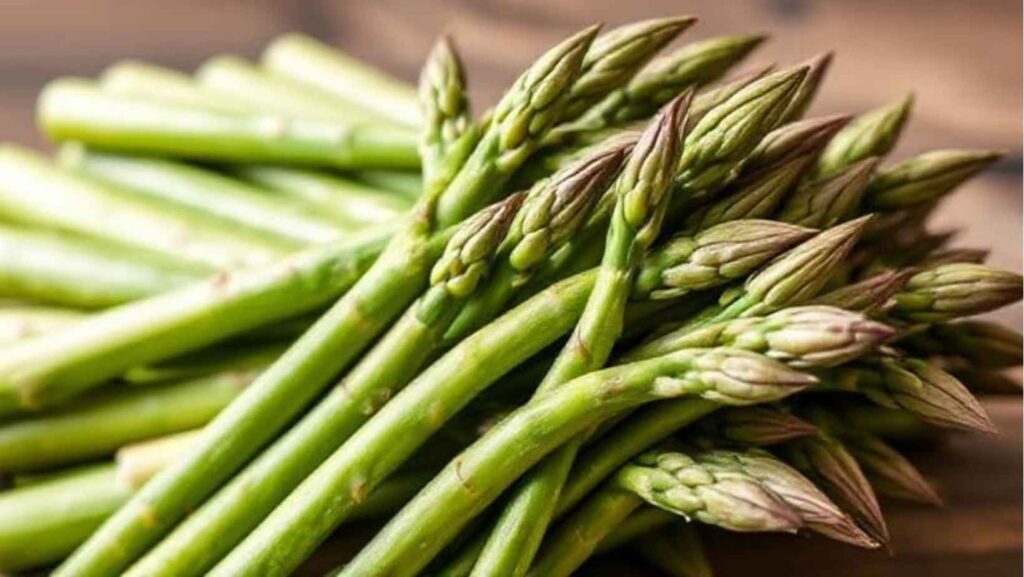
Would you want to know Who Brought Asparagus To America? Drawing on my experience, I would first note that asparagus is an uncommon plant grown primarily for its tender, succulent young shoots in the springtime.
It has big light green ferny leaves when mature.
People have been tending asparagus since 3000 B.C.
Growing initially in the Mediterranean, North Africa, Europe, and the Middle East, Asparagus stalks were offerings to the gods by Egyptians. Tombs have yielded images of asparagus.
Considered a delicacy, asparagus was a treat that delighted Greeks and Romans.
While the Romans developed farming methods to optimize food production, the Greeks harvested wild asparagus.
To enjoy asparagus all year long, King Louis VIX of France had gardeners cultivate it in greenhouses in the 1600s.
The United States lacked naturally occurring asparagus.
Asparagus arrived in New England and was transported by immigrants from France and England around the 1600s. Asparagus arrived in northern California in the 1850s.
California has been the major grower of asparagus since then.
Asparagus is in season in the United States from February to June. However, that is not all; as you learn more in the future, I will cover additional aspects of the topic.
Now, let’s get started.
What are the Costs of US-imported asparagus
Asparagus imports to the U.S. peaked in August and September of 2022; prices were lowest in March and April.
Compared to 2020 pricing, this price trend was a significant departure. Hence, the market is responding to the conditions of the last year.
At the shipping point, an 11-pound box of Mexican asparagus sold for US$32.45, the highest price; Peruvian asparagus sold for US$29.30.
Mexico ships asparagus to the United States throughout the year. However, most of it is sent between February and April.
This generates a time of great supply, which lowers prices. Peru, however, uses Mexico’s low shipping season to focus its supplies between May and December.
What is the Top Asparagus Suppliers to the United States
Asparagus is mostly supplied to the United States from Mexico. Though it represents a 16.5% decline from 2021, the South American nation delivered 361.3 million pounds of the good in 2022.
Peru, meanwhile, exported 216.3 million pounds in 2022, a 0.2% increase over 2021.
Regarding shipping volume, these two nations are competing for the largest share of the United States asparagus market.
Asparagus Growings in Mexico:
Asparagus production in Mexico in 2021 reached 725.3 million pounds, a 9.5% increase over 2020.
Comprising 65.5% of the yearly output, Mexican asparagus production is largely focused between January and April.
May produces the least over this time. Asparagus production in Mexico exhibits clear seasonality, but recent years have shown minor fluctuations in January, April, and December.
What is the Production level of asparagus in the United States
Although asparagus output in the United States in 2020 was 30,146 tons, barely 10.0% compared to Mexico,
the most relevant point is that production has been dropping in previous years owing to the decline in harvested area, from 8,782 to 7,770 hectares from 2018 to 2020, thereby indicating an 11.5% loss.
Simultaneously, however, yields have stayed constant—about 4.0 tons per hectare—31.0% below the world average output.
If the area is declining, it is because local farmers cannot compete with their Mexican and Peruvian counterparts, being the Mexicans preferred by the free trade agreements, which have led to no tariffs from the U.S. government.
The states with the highest production are Michigan, Washington, California, and New Jersey.
To meet the growing demand of its home market, which is also increasing yearly, U.S. imports of asparagus have surged dramatically from 227,933 to 265,807 tons between 2017 and 2020, representing a 16.6% rise.
Mexico and Peru, which in 2020 accounted for 64.0% and 35.1% of the asparagus imported by the United States, are the main beneficiaries of this trend.
What is the Top Asparagus Producing Countries
China ranks as the top asparagus-growing nation in the world. Each year, it generates 7.35 million metric tons of asparagus. Of this, the country claims to export just 4,553 metric tons.
Given that the nation produced only about 292,000 metric tons in 2014, some analysts believe this output figure is exaggerated.
While asparagus output here has been rising for the year, a leap like this seems improbable, assert detractors.
Shandong, Shanxi, Hebei, Henan, and Fujian account for almost eighty percent of this nation’s entire asparagus crop.
More than half of the asparagus grown here is also white type.
Ecuador:
With 376,645 metric tons, Peru ranks second among the world’s asparagus growers.
Originally part of its War on Drugs effort, the U.S. brought this vegetable to Peru in the 1990s. Asparagus cultivation would replace drug (especially cocaine) manufacture, was the theory.
Here, the U.S. government supported the asparagus business, therefore affecting American farmers and the output of this vegetable.
In fact, between California and Washington, the U.S. reduced its asparagus-producing territory by 55%. The asparagus sector provides employment for 50,000 people.
Mexico is:
Third in the world, Mexico is home to many asparagus growers. Every year, this nation produces 119,789 metric tons. To match global demand, its yearly production rate has been rising.
Two of the strongest asparagus-growing regions are Yaqui Valley and the Caborca Region. One of the main sources in the North American market is asparagus from the Caborca region.
How do those tiny asparagus trees grow
It takes three to five years for asparagus crowns seeded to reach their stride. They may be gathered yearly for around twenty years once they begin going.
I’m not sure what a lesson on delayed gratification would be if that isn’t one.
For nine months of the year, the dormant plants remain inactive, sending their stems out to gather energy to store in their subterranean rhizomes (crowns) and roots.
Those stems are trimmed down come spring to allow the edible asparagus stalks to sprout forward from all that stored energy.
In twenty-four hours, the stalks achieve their maximum size. One twenty-four hours! Asparagus develops into an inedible fern if it isn’t chopped straight away.
Maintaining the harvest feels like playing Whack-A-Mole, the arcade game in which you strike plastic moles on their heads immediately upon their random emergence from their burrows).
Maintaining consistency during harvest season requires considerable effort for farmers raising vast asparagus fields.
Workers must search the entire field daily to hand-cut ripe stalks one by one as asparagus ages rapidly.
Final thought
Now that we have established Who Brought Asparagus To America, Most of the asparagus grown in the United States is sold as fresh food.
At a value of $70 to $100 million per year, the United States grows approximately 20,000 to 25,000 acres of asparagus.
States that produce the most asparagus are Michigan, California, New Jersey, and Washington.
There are approximately 4,900 asparagus farms throughout the United States; 75% of them have an acre or less.
Thanks to rising imports from Central and South America, U.S. acreage is now less than one-third of what it was twenty years ago.