
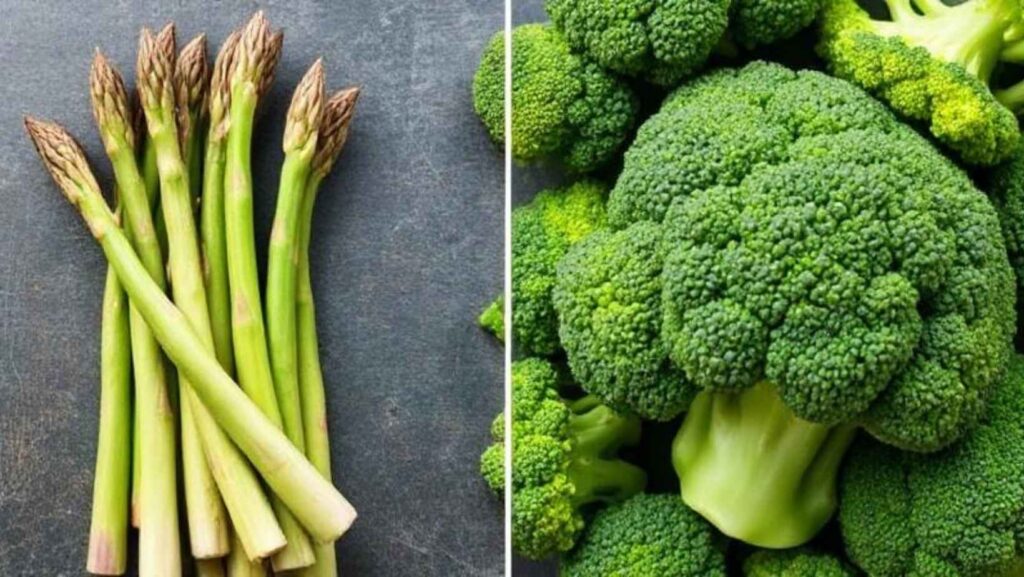
Do you want to discover if broccoli or asparagus is healthier? In my experience, broccoli might be your best option if you want to increase your levels of vitamin C and vitamin K.
Asparagus may be the best option for anyone looking to reduce their calorie and carbohydrate intake while maintaining digestive health.
Including both in your diet guarantees a wide range of nutrients, improving your general health and wellbeing.
What distinguishes asparagus from broccoli, then? The Brassicaceae family includes broccoli, which has a stout stem with a characteristic cloud-like top. In addition, asparagus is a long, thin vegetable that belongs to the Asparagaceae family and has a spear-like head.
Asparagus is high in iron and thiamin, whereas broccoli is considered to be high in potassium, vitamin K, and vitamin C.
Please continue reading to learn more about broccoli and Asparagus, including their taste, texture, and uses, as well as the significant differences between the two vegetables.
Now, let’s get started.
Are Asparagus and Broccoli the Same
Asparagus and broccoli are not the same, though. They exhibit varied traits and belong to several plant families.
Members of the Asparagaceae family, Asparagus (asparagus officinalis) is a blooming perennial. Usually green or purple, it is renowned for its long, slender spears with pointed points.
Cruciferous vegetables of the Brassicaceae family include broccoli (Brassica oleracea var. italica). Its sturdy, delicious stalk and cluster of closely packed green florets create a head or “crown.”
Thus, even though they share certain similarities, Asparagus and broccoli are two distinct vegetables with their unique characteristics.
What is Broccoli
A member of the Brassicaceae family, sometimes referred to as the cabbage family, broccoli has a close kinship with Brussels sprouts, kale, collard greens, cauliflower, and other plants.
Broccoli has a short, thick, light-green stem with a dark green top that looks like a flower or a cloud; this top is called a floret.
Although broccoli is available all year round and grows in the ground, it is at its freshest and in season from October to April.
There are green, white, and even purple types of asparagus. The white ones are the same plant; they are simply cultivated underground to stop chlorophyll from developing.
Talk about a vegetable identity crisis!
For more than 2,000 years, people have been growing asparagus. Roman emperors had dedicated “asparagus fleets” to retrieve the freshest spears, while the ancient Egyptians presented it to their gods. That’s a lot of dedication to vegetables!
What is Asparagus
As part of the Asparagaceae family, Asparagus is related to other vegetables, including onion and garlic.
Usually a brilliant, lighter green hue, Asparagus is tall and slender with a spear-like tip and occasionally features subtle purple tones.
Like broccoli, Asparagus grows from the ground and, although you can buy them year-round, tastes best when in season from February through June (with a peak in April.).
What Does Asparagus Taste Like
Actually, determining the precise flavor of Asparagus may be challenging. Some contend it tastes exactly like green beans, while others say it tastes like broccoli.
Earthy tones combined with broccoli and green beans define the flavor of Asparagus well.
Green beans are the closest vegetable in taste, but their earthiness makes them stand out and have a somewhat unique flavor.
What are the Health Benefits of Asparagus
1. Could Support Weight Loss
Apart from minimal fat and calories—one cup of Asparagus has 27 calories—it also boasts 2.8 grams (g) of fiber. If you’re trying to lose weight, Asparagus is a smart choice.
Your delayed digestion of fiber helps you to feel full between meals. Fiber encourages weight reduction and may help you feel full for extended periods after consumption.
Furthermore, fiber helps reduce cholesterol and improve constipation.
To optimize the low-calorie count of Asparagus, toss it with a hard-boiled egg. Asparagus is high in fibers combined with the protein in an egg, which will make you feel full.
2. Helps Avoid UTIs
Naturally occurring diuretics, such as Asparagus, help your body eliminate extra salt and moisture. Traditional medicine utilizes Asparagus to treat urinary disorders, such as urinary tract infections (UTIs).The first
A diet rich in Asparagus may help prevent these uncomfortable infections from developing. More frequent toilet visits help to clear dangerous germs from the urinary system.
3. Burst with antioxidants
Anthocyanins abound in purple Asparagus, especially. These colors—red, blue, and purple—give fruits and vegetables their hues.
Additionally, the antioxidant properties of anthocyanins might enable your body to combat free radicals that harm cells.
As with any vegetable, overcooked Asparagus might cause the vitamins to leach out. Asparagus should be roasted or boiled merely for four minutes.
4. includes vitamin E.
Asparagus is another essential source of vitamin E and antioxidants. This vitamin boosts your immune system and protects cells from harm caused by free radicals.
Investigating if vitamin E may stop cancer, heart disease, dementia, liver disease, and stroke is still in progress.
How to Identifying Asparagus and Broccolini
Examine attentively their botanical ancestry and unique physical traits to help you distinguish between Broccolini and Asparagus.
Botanical background:
Members of the Asparagaceae family include Asparagus (scientifically known as Asparagus officinalis). Savored as a vegetable for its delicious, thin stalks, this perennial plant is.
On the other hand, Broccolini, a variation of the Brassicaceae family, especially a cross between Chinese broccoli, or gai-lan, and broccoli, is officially classified as Brassica oleracea var. italica.
Physical traits:
The look of Asparagus and Broccolini helps one to recognize them:
Asparagus:
Thin, long stalks ending in sharp spear-like points
Usually green, but occasionally seen in purple and white variants.
Broccoli:
Like broccoli, but with shorter, thinner stems and fewer florets.
Brilliant green hue runs over the florets and stems.
Knowing these special features will help you identify these healthy green veggies with confidence in your yard or home.
Nutritional Characteristics:
Although both vegetables have great nutritional value with particular differences in their vitamin and mineral compositions, Asparagus and Broccolini differ in other aspects.
Calorie count and Macronutrients:
Low in calories, Asparagus is a lean source of protein and offers a little bit of fiber. It’s low in sugar, hence it’s a good choice for a diet.
Also low in calories and with somewhat more protein than Asparagus is Broccolini, a hybrid of broccoli and Chinese kale. While maintaining a modest total calorie count, Broccolini’s fiber content increases.
Digestive health.
What is Broccoli vs Asparagus? Health Comparison
Foods low in energy density are broccoli and Asparagus. Still, they contain various bioactive elements, minerals, and vitamins with significant health benefits.
Asparagus and broccoli have somewhat similar nutritional makeup. Still, they have special variations as well as common dietary traits.
Based on current scientific data, we will examine these parallels and deviations in great detail.
Asparagus has more antioxidants:
Age, diabetes, cancer, heart disease, and cognitive decline are all fueled by oxidative stress. Antioxidants are essential for avoiding oxidative stress in the body because they scavenge free radicals.
Among the numerous bioactive elements found in Asparagus are polyphenols, alkaloids, sterols, flavonoids, saponins, hydrocinnamic acids, and fructans.
As an antioxidant, anti-inflammatory, immunostimulant, antihepatotoxic, antibacterial, and antifertility agent, these bioactive elements enable Asparagus to fulfill various biological functions.
Both May Prevent Specific Cancers
When included in a diet, cruciferous vegetables, including broccoli, have been demonstrated to lower the risk of a number of cancers.
Sulforaphane, indole-3-carbinol, and other bioactive chemicals, such as isothiocyanates, help explain the anticancer potential of cruciferous vegetables.
Here is an inverse relationship between bioactive chemicals in broccoli and:
- Breast cancer.
- Colon cancer is
- The cancer of the prostate
- Lung cancer.
- Renal cancer
- bladder cancer.
- Both consist of plenty of minerals.
- Globally, around 1.3 billion individuals suffer from high blood pressure.
Broccoli offers more potassium than Asparagus in terms of nutrition. One hundred grams of broccoli will meet six percent of your daily potassium need.
One also finds a decent amount of dietary potassium in Asparagus.
Reducing sodium and increasing potassium helps control high blood pressure as well as possibly assist in avoiding renal disease, stroke, and cardiovascular disorders.
What Is Better: Broccoli or Asparagus
Regarding broccoli or Asparagus, none of any vegetables is “better.” Both are wholesome and would be great additions to your diet.
Of course, it would be advisable to select one over the other if you wish to augment with certain nutrients.
For instance, broccoli can be a better choice if you run low in vitamin C.
Still, both veggies taste fantastic either on their own or as a complement to a dinner.
Final thought
Now that we have established which is healthier, Asparagus Or Broccoli, regarding the ultimate health face-off between Asparagus and broccoli, both veggies have several advantages that would make them great complements to any diet.
Both are low in calories and high in fiber, making them excellent for controlling digestion and promoting weight loss.
Additionally, the anti-inflammatory qualities of these veggies may reduce the incidence of cancer and heart disease, among other chronic disorders.
In the end, combining broccoli and Asparagus into your diet will offer a spectrum of health advantages.