
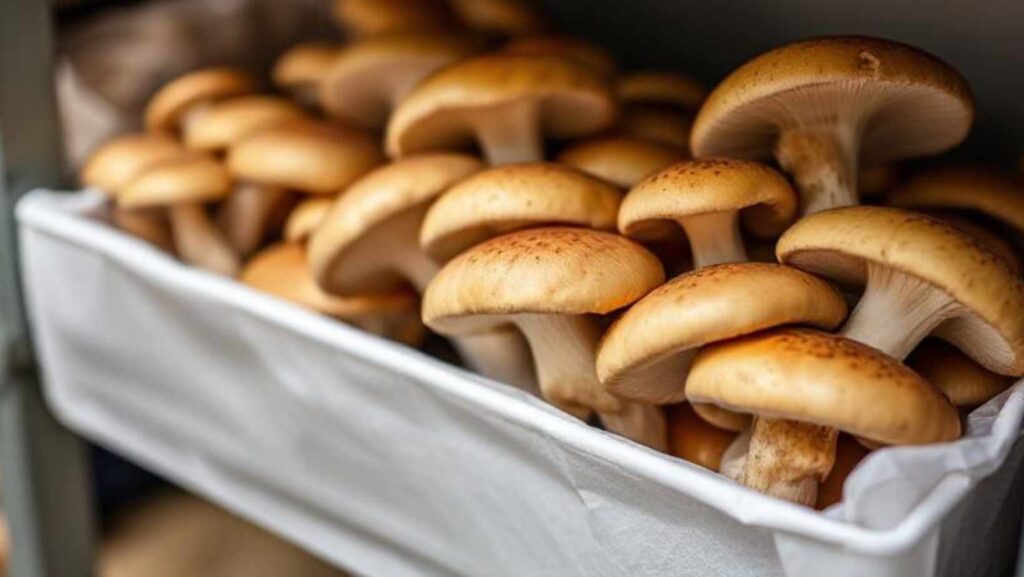
What would you like to know about where to store shiitake mushrooms?
Fresh shiitakes should be kept in the fridge in a paper bag until you’re ready to use them.
They will stay fresh for seven to ten days if you do this.
Using up your leftovers. Most of the time, it’s better to cook shiitake mushrooms before eating them.
I use three different methods for both wild and grown mushrooms, depending on the type and the goal.
Slice mushrooms and either use a food dryer or bake them on low-temperature pans in the oven until they are fully dry. This is how I like to store mushrooms so I can use them in soups, stews, or sauces later.
Afterward, I keep these dry by putting them in a big, sealed box with some silica bags inside.
Mushrooms that have been picked can be frozen whole, sliced, or quartered. Boil them in a saucepan with salt and a little water until the water disappears. This will make the taste stronger. Next, let them cool down before putting them on trays to freeze.
Once they are frozen, take them off the tray, put them in the right kind of freezer bag, and zip it up.
Finally, I use an Italian method to keep both wild and farmed mushrooms so that they can be used as cold starts or antipasti.
Cut up big mushrooms into thick or chunky pieces. Then, add salt to a pan of vinegar and water and bring it to a boil.
Bring the whole thing back to a boil, and cook the mushrooms for one to two minutes.
Put the vinegar on paper towels or a tea towel and let it sit for a few hours. This will help you get more vinegar out of it.
Then, put it carefully into a clean jar. Put a bay leaf, some peppers, and some split garlic cloves on top.
Most of the time, the right way to store mushrooms is the same, whether they are common ones like shiitake or white button or more unusual ones like chanterelle. Place the whole, clean mushrooms in a brown paper bag and fold the top over to seal it.
The paper bag will soak up any water, which will protect your mushrooms.
If you keep dried shiitake mushrooms somewhere cool and dry, they will last for up to nine months.
They should be kept in a container that keeps air out so they keep their best quality and taste.
How to prolong the shelf life of mushrooms
Avoid watering them (washing them) until the very end and keep them in a cold, dry fridge. This is the easiest way to make them last longer.
To keep the mushrooms from getting sticky, you can soak up the water that mushrooms naturally lose by putting them in a paper bag or a zip-top plastic bag with paper towels inside.
Fresh mushrooms might be pricey and only last a short time.
Having to throw away a whole package of sticky mushrooms is a waste of money and food.
So, I tried six different ways of storing them to see which one would help them last longer.
The best method made the mushrooms taste better and stopped slime from building up for ten days.
How we did things and what happened is shown here.
Weintraub says, “Avoid putting mushrooms near strong-smelling food, as they will absorb those smells,” no matter how you store them.
Also, you should eat the mushrooms within a week of buying them, even if putting them in a paper bag will make them last longer.
If you’ve already cut the mushrooms, you don’t have to. Weintraub then says to put them in a jar that won’t let air in and put it in the fridge. They should be used within three days.
You can save fresh mushrooms for later use in these ways:
Clean the mushrooms: To get rid of any dirt or other things on the mushrooms, wipe them down with a damp towel.
You shouldn’t soak mushrooms in water because they are porous and can soak up water. Doing so can change the taste and feel of the mushrooms.
Take the mushrooms and cut them up: Depending on what you plan to do with the mushrooms later, you can slice or chop them to the right size.
Freezing: One common method is to freeze the mushrooms.
Set the mushrooms in a single line on a baking sheet. You can chop or slice them. To make the mushrooms hard, freeze the sheet.
The frozen mushrooms should then be put in a bag or container that can go in the freezer. Make sure all the air is out before you close.
Write the date and the type of mushrooms on the jar.
Frozen mushrooms can be added to soups, stews, and other ready-made foods to make them taste better.
How can the shelf life of mushrooms be extended
by bringing down the temperature? After being picked, mushrooms need to be quickly cooled down and kept at a low temperature to make them last longer.
Low temperatures help mushrooms keep as much of their wetness as possible by slowing their respiration rate and the growth of bacteria.
How long the mushroom will last can be seen by how its color changes and how much it weighs.
The faster these two changes happen, the shorter the shelf life.
Activation of tyrosinase and random oxidation are the two things that cause the color to change to brown.
As long as the mushroom doesn’t change color or lose weight, the type you choose has the most impact on its shelf life.
This is because each strain acts differently at different times of growth, especially when it is being stored.
Eating mushrooms is a great way to get a lot of nutrients, which helps reduce hunger in society.
But because they breathe quickly and contain a lot of water, they can only be stored for one to two days.
This leads to a loss of quality, such as color fading, texture loss, taste loss, and nutritional loss.
So, storing it after gathering is necessary to make it last longer.
This piece talks about ways to keep things fresh using irradiation, mapping, vacuum packing, pulsed electric fields, ozone, electrolyzed water, washing with antibacterial chemicals, coating, and drying and freezing.
Which mushroom preservative
Adding potassium sorbate (0.1%) and citric acid (4%) to the mushroom gave it a shelf life of 24 days.
There are a lot of chitosan and beta-glucan in white button mushrooms. These are two types of fiber that, when separated in a solution, could be very effective at killing germs.
Moreover, white button mushroom extract is a cheap way to keep food and drinks fresh because it is a natural antibacterial that works well against yeast, mold, and bacteria that cause food to go bad after a short time.
Chinova Bioworks came up with the idea of using white button mushroom fiber to reduce the amount of germs in food and drinks.
Mushrooms are now an important part of the human diet because they have been used for a long time in both food and medicine.
These chemicals smell good, taste good, and are good for you because they are low in calories and contain good proteins, vitamins, minerals, unsaturated fatty acids, and dietary carbohydrates.
Compounds that preserve food stop germs from growing that cause food to go bad and stop unwanted color changes in both fresh and cooked mushrooms.
To do this, they use chemicals that are safe for humans and keep the pH level at or above 9.0 for at least part of the process.
Which chemicals are utilized in the cultivation of mushrooms
Rodriguez and Pecchia (2017) and Gowda and Manvi (2019) say that formaldehyde, carbendazim, chlorine, hydrogen peroxide, and calcium hydroxide are some common heat and chemical disinfectants used for treating substrates.
Mold fungus doesn’t really hurt oyster mushrooms like it does champignons.
Second, it is very harmful and has a lot of bad effects that last a long time.
What does “remote effect” mean?
If you get asthma, bronchitis, or skin problems six months later, you probably won’t connect them to the formalin work you did before.
Besides that, it can cause cancer.
It doesn’t mean that you will get cancer right away.
Formaldehyde, on the other hand, builds up in your body over time into a poison that your defense system can’t fight off.
Some base methods that are used to grow mushrooms are ozonization, pasteurization, and cleaning.
To clean the substrate and get rid of competing bacteria, methods such as autoclaving and chemical sterilization are often used.
However, sterilization can also get rid of good bacteria on the base.
Because it doesn’t let helpful organisms grow back during the cooling step, sterilization isn’t as good as pasteurization.
One more way to treat substrates is with ozonization, which needs an ozone generator.
Immersing the material in a container and ozonizing it for a certain amount of time can help kill or inactivate harmful competing organisms.
These methods are meant to lower the number of germs that aren’t wanted while creating an environment that is good for mushroom mycelium growth.
What are the ingredients needed to produce mushrooms
You’ll need bread, dirt, straw, wood, and microbiological growth media to raise mushrooms.
To help your mushrooms grow and produce more, OutGrow® offers a wide range of raw materials that can be mixed with your substrate.
These raw materials are carefully picked out and treated to make sure they are of the highest quality and purity.
In order to make mushroom bases more stable, the following raw materials are often added:
Mesoporous rock: Vermiculite is a natural mineral that is often added to surfaces to help them hold more water and have more holes in them.
It also helps keep the temperature and amount of moisture in the material stable.
Farm-grown wheat straw: Naturally grown wheat straw is a popular substrate addition that gives mushrooms a nutrient-rich base to grow on.
It makes the ground more porous and helps it hold on to water. It also has a lot of nitrogen and other nutrients.
The six steps in mushroom farming are grouped together in a pretty random way, but they do show what parts are needed for a production system to work.
Four of the six steps are breeding, casing, pinning, cutting, and Phase I composting.
The stages are talked about in the order that they naturally happen, with the most important parts of each stage emphasized.
For mushrooms to grow, they need minerals, which garbage provides.
When horse dung and wheat straw are put together, they make mushroom compost most often and for the least amount of money.
How might mushroom deterioration be avoided
Mushrooms can easily go from being too dry to being too wet, even in the fridge.
Put the mushrooms in a paper bag or a basket packed with paper towels to soak up any extra water. This will keep them from getting mushy.
Because there is more water in the fridge box, mushrooms shouldn’t be kept there.
Don’t let them get wet.
Grocery shops give out paper bags instead of plastic ones, which let water escape instead of building up inside the bag.
Although the paper bag keeps the mushrooms from going bad because it lets them dry out, they still need to be kept in the fridge.
Mushrooms can be used regularly even after they have dried out.
For a few minutes, soak them in hot water, like you would do with mushrooms that are too dry.
Mushrooms are vegetables that have sweet and sour tastes.
If you don’t cook the mushrooms right away, they can go from looking beautiful to a sticky, sad mess in what seems like an instant.
The first thing you should do to keep mushrooms fresh for as long as possible is to make sure they look healthy.
Look for mushrooms that look damp but not greasy or wet.
Before you buy mushrooms in bulk or at the farmers market, make sure they feel dry by feeling them. If they don’t, you will lose the slime war.
Conclusion
If you have fresh or dried shiitake mushrooms, the best way to store them will be different.
Dried shiitake mushrooms can be kept for up to nine months in a cool, dry place. Fresh mushrooms, on the other hand, will only last one week in the fridge.
To store fresh Shiitake mushrooms, take them out of any packaging and put them in a paper bag or a paper towel that is only lightly wrapped around the mushrooms.
After that, put the mushrooms in the paper bag or towel and put it in the fridge.
This will help the air flow and keep wetness from building up, which will keep the mushrooms fresh.
Use the mushrooms within a few days of picking them for the best taste and texture. You might want to freeze mushrooms if you can’t use them in food in less than a week.
But freeze the mushrooms as soon as you can because they freeze better when they are fresh. Just remember that you will need to cook them first.