
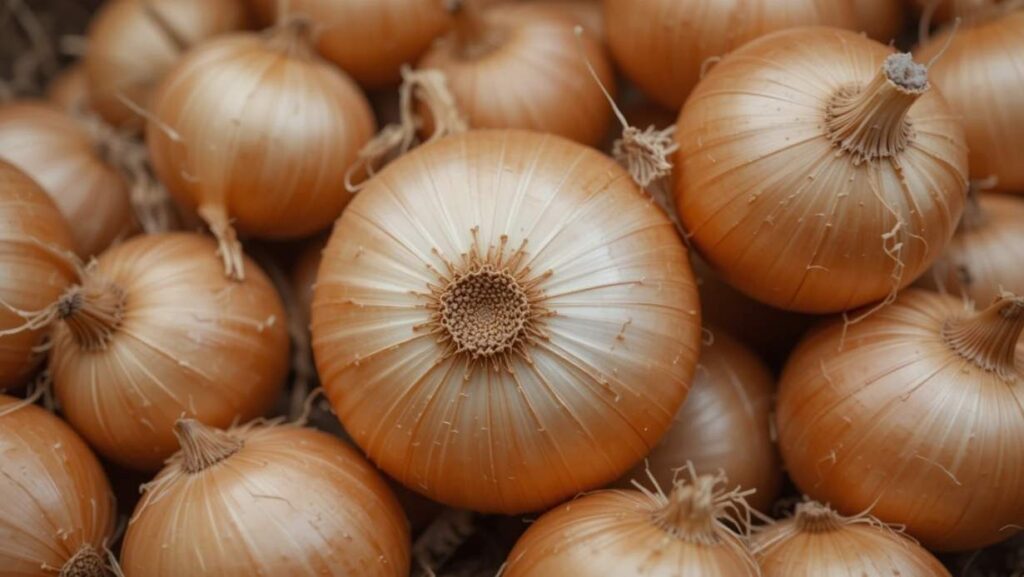
Do you want to know where onions come from? According to what I know, the first signs of production were found in Mesopotamia. This culture then spread to ancient Egypt (where it is mentioned in texts from more than 4,000 years ago), Greece, the Roman Empire, and the rest of Europe and the world.
In ancient China, it was even seen as a sign of wisdom. The onion as we know it today was first grown in the area that includes Iran, Central and East Asia, Pakistan, Afghanistan, Uzbekistan, and Turkmenistan.
In the area where the onion comes from, it has been grown for more than 5,000 years. However, that’s not all. As you read on, I will give you more information on the subject.
It’s time to begin.
Where does the onion originate
A number of scientists, botanists, and food historians believe that onions came from central Asia. West Pakistan and Iran are where onions came from.
Wild onions were probably found and eaten by our ancestors a long time before farming or maybe even writing.
Even 5,000 years ago, onions were known to be widely grown plants. It is thought to have come from Iran, Afghanistan, and Pakistan, all in Central Asia.
It is known that onion trees were grown in China 5,000 years ago. They were an important part of the old Egyptian diet.
An writing on the Pyramid of Giza says that workers were given garlic and onion as food to keep their bodies strong and immune to diseases that could spread.
Because garlic kills germs, it was used to embalm and mummify bodies.
The Israelites were being held captive by the Egyptians. In Numbers of the Old Testament, they complained loudly that they couldn’t eat leeks, onions, or garlic while they were moving through the desert.
The Greeks and Romans also knew about onions and garlic as plants that could be kept as pets.
Garlic was called the “stinking rose” by the Greeks, and the Roman upper class didn’t like the smell.
But among the Roman army, garlic was seen as a cure-all and was highly valued.
After the Romans took over Europe, the easy-to-grow onion plants quickly spread across the whole continent.
Nowadays, it’s hard to find a country or place on Earth that doesn’t grow onions and garlic in a planned way.
Where do onions grow from
You can grow onions from seed, cuttings, or “sets,” which are small bulbs that are not yet fully grown.
Plants need different amounts of time to grow depending on the type of start you use and the weather where you live.
In northern fields, onions are often grown in the spring so that they can be picked in the late summer or fall.
The plant’s little black seeds, on the other hand, are put straight in the field and grow into most of the onions that are sold.
When the conditions are right, onions can also be grown from small roots or cuttings. Onions are very resistant and can grow well in a wide range of conditions.
Who discovered the first onion
The formal name for the onion is Allium cepa, and it is most likely from Asia. It has been grown for more than 5,000 years.
It fed the people who worked on the tombs in ancient Egypt. Pieces of onions were discovered in the tomb of Pharaoh Tutankhamun.
Most likely, these onions were meant to be eaten by the dead as food while they were being taken to the future.
Rome was the first society to bring art and culture to the middle part of Europe. In the United States, places that get a lot of light have dirt that is full of nutrients and has a fine, gritty texture that is perfect for growth.
Where does the red onion come from
Even though onions are grown everywhere, the planting times are shorter in places where winters are very harsh. In every area, onions are grown.
While they also like being in the woods, they are most at ease when the temperature is normal and there is little humidity.
On the other hand, the Tropea red onion is grown along the coast of the Tyrrhenian Sea and between Nicotera and Campora San Giovanni in the town of Amantea in the province of Cosenza.
Nicotera is in the province of Vibo Valentia, and Campora San Giovanni is in the province of Amantea. Briatico and Capo Vaticano are the main places where this product is made.
Where do wild onions grow
They grow 5 to 10 centimeters deep in the ground and are found in the wild.
It is not possible to grow them, and they only get to our tables after being picked by farmers using hoes to remove the dirt from the ground.
The dirt should be loose, light, and drain well so that wild onions can grow. There is no need to use fresh soil.
That means it doesn’t like heavy or clayey grounds. It grows best in siliceous earth, also called silico-clay.
Before you plant, you can use 100 grams of an important fertilizer per square meter.
Do onions grow naturally
When planted in the right place, wild onions can spread freely and reach a height of 18 inches. The bulb is crisp and mild, with a nice flavor that tastes like a leek or garlic alternative, and the leaves and flowers also have a deliciously mild flavor. The plant spreads through aerial bulblets and bulb offsets. Plants that have been treated with pesticides should not be harvested. Diseases, Insects, and Other Plant Problems: Usually free of disease and pests. In some states, it is considered a noxious weed.
Final thought
Humans have been growing onions for thousands of years. They were first planted in Chaldea, then in Egypt during the early dynasties, in Mesopotamia 3000 years before Christ, in Greece, and all over Europe. The Egyptians love it, especially when it’s raw. It’s mentioned in almost 4,000-year-old Egyptian literature, and the Bible says that the Hebrews lamented the loss of it, along with garlic and leek, when they left 1,500 years BC. The Greeks thought it had amazing healing properties, and the Romans built special gardens called Cepinae in its honor.