
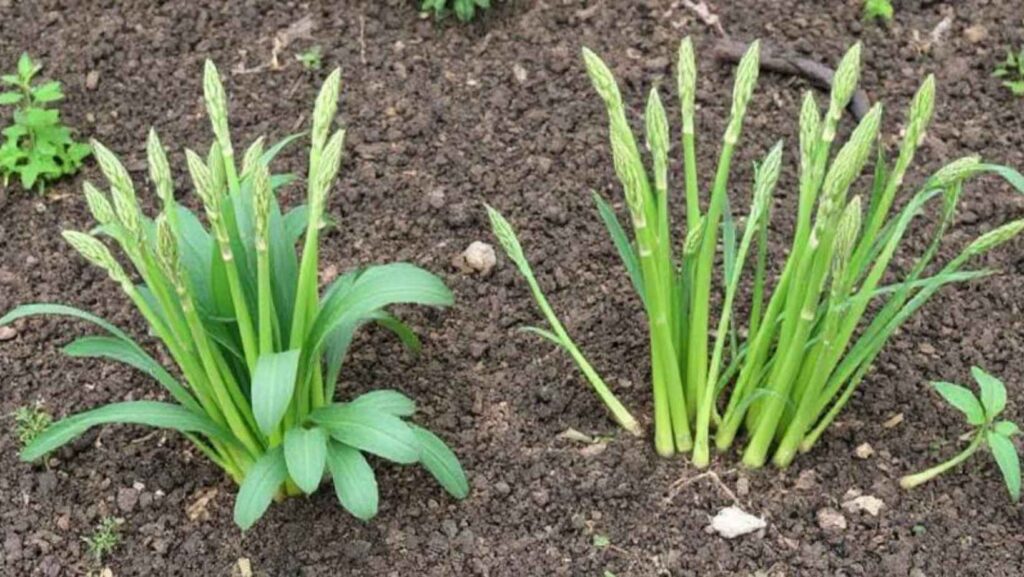
Would you want to know What is the best spacing for asparagus farming? My personal experience has shown me that the best way to cultivate asparagus is to plant crowns roughly 12 to 18 inches apart inside the row, with rows being spaced at least three to four feet apart.
However, that is not all; as you continue reading, I will provide you with further information on the subject, adding to your understanding.
Now, let us get started.
How far apart should I plant asparagus
The planting space should be dug at least 6 to 12 inches deep and 12 inches broad. To allow for growth, space asparagus plants 12 to 18 inches apart.
When planting asparagus, you can dig rows as long as necessary for the number of plants you wish to grow.
Planting in rows should be spaced two to five feet apart or as much space as needed to allow for easy movement around the planting area.
After excavating but before planting, mix a portion of the topsoil with any soil additives that are required (such as fertilizer, aged manure, or compost).
This topsoil mixture should be used to backfill the planting holes slightly, forming a mound at the bottom of the hole. The mound should be approximately 3 inches thick in a 6-inch deep hole and 8 inches thick in a 12-inch deep hole.
Place the top of your bare-root asparagus plants in the hole so that the roots are arranged on all sides of the mound.
Consider enlarging the planting hole if the roots of your asparagus plant are crowded.
Holding the crown, backfill the hole until it is three to four inches below the soil’s surface.
Once the asparagus seedling is completely covered, carefully compact the soil surface to eliminate any air pockets.
The ability of young asparagus to emerge will be hampered by heavy soils that are prone to compacting and by compacting the soil too firmly.
To assist preserve soil moisture and reduce the need for regular watering during the growth season, water well after planting and cover with a thick layer of mulch that is at least 4 inches deep.
Increase the amount of soil, compost, and/or mulch surrounding the planting location as the earth settles and the plants develop.
What is the secret to growing asparagus
The sun, water, and soil are all things that asparagus enjoys. Locate a location that receives at least eight hours of sunlight.
Keep in mind that asparagus grows back every year, which means that the space you choose to plant it will be entirely devoted to this delicious vegetable.
For asparagus, it is essential to have sufficient water, and it also needs enough drainage.
If the soil is excessively wet and does not drain correctly, the roots of your plants may rot, and they will not produce any fruit or vegetables.
A raised bed is one of the reasons I choose to cultivate it in this manner.
It goes without saying that you should give the plant a thorough soaking after planting and then water it once a week, maintaining a depth of one to two inches.
When it comes to soil, asparagus is very particular about its needs. Not only does it not tolerate weeds, but it also thrives with a rich mix of nutrients, such as natural fertilizer or homemade compost.
Another advantage of cultivating asparagus on a raised bed is that you have complete control over the soil, and you won’t have to worry about weeds growing in the garden.
Where to grow asparagus
To cultivate asparagus, select a location that is open and bright, but avoid areas that are extremely exposed and prone to frost pockets.
It may be grown in soils that are deep, well-drained, and moderately rich; nevertheless, a slightly alkaline soil (with a pH value of 6.5 to 7.5) is an ideal environment for its growth.
Verifying this information is simple and may be done using a pH meter or a soil test kit. A fresh asparagus bed shouldn’t be planted where another crop has already been grown.
From the time it is planted, your asparagus bed needs to continue producing for several decades.
If you want to grow spears, it is in your best interest to give some thought to the location where you wish to do so.
Because established asparagus plants are not particularly good at transplanting, I always give the place a lot of attention before planting them.
How to plant asparagus
Plant your asparagus crowns as soon as possible after receiving them, but avoid doing so if the soil is frozen or too wet. To prevent damage, handle the crowns with care and keep them from drying out.
Place the crowns in a box or seed tray, cover the roots with moist peat, and store them in a cool, bright location if you can’t plant them immediately. To plant them out, follow these steps:
Crowns should be spaced 40–45 cm (15–18″) apart, with 1.2 m (4 ft) separating rows. Place the crowns on a curving ridge or mound that is about 10 to 15 cm (4-6″) high.
After spreading the roots throughout the ridge, lightly cover them with garden compost or fine dirt. As the plants grow, more thin soil layers can be added to keep the roots from drying out.
Because there will be greater competition for moisture and nutrients if the crowns are placed too tightly together, the spears will probably be thinner.
Apply a durable top dressing of blood, fish, and bone after planting, carefully hoeing it in.
In the first year after planting, avoid harvesting any asparagus. The crowns are becoming larger during this time so they can later provide hefty crops.
In the second year, assuming the plants are developing well, they can yield no more than one or two spears.
The remainder must, however, be allowed to grow and mature into ferns on the plant. The crown will get more robust in the next years as a result.
In the third year or two years following planting, the first significant crop should be harvested.
How Long Does It Take to Grow Asparagus
As previously mentioned, it may take two to three years for freshly planted asparagus plants to begin producing; therefore, patience is essential.
However, asparagus can continue to be produced for decades after it is established.
Asparagus plants also produce very quickly; over a few weeks in the spring, fresh spears appear every few days.
In spring and early summer, the plant yields ½ pound of spears every foot of row, so we believe the wait is well worth it.
It’s crucial to choose a suitable planting location for asparagus because it’s a perennial plant that returns year after year in the same area.
Select a spot that receives six to eight hours of direct sunlight.
The asparagus bed should be positioned on the perimeter of your garden so that it won’t be impacted by the planting and replanting that takes place there.
Make sure there won’t be any water pooling in the bed. Asparagus dislikes excessive moisture on its roots. If you don’t have access to a location with sufficient drainage, consider growing asparagus in raised beds.
The ideal pH range for asparagus is 6.5, which is neutral to slightly acidic.
The planting site should be cleared of any weeds before a 2- to 4-inch coating of compost, aged manure, or soil mix is applied.
For the asparagus crowns to fully root and avoid being disturbed by rocks or other obstructions, the soil should be loosened to a depth of 12 to 15 inches.
Final thought
Now that we have established the best spacing for asparagus farming, To tell you the truth, I don’t think asparagus plants are very lovely in the garden;
but they make up for their lack of aesthetic appeal in terms of value (asparagus is extremely prohibitively costly in shops).
I am only expressing my perspective.
Even if they are not adequately cared for, asparagus patches can continue to yield for more than a decade.
This is the reason why it is essential to locate a section of the yard that you may devote to them if at all doable.
On the other hand, I believe it’s quite okay to experiment with growing asparagus anywhere you wish.
It is important to be aware that the durability of your patch may be compromised. Even asparagus needs direct sunlight.