
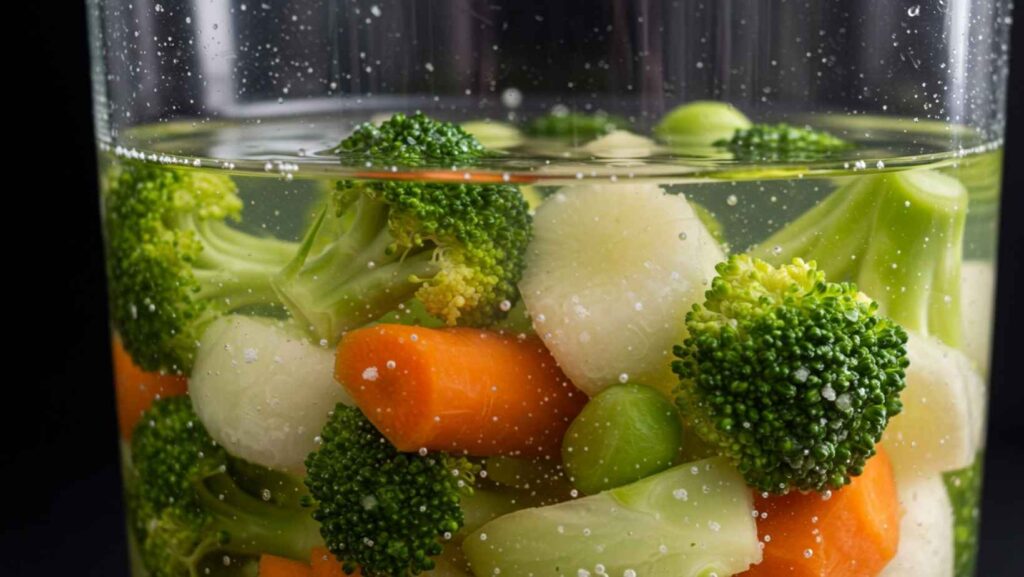
Would you like to know more about salt water’s effects on vegetables? Indeed, the water that is seeping out of the vegetables shrinks and kills the bacterial cells.
Therefore, soaking the veggies in salt water eliminates the germs and bugs and removes pesticides and insecticides.
My mother used salt water as an essential ingredient to flavor veggies every time.
Typically, she soaks veggies in salted water to let them absorb some of the salt and bring out their inherent tastes.
Let’s investigate further.
What Is the Effect of Salt on Vegetables
While preventing the growth of unfavorable spoiling bacteria and fungi naturally found in these foods, salt promotes the growth of these more helpful, salt-tolerant organisms (Doyle et al., 2001).
In addition, salt facilitates the extraction of carbohydrates and water from plant tissues when vegetables ferment.
Generally speaking, exosmosis causes vegetables to release water when they are cooked when salt is added.
Exosmosis: In this process, water moves through a semipermeable membrane from a higher to a lower concentration.
The water seeping out of the vegetables reduces and kills the bacterial cells, eliminating their presence.
Therefore, soaking the veggies in salt water destroys the germs and bugs on them and removes pesticides and insecticides.
The salt recommended when cooking vegetables varies depending on dietary factors and individual preferences.
As a general guideline, one to two tablespoons of salt should be added to every water quart (4 cups).
This enhances the flavor of the vegetables without making them taste overly salty.
Why Do You Put Salt in Water to Boil Vegetables
Exosmosis is the process by which vegetables release water when cooked when we add salt.
Water passes across the semipermeable membrane during exosmosis, moving from a higher to a lower concentration.
However, you’ll also subtly taste the vegetables if you sprinkle a tiny handful of kosher salt into the water.
Like spaghetti, flavoring veggies deeply is enhanced when cooked in salted water. Bonus: the salt prolongs the Day-Glo color.
Enhancing the flavor of food cooked in water is the best justification for adding salt. Water that has been salted will likewise boil (a little) faster.
Although adding salt to water raises its boiling point, this tiny temperature increase does not influence cooking time.
Compared to fresh water, salt water has a significantly lower heat capacity.
This indicates that less heat is needed to raise the temperature of salt water since it is less resistant to temperature changes than freshwater.
What Happens to Vegetables After Adding Salt
Vegetables release water in the addition of salt to maintain the isotonic environment, and this is because the salt solution is hypertonic compared to the vegetable cells.
This process is known as exosmosis, which occurs when the fluid moves from a higher concentration region to a lower concentration.
The water content of the veggies combines with the salt to intensify their taste.
The flavor becomes more nuanced and rich as a result.
Osmosis and Water Loss: Osmosis draws moisture from plants when salt is supplied straight to them.
The water loss in the vegetable cells may impact the texture and juiciness of the veggies.
In some instances, this crisping effect could be helpful for pickling cucumbers.
Texture and Sensitivity: Vegetables’ texture can be affected by salt, particularly after cooking.
When vegetables are boiled or steamed, salt helps break down their cell walls, which results in a softer, more tender feel for the dish.
On the other hand, over-salting or prolonged exposure to salt can cause vegetables to become soft.
Seasoning: The seasoning that gives the vegetables their salty flavor is salt.
This condiment brings out the flavors of the vegetables and highlights the qualities of other ingredients in a dish. The flavors of vegetables are inherent. That’s why it’s so important not to oversalt them.
Preservation: Salt can be added as a preservative when pickling or fermenting vegetables.
During these procedures, salt prolongs the vegetables’ shelf life by inhibiting the growth of harmful bacteria and microorganisms.
What Is the Purpose of Salting Vegetables
Vegetables with high water content tend to become mushy and bland if they aren’t rid of excess moisture before cooking.
To do that, you need two things: salt and time. Salting these watery vegetables draws out extra water and flavor molecules.
Salting is used because most bacteria, fungi, and other potentially pathogenic organisms cannot survive in a highly salty environment due to the hypertonic nature of salt.
Any living cell in such an environment will dehydrate through osmosis and die or temporarily inactivate.
Salt favors the growth of these more salt-tolerant, beneficial organisms while inhibiting the growth of undesirable spoilage bacteria and fungi naturally present in these foods (Doyle et al., 2001).
Salt also helps to draw water and sugars out of plant tissues during the fermentation of vegetables.
Does Salt Destroy Nutrients in Vegetables
Root exposure to high sodium concentrations causes wilted foliage and stunted plant growth.
Excessive salts in soil impede plants’ water uptake and cause plant tissues to become dry and discolored.
If salt is high but not extremely high, plants may grow slowly but not show other apparent symptoms.
In general, we add salt to vegetables during cooking, and the vegetables release water due to exosmosis.
Exosmosis: Water travels from a higher concentration to a lower concentration across the semipermeable membrane in exosmosis.
Boiling and cooking vegetables in high temperatures or water can also decrease their nutrient level.
Water-soluble vitamins like C and B are often lost during these cooking methods.
The most salt-sensitive vegetables include beans, onions, cucumbers, radishes, and celery.
Our favorite herbs should also fare well, even with some salt.
Conclusion
Steaming veggies can preserve nutrients, color, shape, and texture without adding any unnecessary fats through ingredients like oils or butter.
To steam, place food into a steam basket and cover over simmering water.
Since food does not directly touch the water, vegetables retain more nutrients.
If you’re keen on boiling vegetables but don’t want to lose the nutrients, one option is to use the vegetable cooking water in the dish.
This is a good option when cooking curries or stews.
Also, using as little water as possible and avoiding overcooking can help minimize vitamin loss.