
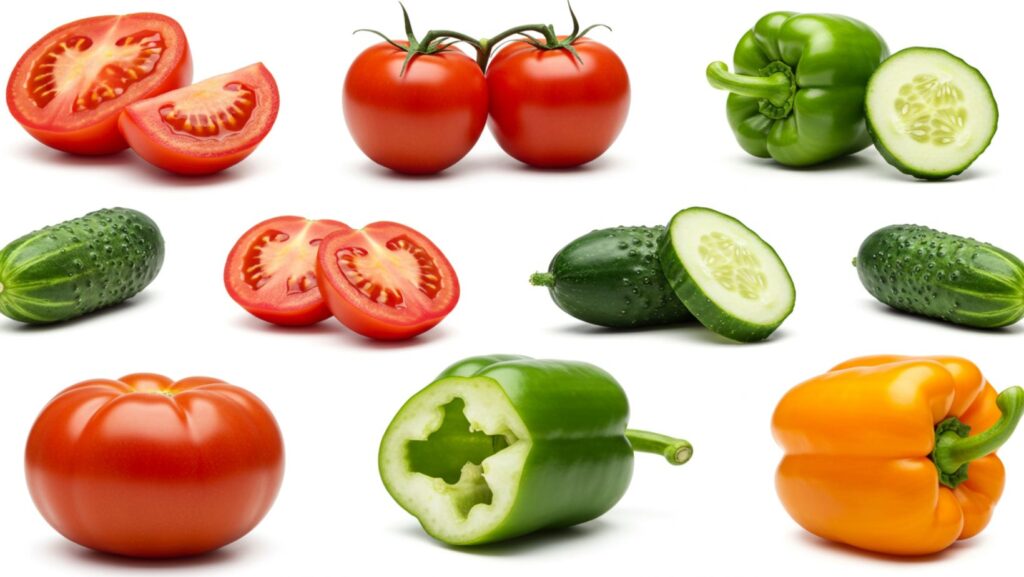
Would yiou want to know Vegetables that are actually fruits? Tomatoes, cucumbers, green beans, okra, olives, pumpkins, sweet corn, sweet peppers, avocados, and zucchini are some examples of common “vegetables” that are actually fruits.
When seen from a botanical perspective, many of these “vegetables” are true fruits since they originate from the blossom and contain seeds.
However, that is not all; as you continue reading, I will provide you with further information on the topic matter.
Now, let’s get started
What Vegetables Are Really Fruits
Many fruits that people mistake for vegetables are actually fruits. Their botanical traits are the reason for this.
The mature ovary of a flowering plant, usually carrying seeds, is referred to as a fruit in botanical terminology.
This description covers a wide range of plants that we often think of as vegetables, including bell peppers, tomatoes, and cucumbers, which grow from the plant’s bloom and contain seeds.
Are Tomatoes Fruits?
Given that it grows from a blooming plant’s ovary and contains seeds, a tomato is indeed a fruit.
The tomato’s savory taste characteristic makes it a popular vegetable in cooking. Still, its biological origin as the mature ovary of the tomato plant firmly places it in the fruit group.
Is pepper considered a fruit?
Given that it grows from the pepper plant’s blossom and contains seeds, a pepper is indeed a fruit.
Because of its savory flavor, pepper is frequently employed as a vegetable in cooking; nevertheless, because it is the mature ovary of the pepper plant, it belongs solidly in the fruit group.
This categorization emphasizes a common distinction between botanical and culinary words by adhering to the scientific notion that fruits are the seed-bearing parts of flowering plants.
Cucumber: Is It a Fruit?
A cucumber is a fruit, yes. This is due to the fact that it carries seeds and grows from the cucumber plant’s blossom.
The cucumber is categorically a fruit due to its biological origin as the mature ovary of the cucumber plant, even if its frequent use in salads and savory meals frequently causes consumers to consider it a vegetable.
Squash: Is It a Fruit?
Squash is a fruit, yes. In particular, squash, which is a member of the Cucurbitaceae family, grows from the carrot’s blooming portion and contains seeds inside its meaty body.
All types of squash, including acorn, butternut, and zucchini squash, fall under this category.
This classification is based on the biological purpose of fruit, which is to preserve and spread seeds, a task that squash satisfies.
Due to its savory flavor and widespread usage in recipes, squash is sometimes treated as a vegetable in culinary traditions. Yet, its botanical classification clearly places it in the fruit group.
Is a Pumpkin a Fruit?
Given that it grows from the blooming portion of the plant and contains seeds, the pumpkin is indeed categorized as a fruit.
A fruit is a flower’s fully developed ovary that envelops and shields the seeds. The seeds are found inside the fleshy center of pumpkins and are formed from the fertilized blooms of the pumpkin plant.
Despite being frequently utilized in savory recipes and described to as vegetables in culinary contexts, pumpkins’ botanical classification as a fruit highlights how crucial it is to comprehend plant reproductive processes and how they relate to food classification.
What Are the Differences between a Vegetable and Fruit
The main distinction between a fruit and a vegetable is found in their culinary applications and botanical definitions.
Fruits—such as apples, tomatoes, and cucumbers—develop from a plant’s blossom and contain seeds that are used for reproduction.
Vegetables, on the other hand, are other plant components that may be eaten, like stems (celery), leaves (spinach), blossoms (broccoli), and roots (carrots).
Usually, they don’t include seeds. Culinary differences also come into play since vegetables are typically savory and used in main courses or as sides, whereas fruits are generally sweet or used in desserts.
Anything that has a seed is a fruit, right?
Not always. Although having seeds is a crucial feature of fruits, it’s not the only deciding element. The structure must also emerge from the ovary of the flower in order to be categorized as a fruit. A more complex explanation is as follows:
Yes, if it grows from the ovary of the flower:
A plant component is a fruit if it grows from the ovaries of a blooming plant and contains seeds.
Tomatoes are a fruit because of this.
No, if it’s a structure that bears seeds and doesn’t grow from an ovary:
Because they do not come from the ovary of a flower, many seed-bearing structures are not considered to be part of fruits.
For instance, although they are not considered fruits in the same sense as tomatoes or apples, grains like wheat, rice, and corn are.
With the ovary wall united to the seed, each kernel is a separate fruit, sometimes referred to as a caryopsis or grain.
What Makes a Vegetable a Vegetable
Determining if something is a fruit or a vegetable may be done from two different points of view: either from the botanical qualities or from the culinary characteristics.
A vegetable is any portion of a plant that is not a fruit, according to the botanical definition. Vegetables are classified as subcategories of fruits.
This encompasses the stems, leaves, and roots of the plant. To provide a more particular definition, veggies are the parts of herbaceous plants that may be consumed.
When it comes to cooking, vegetables are often categorized according to the fact that they have a savory flavor and the manner in which they are utilized in various meals.
It is common practice to consume them either as a component of the main meal or as a side dish.
Depending on the section of the plant that is consumed, vegetables can be further classified as follows:
Beets, carrots, radishes, sweet potatoes, and turnips are all examples of root vegetables.
Vegetables with stems: Kohlrabi with asparagus and Brussels sprouts, cabbage, celery, lettuce, rhubarb, and spinach are examples of vegetables that have leaves and leaf stalks.
veggies grown in bulbs: garlic, leeks, and onions
Artichokes, broccoli, and cauliflower are examples of heading or flowering vegetables.
The seeds of peas and beans are vegetables.
Which vegetables are actually fruit
The pumpkins. As soon as you break it down botanically, the definition of a vegetable becomes hazy, and you find yourself in a debate with your trivia group over whether or not a pumpkin is considered a vegetable or a fruit.
Now that we have that out of the way let’s go into the higher-level botanical classifications of some of our favorite foods since there are a couple that could surprise you.
To begin, a fruit is classified as a fruit rather than a vegetable because it contains the seeds of the plant.
For example, squash, tomatoes, cucumbers, peppers, eggplant, and avocados are all examples of foods that fall within this group. Many people consider these foods to be vegetables.
Pumpkins are, in fact, classified as fruits.
When it comes to peas and beans, things are a little more complicated since if you consume the contents of the pod, you are consuming the seed.
On the other hand, if you are also digesting the pod, then you are consuming both the fruit and the seed at the same time.
What vegetables are actually berries
Berries are defined in this way to include grapes, currants, and tomatoes, as well as cucumbers, eggplants (aubergines), persimmons, and bananas.
However, many fruits that satisfy the culinary definition of berries, such as strawberries and raspberries, are not included in this definition.
Berries are the most frequent form of fleshy fruit, and they are distinguished by the fact that the whole outer layer of the ovary wall ripens into a “pericarp” that has the potential to be consumed.
Berries can be produced from a single flower’s carpels or from many carpels extracted from the same bloom (also known as a simple or complex ovary).
However, there are certain non-fleshy outliers, such as species of Capsicum, which have air rather than pulp surrounding their seeds. The seeds are often lodged in the fleshy center of the ovary.
However, several berries are not only edible but also dangerous to humans. Several of these berries include the fruits of the potato and the deadly nightshade.
Bacciferous or baccate[a] is the term used to describe a plant that produces berries (derived from the Latin word bacca).
What are Fruit veggies examples
fruits like cucumbers, eggplant, okra, sweet corn, squash, peppers, and tomatoes are called vegetables.
Legumes, which include peas and beans, are typically classified as seed vegetables.
The term “modern vegetable farming” encompasses a wide variety of activities, from small-scale production for local sale to large-scale commercial operations that make use of the most recent technological and automated advancements.
Not only that but veggies may be cultivated using either traditional farming methods or organic farming techniques.
There are times when vegetables are germinated in a nursery or greenhouse and then moved as seedlings to the field.
However, the majority of the time, vegetables are planted by planting seeds in the fields where they are going to be produced.
These can be either synthetic or organic.
Harvesting operations are often automated in well-developed nations; however, the practice of harvesting by hand is still practiced in some regions or is used in conjunction with machine activities.
Additionally, harvesting operations are typically mechanized depending on the crop used.
A further worry of the farmer of vegetables is postharvest storage, which may need the use of facilities that are equipped with refrigeration.
What is the number one healthiest vegetable
A leafy green vegetable, spinach is an excellent source of calcium, vitamins, iron, and antioxidants.
Spinach is also a wonderful supplier of iron.
Spinach is an exceptional addition to any diet that excludes meat or dairy products due to its iron and calcium content.
One cup of raw spinach contains only 6.9 calories and is predominantly constituted of water in terms of calorie content. A trustworthy source exists.
In addition, it offers:
- a child’s complete daily needs for an adult Proven and Reliable Source of Vitamin K
- substantial quantities of vitamin A and vitamin C
- Folate, magnesium, and iron iron
- antioxidants rich in calcium
Because it enhances the body’s ability to absorb calcium, vitamin K is a crucial component of a healthy body, particularly for the development of strong bones.
It also plays a significant role in the proper coagulation of blood.
Spinach also has a high level of magnesium, which is essential for the proper functioning of muscles and nerves, as well as a good quantity of iron, which is necessary for maintaining healthy blood and energy levels.
When increasing their consumption of dark leafy greens, those who are currently using blood thinners, such as warfarin (Coumadin), should exercise caution.
In patients who are taking these drugs, it is recommended by medical professionals that they maintain a constant dose of vitamin K over time.
Recipes for eating spinach:
Raw spinach is a popular ingredient that is used in smoothies, salads, and sandwiches.
Additionally, spinach that has been cooked has considerable nutritional advantages and is an excellent element to include in soups and pasta meals.
Final thought
Now that we have established Vegetables that are actually fruits, The fact that some of the most popular “vegetables” in our kitchens are actually fruits from a botanical standpoint is amazing.
Curiosity is piqued, and the diversity and adaptability of these foods are appreciated when one is aware of the differences between fruits and vegetables, particularly from a botanical perspective.
Their essence is in that seed-bearing structure and blossom growth, even when they are cooked or utilized like vegetables.
You will actually be dealing with fruit the next time you need a tomato, Capsicum, or pumpkin, even if you may be using them in other ways in your preferred meals.
These mostly hidden fruits are used extensively in international cooking to offer depth and essential nutrients to a wide variety of recipes.
Knowing that those vegetables are actually fruits adds a delightful twist to your culinary explorations, whether it’s in the form of a salad, curry, or side dish.