
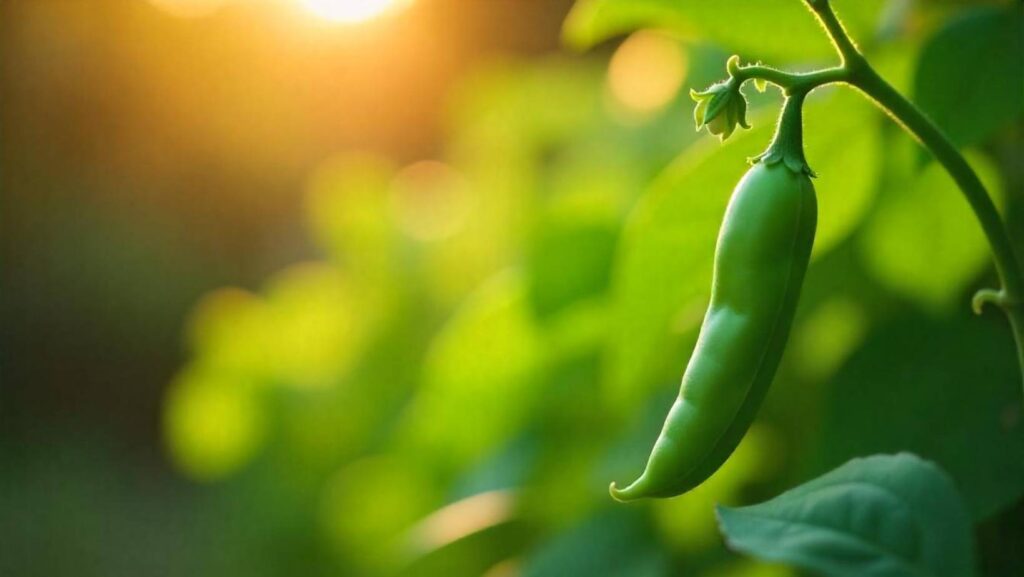
Would you want to know about snow pea growing season? Depending on the environment, snow peas are often cultivated throughout the cooler months of the year, such as spring, fall, and winter.
This is because snow peas thrive in cooler temperatures and are typically grown more frequently during these months.
It is possible to cultivate them virtually throughout the whole year in colder climates, although, in subtropical regions, they may be planted between April and July.
Due to their inability to tolerate heat, they will cease production during the warmer months. However, that is not all; as you continue reading, I will provide you with further information on the topic matter.
Now, let’s get started.
What’s the best month to plant snow peas
To grow snow peas in cold soil. Snow peas contain seeds that are extremely resilient and can grow even in soil that is close to freezing.
Many believe that the temperature at which germination begins is 41 degrees, which is equivalent to 5 degrees Celsius.
In addition, the new small seedling thrives exceptionally well in the cold, and it is able to easily survive a few nights of frost without the need for a row cover over it.
Every year, during January and February, I plant a few rows of snow peas in my polytunnel.
Typically, they begin to germinate at the end of February or the beginning of March, and I am able to start harvesting them in May.
Being able to begin my early summer with fresh snow peas grown in the polytunnel is truly an incredible experience.
When it comes to cultivating snow peas throughout the winter, one of the nicest things is how much my children enjoy doing it.
These early snow peas encourage kids to go on scavenger hunts, which gets them out of the home, and they also encourage them to play outside and try other fresh veggies that are grown in the yard.
It is beyond amazing! Of course, I look forward to eating them as well.
What are the tips for growing snow peas
In the cooler months of the year, snow peas thrive in most regions. They may be seeded throughout the winter, even as far south as Melbourne, because they are not frost-tender.
However, they will thrive if sown in the fall or spring, when the soil will be warmer and promote early growth and germination.
They dislike extreme heat; pollination of the flowers will be poor at temperatures above 30 degrees Celsius, pods will develop quickly, and total yields will be reduced.
Even though seedlings may transfer rather well in the home vegetable garden, these peas thrive best when seeded directly. Plant seeds in rows 100 mm apart and 20–30 mm deep.
Given how active both peas are, some kind of support is necessary to keep the plants and pods off the ground.
It should be enough to have stakes at either end of the rows and wires or strings 200 and 400 mm above the ground, respectively.
After germination, keep the soil damp but not soggy.
To maintain healthy plant growth, use a water-soluble or liquid fertilizer every two weeks; a fertilizer that works well for herbs and vegetables should work well.
Snow peas are best harvested 10–14 days after flowering when the pods are 75–100 mm long and 25 mm broad.
This ensures that the snow peas are still young, sensitive, and flat. The pods may be stiff and unpalatable to eat if the peas have begun to mature.
When the pods are around 75 mm long, and the peas are fairly well formed within the pods, sugar snaps are often harvested.
Both varieties are worth cultivating since they may yield harvests for four to six weeks! “Noelle”
You live in a sunny place. At least five or six hours of sunshine every day are necessary.
What do you need to grow your snow peas
Specifically, a thirty-by-thirty-centimeter plot that contains snow pea seeds and a nutrient-rich soil mix
snow peas need a location that receives at least four hours of sunshine each day, as well as a trellis that they can climb on.
Utilizing the MM-Mix makes it quite simple to cultivate your snow peas.
It is almost certain that you will fall short of your expectations if you cultivate in potting soil of poor quality. Therefore, do not scrimp on the soil mix; instead, strive for the finest.
What is it about Snow Peas in Cold Soil
Snow peas contain seeds that are extremely resilient and can grow even in soil that is close to freezing.
Many believe that the temperature at which germination begins is 41 degrees, which is equivalent to 5 degrees Celsius.
In addition, the new small seedling thrives exceptionally well in the cold, and it is able to easily survive a few nights of frost without the need for a row cover over it.
Every year, during January and February, I plant a few rows of snow peas in my polytunnel.
Typically, they begin to germinate at the end of February or the beginning of March, and I am able to start harvesting them in May.
Being able to begin my early summer with fresh snow peas grown in the polytunnel is truly an incredible experience.
When it comes to cultivating snow peas throughout the winter, one of the nicest things is how much my children enjoy doing it.
These early snow peas encourage kids to go on scavenger hunts, which gets them out of the home, and they also encourage them to play outside and try other fresh veggies that are grown in the yard. It is beyond amazing! Of course, I look forward to eating them as well.
When it comes to snow peas, what kind of soil is ideal
For snow peas to thrive, the soil has to be organically rich, well-drained, and fertile. If you want your plants to thrive, make sure the soil pH is between 6.0 and 7.5.
Before planting, it is possible to improve the soil’s fertility and structure by adding compost or manure that has been allowed to decompose.
Clay soils that are heavy and retain an excessive amount of moisture should be avoided since they might cause root rot.
How do I prevent pests and diseases in snow peas
You should engage in crop rotation and steer clear of growing snow peas in the same location where other legumes have been cultivated for the previous few years.
Neem oil and insecticidal soap are two methods that may be utilized to control pests, such as pea weevils and aphids, which are both common pests.
Make sure there’s enough air circulation around the plants to prevent fungal illnesses like powdery mildew.
In order to stop the spread of infection, all infected plants should be removed as soon as possible.
Final thought
Now that we have established snow peas growing season, popular in Asian cookery, snow peas are crisp and delicious. Established plants’ branches can also be added to salads and utilized in Asian cookery.
In England and France, the snow pea (Pisum sativum var. macrocarpon) is referred to as “mange-tout,” which translates to “eat-all.”
Before the seeds grow and begin to bulge, the flat pod is consumed. Wanneroo is Western Australia’s primary growing region.
Like a green bean, the sugar snap pea (Pisum sativum var. saccharatum) snaps. The edible pods are delicious and have strong walls.
The sugar snap is selected more maturely and is completely rounded, in contrast to the snow pea.
Pea sprouts, often known as “snow pea sprouts,” are popular, particularly in Asian cookery.