
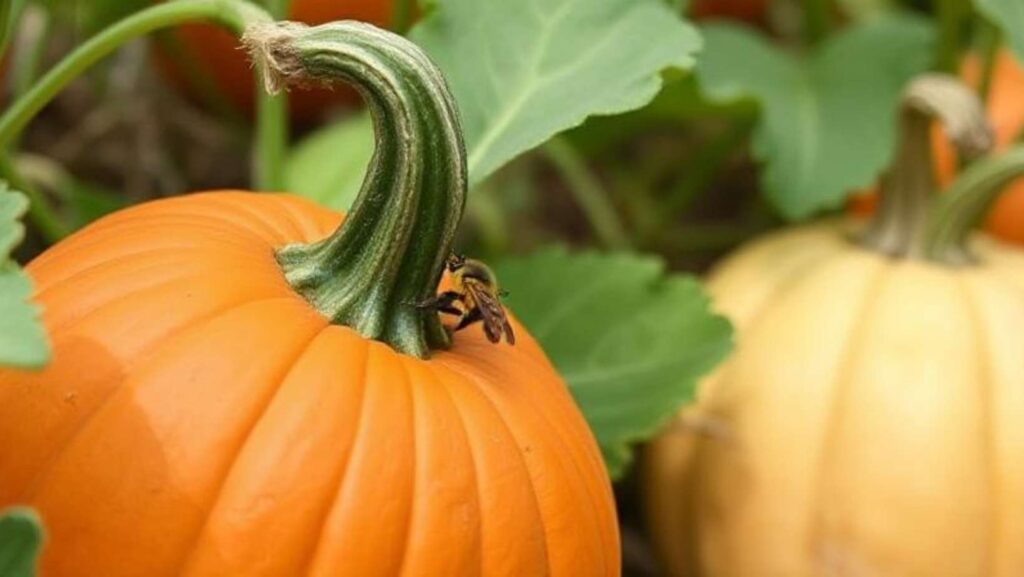
Would you want to know pumpkin pollination tips? My personal experience has taught me that in order to ensure proper pollination of pumpkins, it is necessary first to distinguish male and female flowers.
Next, using a brush or a cotton swab, manually pollinate the pumpkins by transferring pollen from the male flower to the female stigma.
When the blooms are open in the early morning, you should pollinate them. However, that is not all; as you continue reading, I will provide you with further information on the topic matter.
Now, let’s get started.
What is the best way to pollinate pumpkins
Hand pollination is the most efficient method of pollinating pumpkins, guaranteeing fruit growth. This entails carefully moving pollen from the male bloom to the stigma of the female flower.
The procedure is broken down as follows:
1. Determine which flowers are male and female:
Female flowers contain a little growing fruit at the base, but male blooms have lengthy stalks and no fruit at all.
2. Use the flower to gather pollen: Select a male flower, peel off the petals to reveal the pollen-covered stamens, and then gently brush the stamen against the stigma of the female flower.
3. Transfer Pollen: Gently rub or brush the instrument or brush loaded with pollen on the female flower’s stigma.
4. Repeat for More Than One Flower: A single male flower can pollinate several female flowers.
Success Advice:
Timing: Before the female flowers close, pollinate early in the morning.
Weather: Since pollen is readily blown away, pick a day with low wind and warm temps.
Observation: Track the female flower’s ovary swelling, which signifies successful pollination
How do you know when a pumpkin is pollinated
You’re just waiting to see if the fruit grows after pollinating a pumpkin blossom or assuming that bees have a legitimate expectation.
If pollination is successful, the young pumpkin will begin to grow, and you will have what is known as a “fruit set.”
Within a few days, a difference is typically visible to the naked eye. To be sure, I take pictures of all my flowers at pollination and a few mornings later.
As a general rule, if I’m on day three or four and still don’t see any change, it probably won’t work.
Especially if you’re a novice grower and don’t know what to look for, these days may be quite frustrating. From my garden, here are a few samples.
The appearance of a successful pollination
A newborn Connecticut Field Pumpkin, a common orange carving kind, serves as one illustration.
A good indication of health for this type of pumpkin, in my opinion, is that the fruit is about the same shade of green as the stem and vine at the time of pollination.
The immature fruit seems fat, smooth, shiny, and nearly wet, and it is expanding uniformly like a balloon.
Although the flower is gradually withering, it still has a clear attachment to the fruit. (Don’t take the flower off. It will ultimately come off by itself, and that’s okay.)
The appearance of a failed pollination
A failed pollination is mostly indicated by the infant fruit becoming pale or failing to grow.
This little orange pie pumpkin was a failure. The fruit’s glossiness gave me hope at the 24-hour mark, but at the 48-hour point, I realized it had failed because it was not growing.
Observe how the fruit becomes pallid and begins to wrinkle as the shine gradually fades in each picture.
This is what failure looks like on a pumpkin whose offspring are yellow; baby fruit isn’t usually green.
That impairs your ability to detect color, but we can still tell since the fruit didn’t get any bigger, and in the last picture, it started to get a sunken, rotting patch at the tip.
Which type of pollination occurs in pumpkin
The main source of fruit for pumpkins is insect cross-pollination, particularly by bees.
When bees visit flowering flowers, they deposit pollen on their bodies, which the blooms then use to attract females.
This is a more thorough explanation:
Monoecious:
Monoecious pumpkins grow male and female flowers.
Insects are necessary for the pollen transfer between the male and female flowers since pumpkins are not self-pollinating.
Bee Pollination: Because they visit both male and female flowers in quest of nectar and spread pollen on their bodies, bees are the main pollinators of pumpkins.
Flowers, both male and female:
Female flowers provide more nectar but no pollen, whereas male blooms produce both pollen and nectar.
Pollen Transfer: Bees carry pollen from male flowers to female flowers, which forms the pumpkin.
Pollinator importance: A decrease in pollinators can affect fruit yield, whereas more pollinator activity improves the quality of pumpkin fruit.
Other Pollinators: Squash bees and bumble bees are two insects that may pollinate pumpkin blooms; however, bees are the most significant.
Do Pumpkins Self-Pollinate
The answer is no. They require pollination from bees or, occasionally, from you. Female flowers have more nectar but no pollen, whereas male blooms generate both nectar and pollen.
Large, sticky pollen particles attach to the male flowers, which attract bees. After that, they proceed to the divine nectar that the ladies create, and the transfer is finished.
A higher level of pollinator activity improves fruit quality. Even though the pumpkin plants have both male and female flowers, pollination doesn’t appear to be taking place for a variety of reasons.
The bees may be staying indoors due to excessive heat or rain, or broad-spectrum insecticides may have been used in the area. You could end up hand-pollinating pumpkins in any case.
How to Hand Pollinate Pumpkins
You must distinguish between the male and female blossoms on the pumpkin plant before you can begin hand pollination.
Examine the junction of the stalk and the blossom on a female. You’ll see what appears to be a little fruit. The ovary is this.
Male flowers often bloom in clusters, are shorter, and do not bear immature fruit. Hand pollination may be done in two easy ways.
Touch the anther in the middle of the male flower with a cotton swab or a tiny, sensitive paintbrush. The brush or swab will collect pollen.
Next, place the swab or brush on the stigma in the middle of the bloom of the female flower.
Then, contact the stigma of the female flower with the anther. That’s it! As the fruit grows after pollination, the ovary starts to enlarge.
The ovary will wither away if fertilization is unsuccessful, but I am certain that you will be a successful hand pollination.
Pumpkin Pollination and Weather Conditions
Concerns have been raised regarding pumpkin and other crop pollination due to the high temperatures this week and those expected to occur next week.
Temperatures in the high 70s at night or the high 90s during the day for a number of days in a row can cause flower bud abortion. Other problems with plant health and function are brought on by heat stress.
However, hot and dry weather conditions are particularly taxing for crops that require pollination.
Pumpkin blooms will be pollinated by a variety of solitary bees, including squash bees, bumblebees, and honeybees.
After blossoming, pumpkin blossoms only last a few hours before becoming limp and closing. Therefore, during the short time they are open, they need to be pollinated.
Maintaining sufficient soil moisture during pollination is crucial for promoting flower health, pollen quality, and favorable stigma acceptance of pollen. Incorrect bud and flower formation prevents pollination.
For pumpkin roots, vines, flowers, and fruit to develop healthily during this heat wave and throughout the season, irrigation is advised, along with other plant healthcare techniques.
In order to guarantee sufficient pollination, future considerations should also be taken into account:
1. To avoid having too much foliage, maintain plant populations at the suggested rates. The benefit of pumpkin vines is that they effectively compete with weeds once they cover the ground.
High plant densities and excessive leaf cover, however, may make it more difficult for pollinators to find blossoms beneath the canopy.
Furthermore, plants with excessive foliage stay damp for longer, which promotes fungal infections.
2. To increase pollinator numbers, look at hive rentals rather than depending just on native bee populations.
3. Delays in blooming and fruit development can also result from excessive plant growth brought on by higher-than-recommended nitrogen inputs.
Consequently, avoid over-fertilizing pumpkins. This holds for every stage of growth, but it’s particularly true prior to fruit set.
4. In addition to inferior plant/flower quality, dryness may cause an abnormally high male/female flower ratio, which would reduce the number of pumpkins produced per plant.
Final thought
Now that we have established pumpkin pollination tips, In spite of the fact that there are both male and female flowers on the pumpkin plant, you can still have trouble pollinating it for a variety of reasons.
Bee activity can be hindered by a variety of factors, including the application of broad-spectrum insecticides in the surrounding area or poor meteorological conditions, such as an excessive amount of rain or heat.
When circumstances like these arise, the manual hand-pollination of pumpkins becomes a probable requirement.