
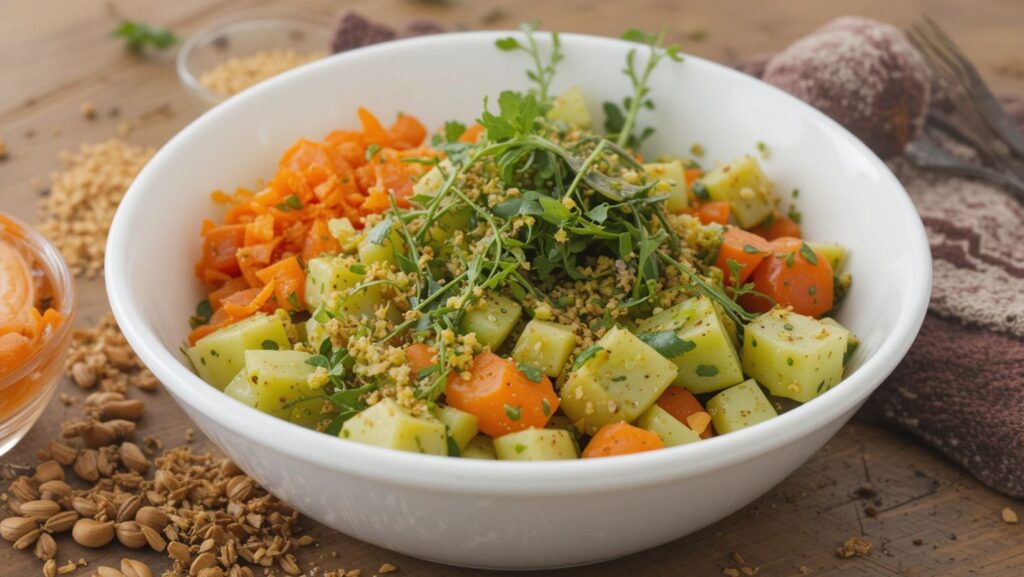
Would you want to know How to cook vegetables without losing nutrients? In my opinion, the best way to cook vegetables while preserving their nutrients is to favor rapid cooking methods such as steaming, stir-frying, microwaving, and roasting.
Additionally, it is important to avoid overcooking the veggies and to use minimal amounts of water or oil.
However, that is not all; as you continue reading, I will provide you with further information on the topic matter.
Now, let’s get started
How To Cook Veggies Without Losing Nutrients
Use these pointers to start cooking veggies instead of boiling them so that their goodness is preserved:
Peeling: Avoid it!
with their skins on increases your intake of fiber, which keeps you feeling satisfied for longer, and nutrients.
The cell walls of many vegetable species’ outer layers are where they store nutrients and antioxidants.
For instance, compared to a peeled potato, a cooked potato with the skin on will have up to 175% more vitamin C, 115% more potassium, 111% more folate, and 110% more magnesium and phosphorus.
Prepare them properly:
The water-soluble nutrients in vegetables that are boiled end up leaking into the water that is dumped down the drain.
Don’t worry, though; there are plenty of alternative methods to prepare those vegetables. Steaming them produces a similar outcome with less leaching.
When you sauté veggies, a little oil is added and the vegetables are cooked over high heat.
Roasting is incredibly simple – put it in the oven and forget about it (but don’t actually forget…!).
When vegetables are roasted, their natural sugars are released, intensifying the flavors and producing a mouthwatering caramelized appearance.
Consume them uncooked:
Certain vegetables are finest eaten just the way they are. Okay, so don’t eat lettuce in the middle of the grocery store, and always wash your fruit before eating!
When consumed fresh, greens like lettuce and broccoli have the maximum vitamin C content.
Consume your vegetables fresh:
Nobody benefits from keeping vegetables in the refrigerator for an extended period, with the possible exception of the compost bin’s worms.
For the most nutritional density, try to consume leafy greens within a few days.
To lock in all that goodness, think about freezing or preserving your vegetables if you don’t believe you’ll finish them before they spoil.
Consuming raw vegetables is quite popular since it reduces processing and cooking, which leads to a better diet, right?
Not all the time!
While most vegetables are excellent while raw, some are actually healthier when cooked:
Cooking spinach releases the bound calcium, which facilitates easier absorption.
Tomato Any cooking significantly raises the amounts of the antioxidant lycopene, which is generated when heat breaks down cell walls.
Asparagus: Alright, the season is over. The cell walls of all vegetables will be broken down by cooking, so keep that in mind for next spring.
When asparagus’s cell wall breaks destroyed, vitamins A, B9, C, and E are released, which facilitates easier absorption by our cells.
How to prepare veggies so they retain their nutrition The ideal moment and technique
Due to the fact that every meal reacts slightly differently to heat, there is no single solution that can be given regarding how to make sure that the nutritional makeup of foods is preserved.
The truth of the matter is that it is all about understanding when to prepare them and how to cook them.
There are a few common guidelines that should be kept in mind when it comes to the preparation of edible veggies.
- Use only a small amount of water.
- The temperature should be kept low.
- Get them ready in a hurry.
A fun fact: broccoli, when it is in its raw form, has around 540 milligrams of vitamin C. About 260 milligrams is the amount that remains after it has been cooked for a few minutes.
However, the longer you boil it, the fewer vitamins it will have. It is essential to keep this in mind while dealing with vegetables that contain vitamins that are sensitive to heat.
What are the best ways to cook vegetables without losing nutrients
We examine several cooking techniques and how they affect the nutrients in vegetables.
Most nutrients are retained during steaming:
One of the finest ways to preserve the nutrients in veggies is to steam them.