
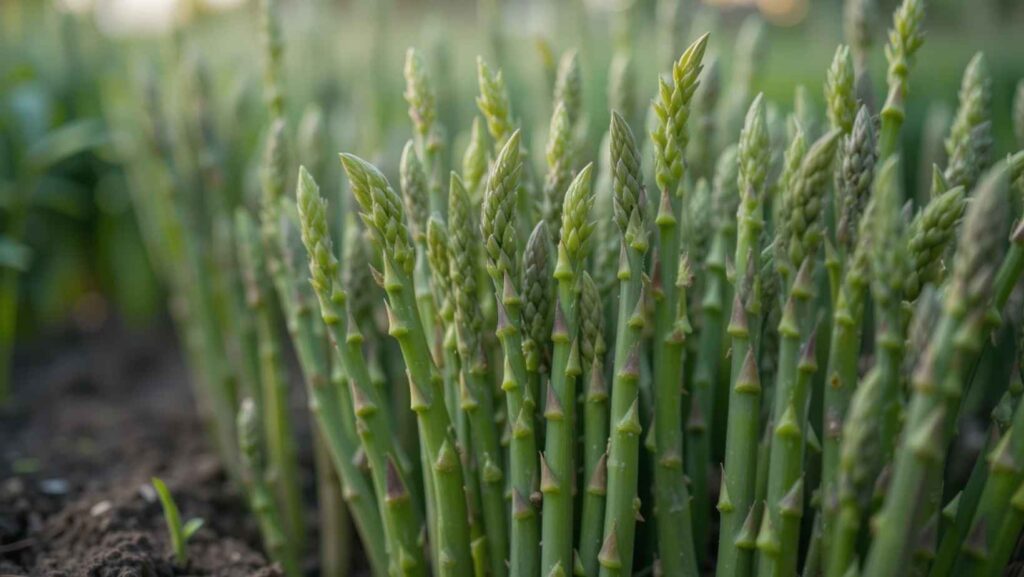
Would you like to know how long it takes asparagus to grow? According to my personal experience, asparagus typically takes around two to three years to reach full harvestable maturity once it has been planted.
The third year is the time when you can anticipate a complete harvest of spears that are thick and robust.
Although asparagus can be produced from seed, it takes the plants three years to reach maturity; therefore, it is often cultivated from one-year-old crowns.
Nevertheless, the plant has the potential to continue producing fruit for ten years or longer, so the wait will be well worth it.
By the time the soil is ready to be worked, which is often in the late winter or early spring, you may begin planting.
However, that is not the case; as you continue reading, I will share further information on the topic matter.
Now, let’s get started.
How quickly does asparagus grow
Asparagus takes around three days to establish a stock that is tall enough to pick when it is first planted in the spring.
However, when the days become warmer and the season begins to get underway, asparagus may grow up to 25 centimeters (10 inches) in twenty-four hours.
The beginning of the asparagus season typically occurs at the start of May, although the timing may vary depending on the weather, with the season sometimes starting in April or even earlier.
The asparagus season lasts anywhere from six to eight weeks, during which time growers gather the herb on a daily basis.
Asparagus grows rapidly when the weather is bright and warm, and because of this, pickers may travel around the field twice a day in order to harvest the stocks.
Why does asparagus take so long to grow
You must wait two or three years after planting your asparagus “crowns,” which are an unimpressive bundle of roots before you can harvest the plants.
This is due to the fact that they must be robust enough to endure when you ruthlessly cut off the developing stems for them to eat.
One of the earliest vegetables to appear in the early spring is asparagus. Ensure the type you plant is suitable for your climate zone.
In Colorado East Slope, where I live, Jersey Giant is a dependable type, so I planted it.
Cut the spiers about half an inch above the ground when they are ready to be harvested, which should be in years two or three. It won’t harm the plant if you have waited for at least two years.
For several years, I was a failure (trial by mistake). If I may, here are some recommendations based on my efforts:
Because heavy soils will not provide the root crowns with adequate oxygen, they will cause them to rot due to excessive moisture. Therefore, you should amend your clay or silty soil.
With the exception of thick soil, this vegetable is thirsty and requires regular watering.
Add compost or well-rotted manure (organic matter) to the soil to improve its quality. Since my soil is alkaline (sweeter), I added some peat moss, which tends toward the acidic soil it prefers. Clay soils have a higher alkalinity level.
(from the web) A pH below 7 is considered acidic. A pH of 7 or above is regarded as basic. Because the pH scale is logarithmic, every value below 7 is ten times more acidic than the next higher value.
For instance, pH 4 is 100 times (10 times 10) more acidic than pH 6 and ten times more acidic than pH 5.
Asparagus prefers soil with a pH between 6.5 and 7.0. You can test your soil and make amendments to balance it out in terms of nitrogen, potassium, phosphorus, and other essential elements.
Does asparagus take 2 years to grow
Growing asparagus and reaching its full potential takes around three years due to a number of factors that are associated with its life cycle and development habits:
As a plant, asparagus is categorized as a perennial, which means it may endure for a number of years.
Before the plant can generate a large crop, it must first be given sufficient time to develop a robust root system.
Description in further detail:
Taking Roots from the Crowns:
In most cases, you may anticipate beginning to harvest spears from asparagus plants that were planted from crowns that were one year old after they were grown.
Starting from Seeds: It will take longer for your asparagus plants to develop a strong root system if you decide to start them from seeds.
As a result, you will have to wait three years before you can anticipate a full harvest.
Establishing a robust root system is the primary objective throughout the first year of a plant’s life, regardless of whether it was grown from crowns or seeds.
Second Year: The plants continue to develop during the second year, and they may produce some small, thin spears.
However, it is not suggested to harvest a large quantity of the plant during this year.
Third Year: By the third year, the plants have reached the point of maturity when they are able to produce a complete harvest of spears that are thick and robust.
How much asparagus do you get from one plant
A well-established plant ought to produce around ten spears during each season.
The shoots should be allowed to continue growing into tall ferny plants throughout the remainder of the summer once the harvesting time has ended.
After that, you need to cut them down to the ground in the fall, and they will re-sprout in the spring, ready to undergo another round of harvesting.
Breakdown in great detail:
Period of Establishment:
Several years are required for asparagus plants to fully develop their root systems before they can yield a satisfactory crop.
Season of Harvesting: The harvest season typically lasts for around six to eight weeks, spanning the spring and early summer months.
The annual yield of spears produced by an asparagus plant that has reached maturity is around half a pound.
Suggestions for Greenhouse Planting:
Sow According to True Seed, you should plant ten to twenty crowns for every adult who enjoys eating asparagus in your house.
During the harvesting process, the Old Farmer’s Almanac recommends collecting spears when they are around 6 to 8 inches tall.
Asparagus plants have the potential to continue producing for over fifteen years, making them an excellent addition to any garden due to their long-term productivity.
What is the best fertilizer for asparagus
After planting, after the crowns start to grow, nitrogen should be applied.
The standard garden fertilizer rate for asparagus, if you don’t have a soil test result, is 1 to 1.5 pounds of fertilizer (10-10-10) with 10% nitrogen, 10% phosphorus, and 10% potassium per 100 square feet, applied prior to planting.
It is advisable to conduct soil tests every three years after establishing an asparagus patch and to follow the test recommendations before adding fertilizer.
Following the establishment of the asparagus patch, fertilizer, compost, or composted manure can be applied either in the early spring, before the appearance of spears, or in late June or early July, following harvest.
Add these inputs only if the soil test indicates that they are required.
When selecting plants, consider that there are both male and female varieties. The plants are hence dioecious.
They all yield edible spears.
Red, inedible berries are only produced in the summer by plants with only female blooms.
The spears of female plants are bigger.
Male plants produce smaller, homogeneous spears.
The majority of hybrid plants, including Jersey Giant, only have male blooms and don’t yield seeds.
All-male flowering plants don’t use energy-producing seeds or fruits.
Male asparagus plants often yield more spears and have longer lifespans.
Female plants can produce unwanted, weedy asparagus seedlings.
Final thought
Now that we have established how long it takes asparagus to grow, We Can See That Asparagus grows best in growing zones three through eight, as it needs cold enough temperatures during winter to go dormant and recharge for the following growing season.
You may find success in warmer temperatures, but the plants could produce less overall, stop producing sooner, and require more fertilizer and care.
If your fronds aren’t completely dying back in warmer growing zones, cut them back yourself in the fall.