
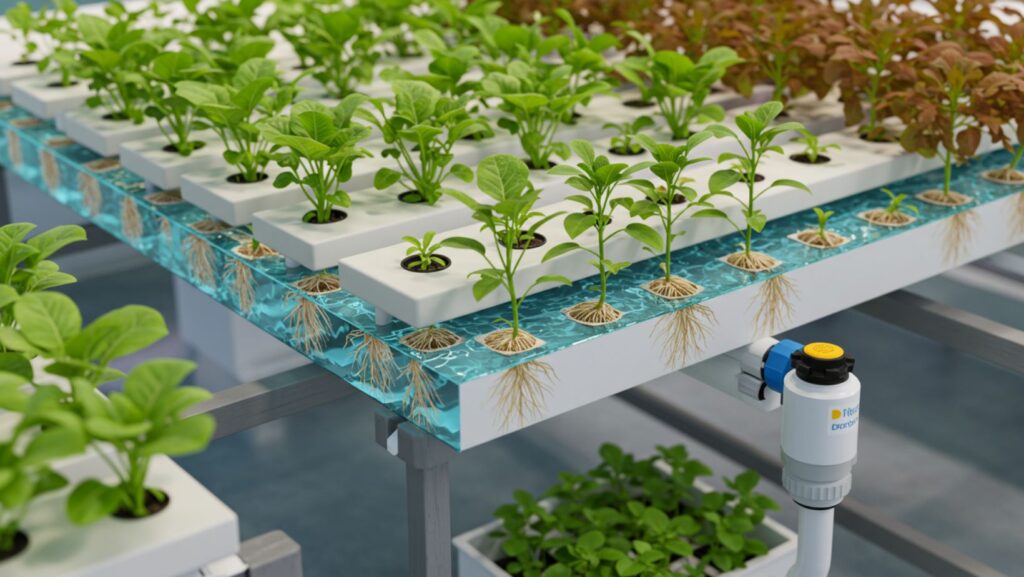
Would you want to know how hydroponic vegetables are grown without soil? In my experience, hydroponic veggies are produced without the use of soil by employing a nutrient-rich water solution instead.
The roots of the plants are either immediately submerged in the water or supported on a soil-free medium such as sand, perlite, or coconut fiber, and the plant is grown in this manner.
A method of cultivating plants known as hydroponics involves the application of nutrients in the form of a solution that is ingested by the roots of the plant.
For the purpose of providing support for the roots, hydroponics may involve the utilization of sand, rock wool, peat, or any other inert media.
However, that is not all; as you continue reading, I will provide you with further information on the topic matter.
Now, let’s get started
Is hydroponics vegetable without soil
Even if they are not planted in soil, plants are nevertheless able to live. Hydroponics is the scientific study of cultivating plants in water that is rich in nutrients.
The term “working water” is derived from the Latin terms “hydro,” which means “water,” and “ponos,” which means “work.”
The term “hydroponics” is derived from these two words. The nutrients are accessible at the roots of the plant when it is grown using hydroponics.
A subset of hydroculture, hydroponics is a sort of horticulture that includes the cultivation of plants, often crops or medicinal plants, without the use of soil.
This is accomplished by the utilization of water-based mineral fertilizer solutions in an artificial environment.
In the absence of soil or fertilizer, what are some of the ways that may be utilized to cultivate vegetables from seeds indoors?
Without relying on conventional soil or fertilizer, the following are some of the approaches that may be used to start seeds indoors:
The use of hydroponics
In this method, plants are grown directly in water that has been supplemented with nutrients. For seed beginning, some popular indoor hydroponic techniques include the following:
A straightforward and undemanding method, the Kratky Method involves suspending plant roots in a container containing nutritional solution. To begin with, this is a simple task.
DWC stands for “deep water culture.” The roots of the plant are suspended in water that is rich with nutrients and oxygen, which encourages fast development.
The microgreens
Very young seedlings are taken for their sensitive leaves, which are rich in nutrients. Microgreens are harvested for this reason. Indoors, they may be grown rapidly and readily without the use of soil:
The trays that A Medium for Growing: Keep the seeds wet after spreading them out over a layer of coconut coir, peat moss, or a hydroponic medium that is specifically designed for the purpose.
In the jar method, seeds such as broccoli or radish are sprouted in a jar with water, and the seeds are rinsed and drained on a regular basis. Enjoy them immediately when they have blossomed.
Additional Choices
The seeds can be sprouted by keeping them wet on cotton pads or paper towels. Cotton pads and paper towels are both useful. Once roots have begun to emerge, seedlings should be transplanted.
Considerations of Vital Importance
Nutrients: Hydroponic techniques necessitate the use of a nutrient solution that is not general. After a few weeks, seedlings that were grown using alternative ways would require a lighter liquid fertilizer.
A sufficient amount of light is essential for all of the measures that are used to avoid weak and lanky seedlings.
Donation of organs The vast majority of seedlings that are grown without soil will, at some point, require being transferred into the soil or a bigger hydroponic system.
It is important to keep in mind that although these techniques initially eliminate the need for soil and fertilizer, you will still need to continue to offer nutrients and support for the proper growth of the plants as they mature.
Please get in touch with me if you are interested in learning more about a certain approach!
What are The benefits of hydroponic vegetables
Even in colder areas, hydroponic greenhouses are able to cultivate a wide variety of staple foods throughout the year in a very small space.
As a result, energy requirements and food miles are decreased.
One additional advantage of hydroponics is that it makes use of land.
In spite of the fact that it does not regenerate soil in the same manner as organic farming does, it utilizes a far smaller amount of it and, if done with awareness, can counteract the detrimental impact.
Growing towers and shelves are utilized by a number of hydroponic farms in order to maximize the utilization of their area and further reduce their overall footprint.
It is possible for a hydroponic farm to cultivate food in as little as ten percent of the space that it would require for a soil farm if it were equipped with a greenhouse, some ingenious shelving and storage mechanisms, and additional grow lights.
Suppose you are attempting to give fresh fruit to metropolitan areas or to prevent the development of valuable green places. In that case, this is a significant advantage that you may take advantage of.
Additionally, hydroponic systems cut down on the quantity of water that is required to cultivate plants.
Farmers who till the soil lose the majority of the water that their plants do not absorb.
When it reaches the water table or the local reservoirs, it flows downward. In more arid regions, this might be a very challenging task.
What are The drawbacks of hydroponic vegetable
There are drawbacks to hydroponic farming, and it is not without its critics. These are a few of its drawbacks:
Compared to earth agricultural operations, hydroponic systems frequently use more energy. Electricity is required for nutrient cycling, water recycling, heating, and additional UV illumination.
Compared to hydroponic farms, soil farms usually need less power despite their substantial reliance on carbon-emitting tractors and other heavy machinery.
Compared to indoor soil farming, indoor hydroponic farming still requires less energy.
High setup and maintenance costs may also be a deterrent. Starting a greenhouse hydroponic farm is substantially more costly than starting an outside soil farm.
It is frequently necessary to construct facilities and equipment from the ground up. It might be challenging to locate competent engineers and scientists. Land may be expensive in urban and suburban regions.
Another controversial topic is the nutrient density of hydroponically grown fruits and vegetables. Some soil farmers think that their stuff is healthier than hydroponically farmed fruit.
It appears, nonetheless, that the farm determines whether the hydroponic product has a better nutritional richness than earth produce.
Hydroponic farming’s organic certification is a contentious issue. The USDA made it possible for hydroponic farms to apply for organic certification in 2019.
Opponents contend that hydroponic farms need to be excluded from these certifications as they call for soil-replenishing techniques.
Much of the criticism is motivated by economic concerns about hydroponic farming. Hydroponic farming is costly, particularly when done according to organic standards.
Some organic soil farmers worry that they may be forced out of business by big food companies who can afford to construct hydroponic facilities quickly.
Can you grow hydroponics with just water
Absolutely! The amount of food in the medium that will sustain that type of development will determine whether you have a huge crop or not.
Plant-growing media range from fantastic to appalling. You’re in luck if you know you’ll be developing in some of the amazing areas.
Your seeds might not even sprout if you are growing in some of the worst things, and if they do, your plants might suffer from the beginning.
I would suggest the following to a novice grower:
I would plant your seed in its eternal home, which should be, say, three ladies for cars and five gals for pictures.
You want to give the plants space to spread their roots. In general, larger is preferable, with the ideal location being on healthy soil.
Ask the cashier what kind of potting soil everyone prefers when you purchase yours from a grow shop.
Purchase a full-spectrum organic fertilizer (always stay organic). This is what you’ll use if your plants aren’t developing quickly enough.
You can tell that by seeing how much your plant grows on every sunny day. The larger the plant, the more it will grow.
Additionally, consider “plant time.” What exactly is it? Just understand that plants require time to respond to stimuli unless it’s disastrous, which is not what you want.
Allow a few days for your plant to respond to various treatments, such as fertilizer additions, trimming, and topping. Even water alone.
Final thought
Now that we have established how hydroponic vegetables are grown without soil, In the end, hydroponically produced veggies can be just as nutrient-dense as those grown in soil, depending on the fertilizer solution used.
As much as I believe that soil is ideal for plant growth, hydroponics has advanced significantly.
I have witnessed hydroponic growers test their leafy greens for essential nutrients, and the results are sometimes much higher than the typical range for their crop.
Traditionally, soil is where plants get their nutrients. Instead, the plants under hydroponics receive their nutrition from a solution.
(The only difference is that fertilizer is misted onto the roots in aeroponics, where the roots of the plants are suspended in the air.)
Hydroponic plants are often found inside, frequently on tall shelves, in huge warehouses or greenhouses, and they are dependent on artificial light instead of sunshine.