
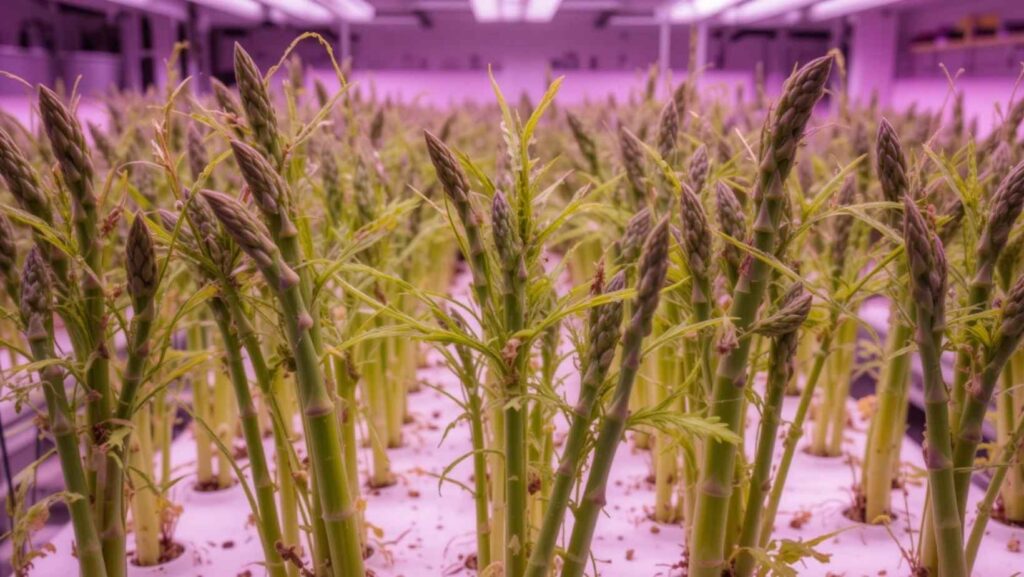
Would you like to know if you can grow asparagus in a hydroponic system? In my experience, the answer is yes; it is possible to cultivate asparagus using hydroponic methods.
In fact, it can be an excellent method for increasing yields and enjoying the benefits of indoor gardening, particularly in warm, controlled environments.
However, that is not all; as you continue reading, I will provide you with further information on the topic matter.
Now, let’s get started
Why Grow Asparagus Hydroponically
Asparagus has always been a patience challenge. It may take three years or longer for plants growing in soil to produce to their maximum capacity.
However, you can eat those delicious spears much sooner using hydroponics. Here are some reasons to think about it:
Advantage of Speed: The expedited timeframe of hydroponic asparagus is its greatest attraction. Under ideal circumstances, you might be able to harvest your first spears a year or two after planting, as opposed to the long wait that comes with conventional soil cultivation.
Potential for Out-of-Season: Is asparagus a wintertime craving? It’s feasible, thanks to hydroponics!
Expert farmers can induce their asparagus plants to produce tender spears outside of their normal growing season by adjusting temperature and light cycles.
(If True) Space Savers: Although asparagus plants can grow very large, certain hydroponic systems enable more dense planting than conventional garden beds may allow. Growers with limited space may find this particularly intriguing.
The “Wow” Factor: Growing your asparagus is, let’s face it, amazing. Is it possible to grow it hydroponically throughout the year? That’s a remarkable accomplishment that demonstrates your commitment and growth prowess.
Note that growing asparagus hydroponically is not without its difficulties. It requires a specific arrangement, careful nutrition management, and knowledge of the plant’s unique growth cycle.
Why to Choose Hydroponics for Growing Asparagus
There are several reasons why farmers prefer growing asparagus hydroponically. Because they can more accurately regulate factors such as food, water, and temperature, plants grow exceptionally well.
As is well known, asparagus output peaks in the spring and declines in other seasons.
However, with hydroponic asparagus, regular harvests are achievable without production fluctuations, thanks to control over temperature, humidity, lighting, electrical conductivity (EC), and pH.
Since asparagus can be cultivated year-round using hydroponics, fresh asparagus is always available for sale.
The hydroponic system offers an advantage in preventing these issues since it is inside and restricts the introduction of infections and germs.
What are the Benefits of Growing Asparagus in Hydroponics
Asparagus is a plant that thrives in the temperate zone, meaning it requires warm conditions to grow and develop properly.
You can make adjustments to all environmental parameters one at a time when using hydroponics.
Asparagus can avoid falling into dormancy, which occurs when temperatures decrease if the environment is properly controlled.
Other advantages of cultivating asparagus include the following:
- The rotation of crops more often
- The saving of water
- You can set the temperature.
- It is possible to pump the plant with a significant amount of nitrogen.
Because it is a heavy feeder, asparagus is an excellent choice for hydroponics, as it allows you to provide the plant with as many nutrients as it can process.
Additionally, a plant that can access a plentiful supply of nutrients will develop into a healthier and more productive crop.
Now that we have that out of the way let’s talk about the ideal growth circumstances that your asparagus will have when it is grown in a hydroponic system.
Can I grow asparagus indoors year-round in a grow tent
Generally speaking, increasing asparagus in pots can be challenging. The plants have a large root system and leaves, and in their second year, they begin to produce the typical shoots.
Since these organisms prefer a lot of areas both above and below ground, the adjective “extensive” is really too mild!
But if you use big enough pots, it is possible. In response to your second inquiry, asparagus doesn’t actually require a time of winter dormancy.
I’ve never compared the methods, but I’ve heard that your shoots won’t be as big if you don’t supply this.
I can only rely on what I’ve read because I’ve never grown asparagus in a greenhouse or in pots.
Considering how little asparagus yields per square foot, I believe the grow tent would be a very bad investment.
A greenhouse placed over an in-ground garden can be used for this purpose.
Remember that each plant can only have its shoots harvested for a few weeks before the shoots must develop into leaves to feed the roots and subsequent shoots.
I’m not sure if you can get more than one season’s worth of shoots from a plant without limiting its development because I haven’t attempted it.
In order to shock the roots into producing new growth, I suppose you must let the foliage to develop for a considerable amount of time—I’m not sure how long—before trimming it all back to the “ground.”
How many of such cycles can a single plant support in a year, then? You may have two harvests a year in a greenhouse if you typically have six months of growth and six months of dormancy.
Assume for the moment that you would receive three.
To acquire large and deep enough pots, as well as the “air” room for the plants to develop, you still need to set aside a significant amount of space in the grow tent.
What are the Growing Conditions for Hydroponic Asparagus
As a monoecious plant, asparagus can have distinct genders, either male or female.
The females will produce berries and grow into a plant that resembles a fern. Avoid eating these berries. They are poisonous to people.
The stalk that we are all used to consuming is produced by male plants. To feed a family of four, you will typically need 25 plants.
Before botanists determined that asparagus was linked to the Allium genus, which includes species such as garlic and onions, it was believed that asparagus and the lily family were closely related.
However, a more thorough genetic analysis led them to conclude that it belonged to the Asparagaceae family.
Although its origins are debatable, most people agree that asparagus originated in Europe and western Asia.
Another peculiarity of asparagus is that it grows in coastal environments, meaning it prefers soil that is too salty for typical weeds.
Since it is a perennial crop, you will be urged to keep it in the best possible circumstances so that it can live a long and healthy life.
What temperature is necessary for this plant that enjoys warmth
Temperature: As we’ve already discussed, asparagus prefers warm temperatures. The ideal growth temperature range for your crop is between 75°F and 86°F.
The plant’s crown will emerge upwards after the optimal temperature has been attained and sustained.
To prevent your plants from tipping over, stake and trellis them to support their growth.
Lower the temperature to between 72°F and 78°F when attempting to germinate seeds.
When asparagus becomes too cold, it will not absorb nutrients and will revert to dormancy; therefore, temperature is crucial.
Nutrients: As previously stated, asparagus is a huge fan of nitrogen. Ensure your plant always has access to a balanced nutrition solution.
Additionally, the roots of an asparagus plant are particularly meaty and have a large capacity for storing nutrients.
One hundred fifty pounds of nitrogen, 37 pounds of phosphorus, and 170 pounds of potassium may all be stored in a crop that is about an acre in size.
Therefore, overdosing on the crop is not a concern.
View our suggestions for the best nutrition solutions: The Best Nutrients for Hydroponics.
Maintain the solution’s pH between 6.0 and 6.8 and its electrical conductivity (EC) between 2.4 and 3.0.
Light: As much light as possible is ideal for asparagus. Although they can withstand some shade, you want your plants to thrive.
Therefore, please place them in a spot that receives full sunlight in your yard or outside.
Set the lighting schedule to run for 12 hours during the day and 12 hours at night if you’re growing indoors.
A general LED lighting setup, such as the MARS Hydro LED Grow Light, can be used; its reflecting shield will offer good coverage.
What are the Best Hydroponic Systems For Asparagus
Since asparagus may endure up to 20 years, you should have a long-lasting hydroponic system. Several configurations will function, including:
Nutrient Film Technique (NFT) and Deep Water Culture (DWC)
Additionally, Ebb and Flow
We would advise using a DWC, as it would let the plant’s roots to absorb the nutrients in the solution fully.
Even though an NFT or Ebb and Flow system might increase crop potential, scaling up output can be challenging, so start with a smaller system to work out any issues.
For the first year, we advise using a five-gallon bucket system, such as the PowerGrow DWC Hydroponic Bucket System, for asparagus.
This package contains the following items:
- Net pot built into the lid of a five-gallon bucket
- Pump for air
- Tubing for air
- Rockwool seed starting kits with Air Stone Growing Medium
- Your essential needs for a DWC hydroponic system are listed above.
This technique is relatively easy to set up; however, it may vary slightly depending on whether you’re growing indoors or outdoors.
Upgrade to an Ebb and Flow system, such as the Active Aqua Ebb and Flow Grow System, if you feel like you’ve mastered the art of hydroponic asparagus cultivation.
This sophisticated system can link up to 48 pots and is extensible. It has an LED emergency indication light, an emergency shut-off valve, and an adjustable float ladder.
Because of its two layers—an outer and an inner shell—the pots themselves make it simple to examine the roots of your plants.
A strong 120v pump and timer are included, and all of the tubing and fittings are ¾”.
Let’s now concentrate on how to begin growing asparagus.
Final thought
Now that we have established that you can grow asparagus in hydroponics, Hydroponically growing asparagus demonstrates your patience and competence.
Unique and fulfilling benefits include the potential for quicker harvests compared to conventional soil-based farming, as well as the ability to defy seasonal limitations.
This is hardly a light-hearted endeavor. For those sought-after year-round spears, hydroponic asparagus requires a particular setup, attention to its fluctuating needs, and the capacity to control its environment.
But picture the excitement of picking your luscious asparagus that has been carefully cultivated in your hydroponic system.
Asparagus is a tasty and satisfying addition to your hydroponic arsenal, regardless of your goals for yield speed or the challenge of year-round production.