
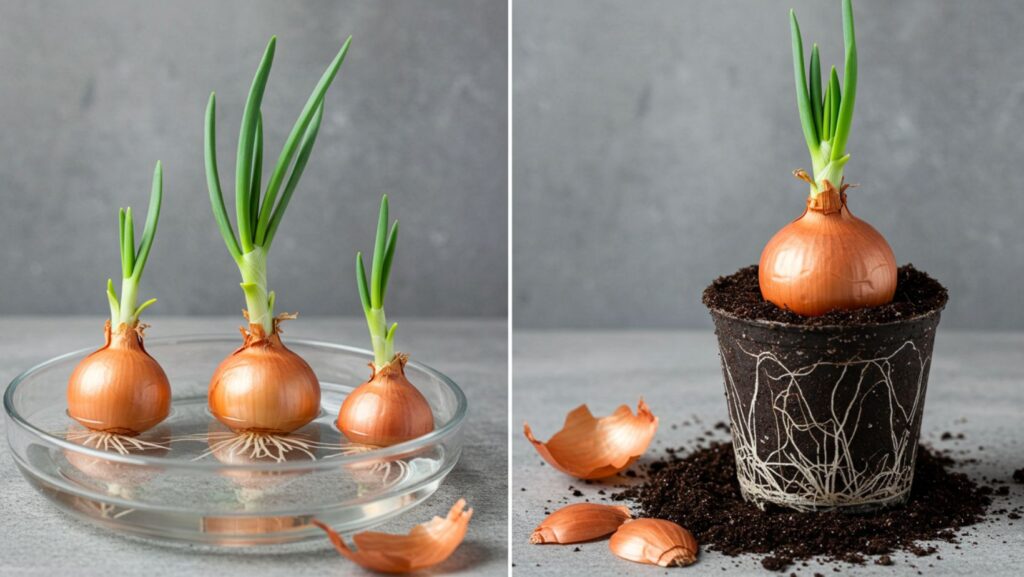
would you want to know if onions can regrow from scraps? According to my personal experience, the answer is yes; it is possible to regenerate onions from leftovers, such as the bottom of an onion or an onion that has sprouted.
The bulb onions that are used in cooking are also capable of being regrown.
The only thing that sets this procedure apart from the process of regrowing scallions is the fact that it involves planting the leftovers of these onions in soil.
You may accomplish this by planting the onion scrap outside in your garden or by placing it in a tiny pot and placing it in a window that gets plenty of sunlight.
On the other hand, that is not all; as you continue reading, I will provide you with further information on the topic.
Now, let’s get started
Can green onions regrow if cut off the root and put in water
It is possible for green onions to regenerate if the root end is removed and the onion is then put in water.
This method of propagating green onions is a straightforward and uncomplicated one, and it is frequently utilized by home gardeners and cooks who are looking for a steady supply of fresh green onions.
By following these methods, you will be able to regenerate green onions in water:
The root end of the green onion should be removed, leaving approximately one inch of the white section of the onion whole.
Put the white portion of the root end in a jar or glass of water, and make sure that it is completely immersed.
Replace the water in the jar or glass every couple of days and place it in an area that receives plenty of sunlight.
You should begin to notice fresh green shoots developing from the top of the onion after a few days have passed.
When the shoots have reached a length of around four to six inches, you may remove the tops and utilize them in the same manner as you would any other green onion.
For as long as you keep the onion submerged in water and expose it to sunshine, it will continue to produce new shoots.
It is important to keep in mind that after a number of cycles of regrowth, the green onions may become lacking in flavor and less robust.
You may prevent this from happening by planting the green onion in the soil after it has gone through a few cycles of regrowth.
Growing onions from scraps in water
Due to the fact that onions may be grown in water from scraps, it is feasible to carry out a method that is quite similar to the one described before but without the requirement of any soil or compost.
As seen above, take the root end of an onion and place it in a bowl or other container, allowing it to rest in water that is approximately one to two inches deep.
It is necessary that it is not completely immersed but rather in the water.
Sprouting will begin after the container containing the onion is placed on a windowsill that receives sunlight.
A different choice is to make use of cocktail sticks, which may be inserted into the sides of the jar, and then allow the onion to sit on top of the jar while it is filled with water.
This will ensure that the base of the onion is in contact with the liquid.
Within a week, the roots of the onion should begin to sprout out of the onion, and you should periodically replace the water to keep it fresh.
Onion that has sprouted can be planted and allowed to develop on its own.
How to Grow Onions from Scraps is easy.
A few nights later, I used another green onion and inserted it into the glass with the previous one. Once again, within a single day, there was apparent growth in the stem of the onion.
Currently, I have a little glass full of onions, and all that is required of me is to replace the water that they are in periodically.
Whenever I feel like I could use some fresh onion greens, I just cut them off or trim them as necessary.
I have started experimenting with several different “scraps,” and I will keep you all updated on what else is successful in maintaining the yields of vegetables!
Update: After a few days of growth and re-use, the onions begin to become worn out and a little bit bitter.
If you want to attempt to propagate them in a way that is healthy and might last for a longer time, it could be advisable first to start them growing in water using this method and then plant them in some soil.
How to Regrow Onions in 2 Easy Steps
First step
With your fresh yellow onion, cut off one inch from the bottom of the onion, which is the side that is closest to the root.
In addition to that, you may also utilize old sprouted onions!
The second step
Insert the roots of the yellow onion that have been sliced into a small bowl with the root side facing down.
Add just enough water to ensure that the roots are submerged in the water, but not so much that the top of the onion that has been chopped is soaked.
Should it become moist, it may begin to develop mold.
In most cases, you can prevent the yellow onion from falling over by leaning it against the edge of the tiny bowl.
Additionally, be sure to replace the water every two to three days.
It’s as easy as that!
How to Grow Onions From Discarded Onion Bottoms
Step 1: Supplies
You’ll require:
The onion
Potting Soil and a Clean Knife Cutting Board (optional)
Step 2: Cut Off the Bottom of the Onion
With all of the roots still in place, chop off the bottom of the onion. You want to leave as much of a bottom on as possible. Aim for 1.5 to 2 inches of connected “meat.”
To allow for callousing, let it dry in a well-ventilated, shady place for a few hours to a few days.
Note: Calling could take a few hours. The sliced areas may be sufficiently calloused if they feel somewhat shriveled and dry to the touch.
Step 3: Making pots
Compact the beginning pot after filling it two-thirds of the way.
To support the bottom of the onion and provide adequate soil contact, make an indentation in the middle.
Add 1-2″ of dirt on top.
Water as required.
Note: If you don’t want to bother, you can plant it straight in the ground without using the starting pot.
Step 4: Complete
Take the onion bottom out of the pot after it has a few leaves.
Take off the old onion scales.
Slice between plants, leaving some of the roots in place to separate plants as needed. A single onion bottom may give rise to many plants.
Replant in a growth bed that has been prepared.
To provide room for the bulb to grow, trim leaves to one-third of their original size. Although this may appear severe, the onion will experience less stress when growing new leaves.
Do it again. Harvest as fully grown mature onions or green onions.
What is the best time of year for growing onions from scraps
You may guarantee a supply of onions for all your culinary requirements by regularly sprouting onions from their waste.
It is, therefore, conceivable to sprout some onions for bulbs and some onions for a rapid harvest of tasty onion greens with a little forethought.
While growing onions through to bulbs is better suited to specific seasons, you can easily sprout onions to receive onion greens all year round.
What time of year is ideal for sprouting them before planting them outdoors? The best time to plant sprouting onions outside is in the spring or early summer when they will receive the six to seven hours of light each day that they need to develop into large, robust bulbs.
Onions are hardy plants that may be sprouted for planting in the fall and winter, but they are quite likely to bolt in the spring.
Speaking of ideal growing circumstances for sprouting onions, “Onions are heat-loving, full-sun plants.”
They will thrive if you plant them in tilled soil in a warm, light location.
Artificial lighting may be utilized to make up for any lack of natural light, and onions can be grown inside all year round.
A excellent solution for those without outdoor space to cultivate their onions is to grow them in pots.
How long does it take to grow onions from scraps
If you want your sprouting portion to grow into another onion, growing onions from leftovers might require a little patience.
You should anticipate waiting 90 to 120 days after starting an onion on a windowsill before harvesting it.
If you are sprouting for onion greens, the duration is much shorter; you may harvest them in a few weeks.
The time it takes for scallions to mature and be ready for harvesting is less than six weeks. In soil or water, green onions can even grow again from the same root several times.
It is possible to perform this up to five times until the energy runs out and any resulting growth is insufficient.
Final thought
Now that we have established onions can regrow from scraps, Regrowing onions from leftovers that would normally be thrown away can help you reduce the amount of food that is wasted and lead a lifestyle that is more environmentally friendly.
If more individuals are encouraged to use up the leftovers from their meals, then fewer people will be forced to rely on purchasing their food from stores.
Instead, they will be able to obtain their food from a location that is only a few steps away.
It is the buyer that continues giving; before you realize it, you will have a cornucopia of freshly produced food that comes at no expense to you other than the initial outlay, and sometimes, it is the purchase that keeps on giving.