
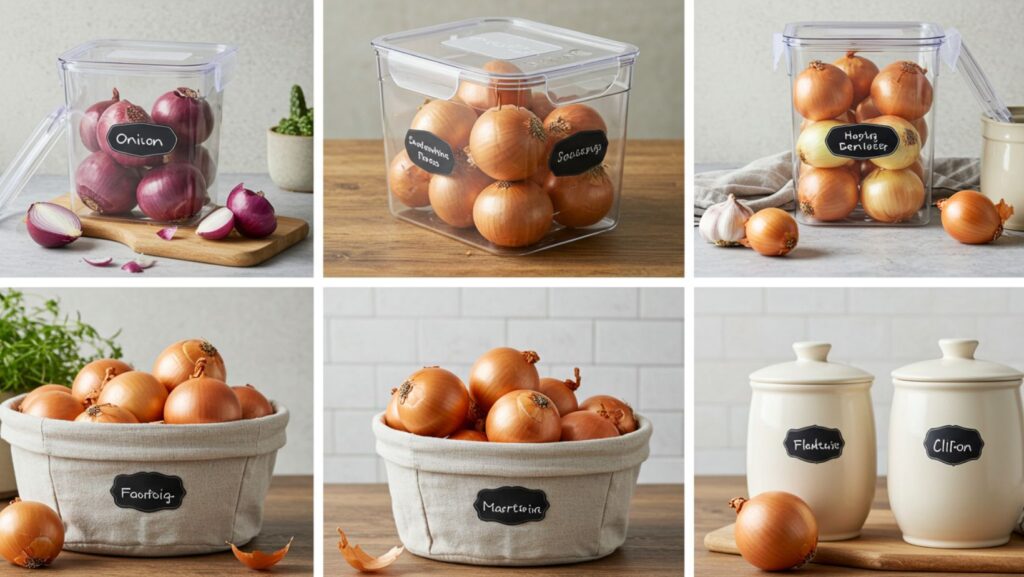
would you want to know the best onion storage container? From what I’ve seen and done, Crates, mesh sacks, or baskets allow air to circulate while storing onions.
To keep moisture out, don’t use plastic bags. Stay Out of the Sun: To stop onions from sprouting, store them in a dark spot. Check the onions for deterioration every so often.
Because I usually purchase a large quantity of onions at once, I find that the most important thing is to store them properly so that they last as long as possible.
Because an onion that has become mushy and rotten is the worst.
If you share my aversion to food waste, you’ve found the ideal spot. If you have any onion on hand, whether it’s raw or sliced and diced, here’s how to keep it fresh.
Now, let’s get started.
What is the best container to grow onions in
It is sufficient to use a pot that is at least 8 inches in diameter for onions that you intend to harvest as scallions or spring green onions.
In order to cultivate bulb onions, you will want a container that is sufficiently broad to allow for around three inches of room around each onion.
Onions are typically grown in plastic tubs or half-whiskey barrels, which are popular choices among gardeners.
What are the The 6 Best Onion Storage Containers
1. Jute Hanging Onion Basket
Try this jute hanging onion basket. It maximizes vertical space while adding a pop of modern farmhouse flair to any kitchen or pantry.
The eco-friendly jute basket hangs easily on hooks and is such a beautiful, space-saving kitchen storage idea.
You’ll want to buy up a couple extra to keep fruit and veggies. Pro tip: We recommend the big size for solid onion storage.
“They’re great quality and very sturdy,” reveals one Etsy reviewer. “I ordered a large, and it fits five tangerines, one apple and one orange.”
2. Stackable Wire Baskets
Opt for stackable pantry storage containers, like these farmhouse-style stackable wire baskets that are perfect for veggies.
The metallic black wire is robust enough to resist many pounds of root veggies at a time while keeping them sprout-free for weeks without fear.
Amazon consumers enjoy the bamboo lid that makes them stackable. Not to mention the label tag for simple organization. S
et them side by side, on top of each other, or in separate sections of the kitchen—they’re oh-so-versatile.
3. Vintage-Inspired Onion Storage Container
These vintage-like cream onion jars offer a classic complement to any kitchen decor. They’re built of robust, powder-coated sheet steel, giving a dark, temperature-controlled atmosphere.
This collection of three canisters functions as an onion, potato, and garlic keeper all in one, allowing plenty of space to hide vegetables in style. Yes, until French onion soup is made in a crock!
4. Bag for storing onions
Onions lose freshness when exposed to light. This farmhouse-style onion bag is useful. To keep onions fresher, its blackout lining blocks natural light.
It stores on the kitchen island cart and is easy to open and close with the drawstring closure. Five to eight pounds of onions fit in this onion storage holder. This genius avocado keeper is essential.
5. Two-tier bamboo baskets
Two-tier bamboo basket for stylish produce decluttering.
It can store seven pounds of fruit, veggies, onions, and potatoes on the kitchen counter or pantry shelf and ventilates from three angles. When buying produce, you’ll feel like you’re at a farmers market.
6. Onion Saver
When storing cut vegetables, this onion saver helps. This unique kitchen gadget reduces food waste by preserving freshness and preventing fridge-wide onion odor.
No more wrapping half-used onions in plastic wrap; this onion storage container is the perfect little home for partially used produce.
Choosing Which Storage Onion to Grow
The majority of storage onions are long-day types, which means that they need at least 14 hours of sunshine in order to develop their full potential.
Because of this, they are most compatible with being produced in states that are located in the north.
You should go with a short-day variety, such as Red Bull if you live in the southern region. The outcome will make you feel a great deal more content.
It is clear from the list that there are a significantly greater number of yellow storage onions available than there are red or white ones; nonetheless, it is not impossible to cultivate a combination of the two.
As a result of the fact that certain storage onions have a longer store life than others, many gardeners choose to cultivate a range of keeping onions.
Once they have harvested all of the onions, they utilize the ones that have the shortest storage life first.
This is a clever approach to assure that you will have a sufficient quantity of onions to withstand the harvest that will take place the following year.
To ensure that your onions are well established before the hot weather arrives, you should begin planting them as soon as the land is able to be worked.
When you are beginning the remainder of your seeds indoors, it is a good rule of thumb to plant your onions outside. Your onions will be more successful.
How to Store Onions
When stored in a well-aired area, such as a countertop, onions have the potential to last for up to three months.
As an alternative, you might store them in a wire basket or even a paper bag. These onion storage containers come highly recommended by us.
It is not required to store onions in the refrigerator since as soon as they are exposed to cold temperatures, their texture will become more pliable.
There are indications that the onions have gone bad, such as a softer texture and areas of dampness.
In point of fact, you should not put any of these goods in the refrigerator since doing so accelerates the rate at which they spoil.
How to Freeze Onions
What is yet more helpful method for keeping onions? Put your freezer to use!
What you need to do is not very much: Put the raw, sliced onions into a zip-top bag that is suitable for the freezer, press out as much air as you can, and then place the bag in the freezer.
If you want to prevent the onions from adhering to the bag, spread them out on a sheet pan or a shallow baking dish and freeze them for one to two hours before transferring them to a container.
When stored there, they will remain for at least half a year.
We would not advocate using your defrosted raw onions in recipes where they would be left uncooked, such as guacamole or salads; nevertheless, stews, braises, and sauces are delicious dishes that would benefit greatly from their inclusion.
Additionally, you should avoid using this bunch for caramelizing as well since they have the potential to turn quite watery after being stored in the freezer for a period of time.
You may, however, prepare caramelized onions from a freshly cut onion and then freeze them.
To store your frozen caramelized onions, you can use ice cube trays, muffin pans, zip-top bags, or any other airtight container. To put it simply, the entire world is your onion.
Final thought
Now trhat we have established the best onion storage container, It is preferable to preserve onions whole, whether they are Vidalia, Spanish, red, or even shallots.
They are naturally protected from the weather by their papery shell.
Good air circulation and removing the onions from plastic produce bags, if you use them to collect them at the supermarket, are essential since any moisture that becomes trapped around them may encourage early spoiling.
Put the container somewhere dark and dry, such as within a cabinet or the back of your cupboard.
Onions might deteriorate because of temperature and humidity changes caused by sunlight. Whole onions will be kept for six to eight weeks if they are kept properly.
Wrap securely in plastic wrap or keep in an airtight container in the refrigerator for up to a week if you have previously peeled onion or have any leftover bits you would like to preserve.
In addition to keeping peeled onions fresher, securely sealing them will stop any odors from this strong component from leaking into other things in the refrigerator.