
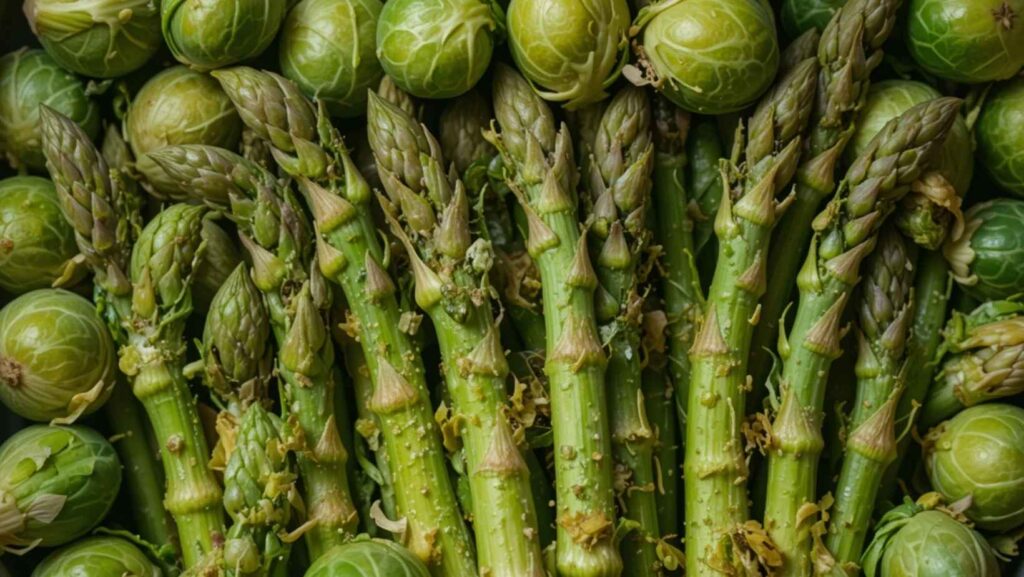
Would you like to know about Asparagus or Brussels sprouts? In my experience, asparagus contains 20 calories per 100 grams, whereas Brussels sprout contains 43 calories.
There has been a 53% decrease in calorie content. Asparagus, compared to Brussels sprouts, has a higher protein-to-carbohydrate ratio and a similar fat content.
But wait, there’s more! I’ll provide more details as you continue reading.
Here, we present further similarities and differences in the nutritional content of asparagus and Brussels sprouts.
We may begin now.
Brussels sprouts vs asparagus: what’s the difference
Vegetables are a vast and varied world, and each one has its own unique set of nutrients and health benefits.
Popular choices include asparagus and Brussels sprouts due to their high nutritional profiles and extreme adaptability in cooking.
Although they differ in composition, both are abundant in essential minerals, vitamins, and phytonutrients.
Although they may be cooked in the same way as asparagus, Brussels sprouts have a stronger flavor.
Roasting or sautéing Brussels sprouts brings out their natural sweetness and caramelization, making them a great addition to salads, roasted vegetable dishes, or as a side dish.
Is asparagus good for your health
In the long run, your immune system will benefit from eating asparagus since it promotes good intestinal transit and has draining properties.
With its low-calorie count and abundant nutrient content, this vegetable is perfect for the next sunny days when it is cultivated.
The fact that this veggie helps the baby grow and develop makes it a great ally for pregnant ladies.
Like many other veggies, this one helps reduce the risk of cancer and heart disease when eaten regularly.
What are the benefits of Brussels sprouts
Brussels sprouts are a great way to get your daily dose of minerals, including iron, potassium, calcium, and magnesium.
Glucosinolates, a group of phytochemicals linked to a decreased risk of developing certain cancers, are also abundant in it.
A high-cruciferous vegetable diet may reduce the risk of stomach, lung, kidney, breast, bladder, and prostate cancers, according to some research.
Crunchy vegetables, such as Brussels sprouts, may help ward off diabetes, high cholesterol, high blood pressure, heart disease, and other health issues.
Furthermore, Brussels sprouts contain carotenoids, which are plant pigments that may be beneficial for the eyes.
Brussels sprouts also provide other health benefits, such as:
1. Containing plenty of antioxidants that provide protection
Antioxidants are chemicals that protect by reducing the impact of oxidation; this property may make them useful in the fight against chronic illness.
The research found that reducing oxidative damage by as much as 28% was possible with a daily intake of 300 grams of cooked Brussels sprouts.
Inflammation is usually to blame for this damage, and it appears that brassica veggies are especially good at reducing the effects of inflammation.
2. It has substances that can fight cancer.
While it’s true that no single food will stop cancer in its tracks, research shows that eating a healthy, well-rounded diet can reduce your risk.
This is because glucosinolates and other anti-cancer plant compounds found in Brussels sprouts aid in the body’s detoxification and elimination of carcinogens.
3. Can perhaps encourage normal heart function
Brussels sprouts have extremely high levels of the plant compound kaempferol.
The antioxidant’s beneficial effects on heart health are only one of several health benefits that have prompted research into it.
One possible way to reduce the risk of cardiovascular disease is to consume more vegetables, especially those from the Brassica family, such as Brussels sprouts.
Is it reasonable to eat Brussels sprouts in the evening
Indeed, it is. A festive winter side dish including Brussels sprouts that even a novice cook can make!
Cabbages are the winter vegetables of the nobility! In terms of health benefits, they are abundant in fiber, vitamins, and minerals.
Brussels sprouts, which we often overlook when cooking, offer all the flavor we need when cooked correctly. Ideal for quick weekday meals, this vegetarian version of our Brussels sprouts recipe is sure to please.
Brussels sprouts have a shelf life of four to five days when stored in the refrigerator. Another option is to boil them for 10 minutes and then gently drain them.
Before cooking, make sure the cabbages are clean and remove any damaged leaves.
Despite all these benefits, you may be wondering if it’s healthy to consume Brussels sprouts every day. Not only is it safe, but you should also ensure that you eat other nutritious meals.
A varied diet is crucial for a well-rounded diet, as consuming the same foods daily might not provide the most fantastic range of nutrients.”
How many Brussels sprouts can you eat a day?
One serving (150 grams) provides all the daily vitamin C. In addition to being high in folic acid, potassium, calcium, and iron, Brussels sprouts are also good source of vitamins K and E.
• Aids in cancer prevention: Brussels sprouts, mainly when consumed in the digestive tract, can postpone or even completely prevent cancer.
Biologically significant components, such as chlorophyll and selenium, give it double the anti-carcinogenic potential of other varieties of cabbage.
It is consequently advised that those who are more susceptible to cancer consume a lot of Brussels sprouts.
This also helps when receiving chemotherapy.
• Promotes healthy blood values: Over time, the mustard oil glycosides in Brussels sprouts can lower high blood sugar and cholesterol levels.
Furthermore, the green florets’ high folic acid, vitamin B6, and iron content aid in developing red blood cells.
• Boosts immunity: Brussels sprouts’ high zinc and vitamin C content fortifies the body’s defenses against infections and microorganisms.
Many individuals regularly eat raw sprouts without experiencing any adverse health effects.
To ensure your safety, boil the sprouts in salted water for 5 to 10 minutes or sauté them in oil to eliminate germs.
Cooking them improves their nutritional absorption and digestive system even further.
How to cook Brussels sprouts.
You are unlikely to include Brussels sprouts in your diet, even if you know all their health advantages if you can’t make them taste good.
Don’t overcook Brussels sprouts, as they can become quite flavorful and pungent.
Here are some dishes to try using Brussels sprouts:
After rinsing the sprouts thoroughly, drain them. You can also boil or steam the sprouts to add a bit of texture.
Finely cut the tomatoes and onions for the salad. Add the chopped vegetables and sprouts to the mixture, along with the chat masala, pepper powder, salt, and green chilies.
Add some lime juice and coriander and stir thoroughly. Present the moong sprout salad right away.
Moong sprouts can be substituted with chana, bean, or mixed sprouts. Sprouts Bhel Bhel is a tasty, nutritious, easy comfort dish that is quite popular.
Above all, it’s simple to create. This easy and tasty recipe can be used to make these mixed sprouts. If you don’t have mixed sprouts, you can also just use bean or chana sprouts.
Final thought
Now that we have established that asparagus and Brussels sprouts are comparable, we can see that asparagus lacks far more vitamins C and K than Brussels sprouts.
Asparagus has a lot more vitamin A and vitamin E than Brussels sprouts. Vitamins A, E, calcium, riboflavin, zinc, niacin, pantothenic acid and magnesium can all be found in large amounts in Brussels sprouts.
Potassium, calcium, vitamin B6, and thiamin can all be found in large amounts in Brussels sprouts. This vegetable has a lot of iron, vitamin C, and vitamin K.
Vitamins A, E, C, Niacin, Pantothenic Acid, Vitamin B6, Potassium, Magnesium, Zinc, Calcium, and Phosphorus are abundant in asparagus.
Asparagus is an excellent source of iron, riboflavin, thiamin, and vitamin K.
For many of us, Brussels sprouts are a great addition to a diverse, well-balanced diet, as they are high in fiber and packed with nutrients.
However, you might need to control the quantity of your servings if you have a thyroid condition or a digestive ailment.