
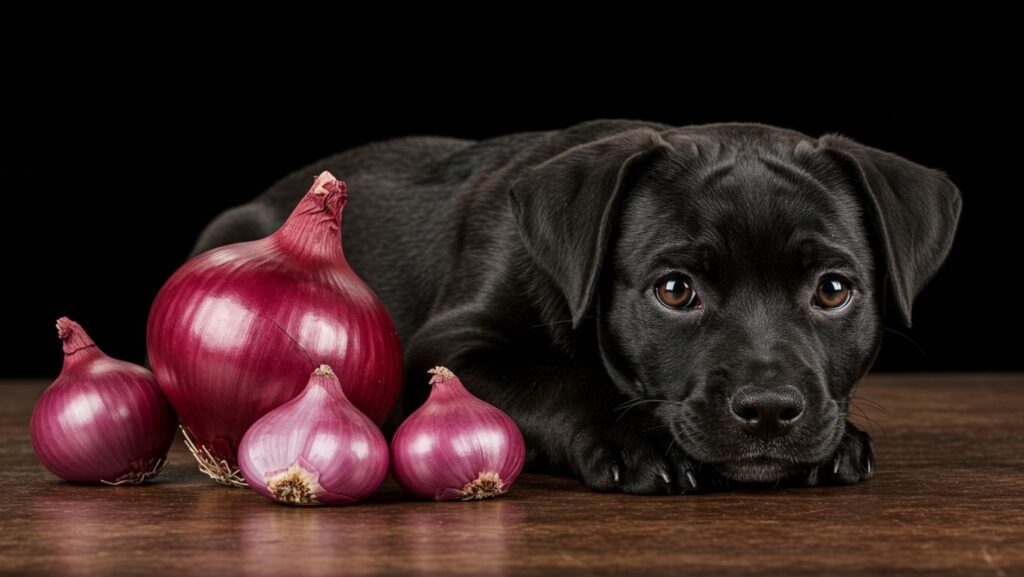
Would you want to know if red onions are safe for dogs to eat? In light of my experience No, red onions are not healthy for dogs to eat.
All onions, including red, white, and yellow ones, are poisonous to dogs and can harm their red blood cells. If your dog consumes any quantity of onions, you should call your veterinarian right away.
N-propyl disulfide is a poisonous principle found in onions. This substance breaks down red blood cells, which results in anemia in dogs.
By binding to the oxygen molecules in your dog’s red blood cells, the toxin damages them oxidatively.
But that’s not all; as you continue reading, I’ll provide additional information on the topic.
Now, let’s get started
Are onions toxic to dogs
Onions are, in fact, one of the foods that are regarded to be poisonous to dogs.
They are said to include a substance known as N-propyl disulfide, which is responsible for causing oxidative damage to the red blood cells of a dog, which ultimately leads to anemia and, in the most severe cases, death.
All components of the onion plant, including the meat, leaves, juice, and any powders that have been processed, are poisonous to dogs, regardless of whether they are raw or cooked.
The same may be said for the other members of the allium family, which includes garlic, chives, leeks, red, white, yellow, sweet, or green onions, and even garlic.
Why Are Onions Bad For Dogs
Dogs should avoid onions because they contain a toxin known as N-propyl disulfide, which is extremely hazardous to them.
This chemical causes oxidative damage because it attaches itself to the oxygen molecules that are present in the red blood cells of your puppy.
In addition, the chemical causes the body of your dog to attack its red blood cells as if they were foreign, a process that is referred to as hemolysis.
This illness has the potential to result in hemolytic anemia, which is a potentially fatal condition if it is not addressed.
Your dog may get symptoms in a short amount of time if he consumes a significant quantity of onions.
On the other hand, it is more possible that your dog accidentally consumed a lesser quantity of onions.
This implies that the symptoms of onion poisoning could not appear until a couple of days later.
Some of the symptoms that your dog may be experiencing from onion poisoning are as follows:
- Pale gums
- Urine that is discolored or black
- Throwing up
- Breathing that is erratic
- Heart rate that is elevated
- Uncoordinated movements, also known as ataxia
When it comes to onions, dogs should avoid eating them in any form, including raw, cooked, dried, powdered, and even the leaves.
How much onion is toxic to dogs
No quantity of onion is safe for dogs to consume, yet accidents sometimes occur, and we understand that.
You might be wondering how much cause for concern there is if your dog does end up eating an onion.
Even a small amount of onions, as little as 0.5 percent of their body weight, can be poisonous to dogs.
Therefore, a dog weighing forty pounds might develop onion toxicosis from consuming only 0.2 pounds (about 91 grams) of onions.
Think about what it would imply for a Yorkie that is so small!
Likely, you will not experience a great deal of difficulty if you have a larger breed of dog and they manage to steal a little piece.
Nevertheless, you should continue to keep a careful eye on them and periodically consult with your veterinarian for individualized guidance. The Pet Poison Helpline is another option for you to consider.
What are the Symptoms of onion toxicity in dogs
Be on the lookout for the following if you suspect that your dog may have consumed an onion or onion powder:
Lethargy is present. Be on the lookout for behaviors that your dog often enjoys, such as a lack of interest in playfulness, walks, and other activities.
Failing to be strong. Dogs may suffer wobbly limbs, collapse, take longer to stand or be unstable on their feet. They may also take longer to stand.
Appetite that has decreased. It is possible that your dog will not be interested in food and treats or that they will completely refuse their favorite meals.
Pale gums. Any discoloration of your dog’s gums that is not typical has the potential to be an indication of a problem.
Passing out. Be on the lookout for any rapid loss of consciousness in addition to monitoring your dog’s overall response.
Reddish urine. An indication that anything is awry is the presence of a red or pink discoloration in the urine of your dog after it has been exposed to onion.
Throwing up. Symptoms such as drooling and dry heaving are commonly observed in dogs prior to the onset of vomiting, and these behaviors might all be indicators of a more serious health issue.
Heart rate that is elevated. Larger dogs have a heart rate that is around 70 beats per minute slower than smaller dogs, who have a heart rate that is approximately 120 beats per minute quicker.
If a dog’s heart rate is noticeably fast, it is important to take them to the veterinarian.
Inhaling deeply. Even though heavy panting is a natural behavior for dogs who are stimulated, it may be an indication of a more serious issue if other symptoms accompany it.
What are the ways of Treating Onion Poisoning In Dogs
To avoid organ failure, transport your dog to the closest emergency veterinary facility as soon as possible if they consumed onions.
Your dog should be examined by a veterinarian even if you don’t believe they ate enough to cause harm.
Furthermore, you should still see a veterinarian to make sure your dog hasn’t eaten too many onions if you’re not sure whether they did.
Using blood samples, a veterinarian can usually diagnose onion toxicity with ease.
To be safe, your veterinarian will probably induce vomiting without testing if you are certain that your dog had onions within the past two hours.
It’s critical to induce vomiting as quickly as possible since the longer the poison remains in your dog’s body, the more harm it might do.
However, vomiting can only be induced within the initial hours after consumption, before the dog begins to metabolize the poison.
Call a veterinarian and ask them to demonstrate how to induce vomiting properly if you have to do it at home. Additional remedies for canine onion poisoning include:
Activated charcoal
Blood transfusion 2 IV fluids
Fortunately, the majority of dogs that undergo therapy recover from minor onion poisoning without any lasting consequences.
Naturally, prevention is the best way to address onion poisoning. Never give your dog any garlic or onion.
Final thought
Now that we have established that red onions are not safe for dogs to eat Due to the fact that dogs are frequently oblivious to the quality of the food they consume,
we need to exercise caution when selecting the kinds of snacks and table scraps that we give them to eat since they could include components that are hazardous to dogs.
Onions are a typical meal that should be avoided while doing so with dogs. Onions, in any form, including onion powder, pose a significant health risk to canines.
It is not a good idea to combine onions and dogs since they have the potential to make them severely ill and are extremely harmful to their health.