
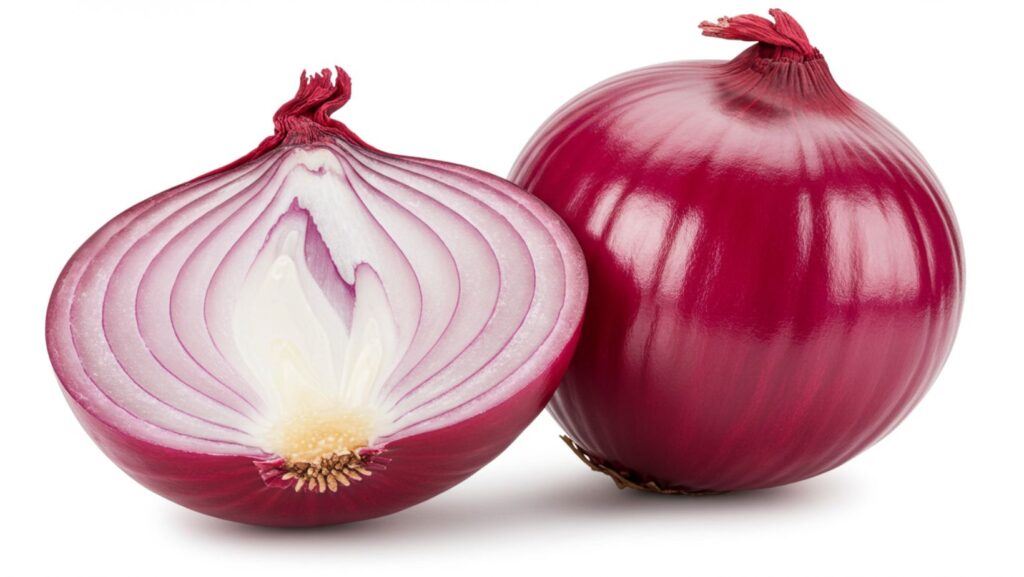
Would you want to know if red onions have low FODMAP? There is no evidence to support the claim that red onions are low in FODMAP; rather, they are classified as high in FODMAP.
Every type of onion, including red onions, white onions, and brown onions, has a high FODMAP content.
Garlic, shallots, and red onions can be reintroduced into your diet if you do not experience any adverse effects after consuming fructans.
You are in a really fortunate position since you are able to reintroduce onions if fructans and GOS are not a concern.
However, that is not all; as you continue reading, I will provide you with further information on the topic matter.
Now, let’s get started
Low FODMAP Onions
You should be aware that there are onions that are low in FODMAPs. We had previously believed that all onions included a high concentration of FODMAPs; however, additional research conducted by Monash
large pickled onions contain a low amount of FODMAPs, but tiny pickled onions contain a high amount of FODMAPs.
In comparison to little pickled onions, which are high in fructose, large pickled onions have lower quantities of fructans in their composition.
As to the distinction, why? It is believed that the process of canning huge onions produces a reduction in the number of water-soluble fructans, which in turn results in lower levels of FODMAPs in large pickled onions.
Pickled onions that are smaller in size are not treated in the same manner as larger onions in order to allow the FODMAPs to leach out; rather, they are just put in the vinegar rather than subjected to lengthy processing in the vinegar.
Are green onions or scallions low in FODMAP
Additionally, depending on the section of the onion that is utilized, green onions may have a low FODMAP content.
As a result of their low levels of FODMAPs, the green tops of scallions and green onions can be utilized to impart a flavor similar to that of onions while adhering to a low FODMAP diet.
Because of its high FODMAP content, the white component of the green onion, often known as the bulb, should be avoided during the low FODMAP diet.
How to enjoy onions on a low FODMAP
the diet In spite of adhering to a low FODMAP diet, it is still possible to take pleasure in the flavour of Australian onions.
Since fructans are not fat-soluble, you may use oil to impart the flavor of onions into your food. This will result in delightful onion flavors.
In this manner:
Include big onion pieces in foods that are prepared with oil, such as stir-fries or vegetables that are roasted.
After cooking, the onion should be removed before the meal is consumed.
In order to improve the taste of your homemade salad dressing that is based on oil, you should use slices of onion.
You need to remove the onion before using it. Alternatively, you might use a frying oil that has been infused with onion.
Because fructans are water soluble, it is advisable to avoid adding onions to foods that are dependent on water, such as casseroles and soups, as much as possible.
Why are onions high in FODMAP
Because they contain a substantial quantity of fructans, onions are regarded to be high in FODMAPs.
Fructans are a kind of carbohydrate that is poorly absorbed by the small intestine, which leads to fermentation by gut bacteria.
This fermentation can cause digestive discomfort, such as bloating and gas, in persons who are sensitive to FODMAPs.
Moreover, Onions are a rich source of fructans, which are chains of sugar that are difficult for the body to break down.
Onions are a concentrated supply of fructans.
Bloating, gas, and diarrhea are among the symptoms that can be brought on by fructans (also known as fructans).
The following are some important considerations regarding onions and FODMAPs:
• Fructans are the culprit: The primary FODMAP component found in onions is fructan, which is a complex sugar that the majority of individuals do not have the enzymes to break down properly.
• The fermentation process in the gut: When undigested fructans make their way to the large intestine, bacteria in the gut quickly ferment them, which results in the production of gas and causes digestive problems.
In the case of individuals who suffer from Irritable Bowel Syndrome (IBS), it is frequently seen that the consumption of foods that are rich in FODMAPs, such as onions, might exacerbate their symptoms.
How to avoid onions on a low FODMAP diet
During your time on the low-FODMAP diet, you should steer clear of any onions, especially red onions.
A word of caution: stay away from spices like spice mixes and blends that include onion.
Those sauces, gravies, and salad dressings that could include onion should be avoided at all costs.
Put in a request for dishes that do not include onion.
Why is onion a problem on the low FODMAP diet
In addition to fructo-oligosaccharides, which are more popularly known as fructans, onions also contain fructans.
Onions, garlic, wheat, rye, barley, and artichokes are all examples of foods that contain fructans, which are a kind of short-chain carbohydrate.
Because humans lack enzymes that are capable of breaking down any of the oligosaccharide sugar groups, these sugar groups are difficult to absorb in the small intestine.
As a result, they are fermented by the bacteria that live in the gut, which can result in symptoms of irritable bowel syndrome (IBS) in those who are vulnerable to developing the condition.
Onion consumption might result in very unpleasant symptoms of irritable bowel syndrome (IBS).
In the course of the FODMAP elimination phase, it is strongly suggested that you eliminate all forms of onion from your diet, including fresh, minced, and dried onion.
This indicates that you should check any packaged goods, sauces, and dry spice mixes such as curry powder, five spice, and chili powder for the presence of onion that has been added since even a small amount might be considered excessive.
During the reintroduction phase, you may then test the fructans and onion to see if or not you are able to add tiny quantities back in
How do you replace the onion flavor while eating low FODMAP
When following a low-FODMAP diet, there are several ways to substitute the flavor of onions:
Use leek or spring onion green tips.
Similar to onion bulbs, leek bulbs, and white spring onion bulbs also contain fructans.
This implies that you should only utilize the dark green tops of the leeks and spring onions, and you should stop chopping them when the color begins to lighten.
Before adding other spices and herbs to the recipe, I usually fried the green tips, much as you would an onion.
As a low-FODMAPS substitute for onions, chives provide food with a subtle onion flavor with a touch of garlic.
Final thought
Now that we have established that red onions are not low FODMAP, Both garlic and onion are found in some condiments, sauces, marinades, and dips.
If you are uncertain about their FODMAP content, ask for them individually or on the side.
Marinades and sauces made with garlic or onions, as well as vegetarian mince, are high in FODMAPs.
Some low FODMAP possibilities are chutney, cranberry juice, barbecue sauce, mayonnaise, and soy sauce.