
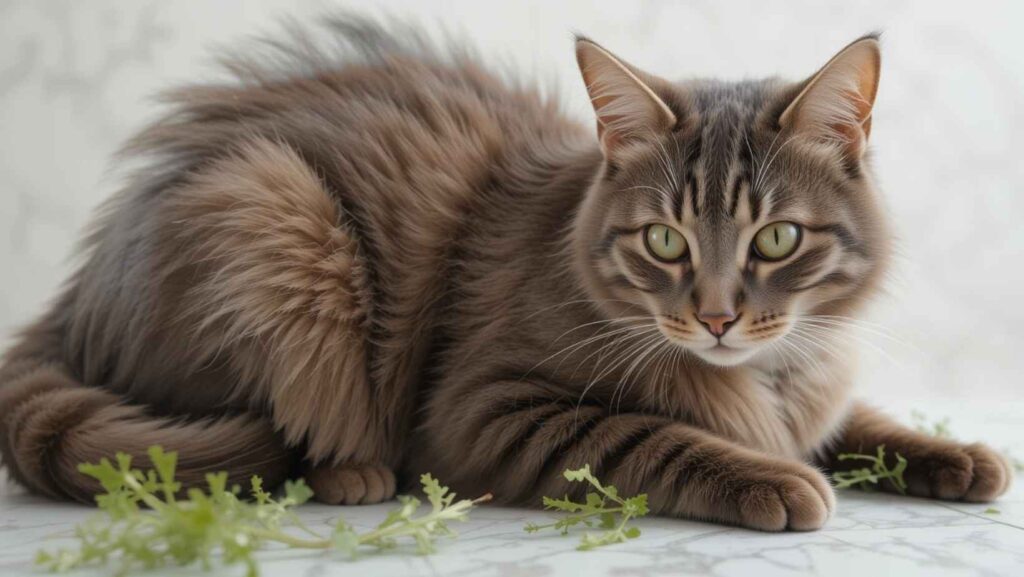
Would you want to know if celery injured the cat?
When given in moderation, celery may be a safe and healthful treat for cats if they’re even interested in this veggie.
It has vital vitamins and minerals, including potassium, vitamin K, and folate that help improve their general health.
Cats appear to obey no rules, even being unpredictable regarding their tastes! You never know if they’ll like celery unless you give it to them.
You may have observed that your cat adores chewing on some materials, such as wood, furniture, or cardboard.
Celery is one of those foods; your cat could like its nice crunch.
An excellent way to engage your cat’s brains and taste buds simultaneously is to dangle some celery from your palm!
Anecdotal data suggests that cats respond to celery leaves like they would to catnip—that is, by rolling, scratching, and vocalizing ridiculous things.
The leaves of celery can have a catnip-like effect and are highly fragrant.
Celery has the lactone sedanolid, which can have a comparable effect, even though it lacks nepetalactone, the stimulating compound in catnip that causes cats to act intoxicated.
It’s conceivable for your cat to show zero interest in celery or develop an obsession with it. You have to give it a go to find out! Celery has long been regarded as a wholesome food.
The verdant, leafy stalks are abundant in antioxidants, vitamins, and minerals.
Thanks to its delightful crunch, it’s also a terrific guilt-free, low-calorie snack choice.
Celery is thought to be safe for humans, but cats are not like us at all.
Celery is edible to cats!
But celery isn’t a substitute for a diet that is well-balanced. Celery should not be a substantial portion of a cat’s regular diet; pet parents should consider it an extra treat.
Cats must consume meat as they are obligate carnivores. Cats may get quite sick without meat and various vitamins and minerals in the right amounts.
But you may offer celery to your cat if you cut it into the right amounts for a nutritionally balanced diet.
Why do cats rub on celery
You may have noticed that cats are drawn to the leaves that emerge at the top of celery stalks and may even desire to rub them against their faces.
This is because celery leaves function similarly to catnip for cats!
This cat rolls, rubs, and vocalizes while consuming celery leaves as though they were catnip.
I had never heard of this reaction before, so I decided to experiment on my menagerie and encourage others to report their experiences with comparable at-home experiments with celery leaves.
Scent glands may be found on a cat’s belly, between its toes, and beside its tail.
Pheromones are released when a kitten kneads on its mother’s stomach while consuming milk.
Pheromones are also released when a cat scratches on your couch or a scratching post.
Carnivores include cats.
So, they are not expected to be fed fruits and vegetables daily.
Even most of the veggies are poisonous to them.
However, celery is one of the few foods suitable for humans.
Cats are notoriously picky animals that take time to get up to new people.
Sometimes, a mutually committed friendship between a cat and its pet parent takes months or even years to develop.
Even once this link is formed, you will need to be able to read your cat’s body language to interpret what it is trying to tell you.
Cats frequently communicate secretly by rubbing against humans or other animals, moving their tails, and blinking their eyes.
Scent glands may also be found all over a cat’s face, particularly around the lips, forehead, and cheeks.
Known as feline face pheromones, those scent glands generate five distinct pheromones.
Why is my cat attracted to celery
The leaves of celery can have a catnip-like effect and are highly fragrant.
Celery has the lactone sedanolid, which can have a comparable effect, even though it lacks nepetalactone, the stimulating compound in catnip that causes cats to act intoxicated.
Cats may safely eat celery as a snack.
Veterinary specialists attest that your cat is not at risk of poisoning from this crunchy vegetable.
Celery is high in nutrients and fiber and may even help cats with certain digestive problems.
But keep in mind that cats are obligate carnivores, so meat should make up most of their diet, with occasional treats like celery.
Cats may safely eat celery stalks, but what about the leaves?
No need to be alarmed if your cat chews on one or two leaves.
On the other hand, consuming excessive celery leaves may cause unpleasant stomach symptoms, including diarrhea and vomiting. Kidney failure might potentially result in severe situations.
Can cats eat raw celery
Once you’ve established that your cat likes celery and doesn’t respond negatively, you may give them up to ¼ cup of finely chopped celery every week.
It is always served plain—never seasoned—either raw or cooked.
Celery has long been regarded as a wholesome food.
The verdant, leafy stalks are abundant in antioxidants, vitamins, and minerals.
Thanks to its delightful crunch, it’s also a terrific guilt-free, low-calorie snack choice.
Celery is thought to be safe for humans, but cats are not like us at all.
A good supply of vitamins is found in celery, which is helpful for your beloved kitty.
Additionally, the vegetable is strong in fiber, which is beneficial for any cat with digestive problems.
Celery can help your cat’s kidneys operate and has diuretic properties.
As a bonus, you may find that cats are drawn to the leaves that emerge from the tips of celery stalks and may even feel the need to rub them against their faces.
This is because celery leaves function similarly to catnip for cats!
The simplest response is that cats may safely eat celery, which provides your pet with various beneficial nutrients.
Celery is high in health benefits for people; the same is true for cats.
While celery cannot completely replace a cat’s diet, it may make a delicious supplement to their dry cat food.
What vegetables are toxic for cats
While cats may consume veggies, they should avoid foods like onions, garlic, leeks, scallions, shallots, and chives since they can cause digestive issues and even damage red blood cells.
Additionally, garlic bread that includes these herbs and vegetables should be avoided.
If vegetables had the flavor and aroma of bacon, more people would be inclined to eat them.
Let’s be honest: even if broccoli tastes delicious, the scent of its cooking isn’t very pleasant.
The good news is that most of our dogs are not as demanding as we are, which is something we appreciate!
Cats who consume raw meat or eggs may get salmonella or E. Coli illness, just like people.
The sickness can cause symptoms such as tiredness, vomiting, and diarrhea.
Humans can contract E. Coli and salmonella, so ensure you wash your hands well after handling raw food and keep your cat away.
Additionally, an enzyme in raw eggs may cause issues with the skin and coat.
Also, avoid giving your cat uncooked bones to eat since this might lead to choking, blockage of the digestive system, and tooth damage.
Although your cat might like milk, it’s not always healthy. The lactose in milk is difficult for cats to digest, leading to upset stomachs and diarrhea.
Most cats aren’t exposed to lactose until they become kittens, which comes from their mother’s milk.
For a few weeks, kittens are the only ones that drink from their mother’s milk. Thus, their digestive systems are frequently unprepared to tolerate the reintroduction of lactose.
Therefore, even if some cats can drink milk without any problems, they are not advised to do so once they are weaned since it may cause stomach problems.
Can my cat eat rice
Yes, cats can consume modest amounts of rice.
A small amount in their food won’t hurt them because it’s non-toxic, but you shouldn’t feed them too much because it’s not a necessary component of their diet.
When a dog or cat is sick and needs food that won’t disturb their stomach, rice is given to them.
Fish meat can contain parasites*, but it doesn’t need to have any seasonings or flavors, so you can skip the rice and serve the cooked fish.
Meat is also good, but again, no seasonings or spices.
Onions and garlic are particularly bad for dogs and cats, though I’ve read that garlic is okay for dogs in very small amounts so I would avoid it completely.
One of the most widely consumed grains in the world, rice is a seed that may be prepared and consumed in many ways.
Your cat should eat foods high in nutrients, some of which can be found in rice.
Although additional components are also suggested to provide your cat with the other nutrients necessary to be happy and healthy, rice is an excellent basic ingredient in a balanced cat food product.
Although cooked rice has no health risks, it should be noted that this statement only applies to cooked rice.
Your cat may not benefit from any additional ingredients that people might find enjoyable, such as salt or soy sauce (which also contains a lot of sodium).
Even while including vegetables in your cat’s diet, such as carrots or peas, provides nutritional benefits, it’s still advisable to see your veterinarian before adding anything new.
Can cats eat rice and milk
While white rice is okay for your cat, rice pudding contains dangerous elements like milk and sugar, so you should never serve them.
The health of your cat may suffer from these components.
Since many cats are lactose intolerant and may have stomach problems if they drink milk, it is usually not advised to offer milk to cats.
Regarding rice, it should not constitute a substantial portion of a cat’s food, but it can be added to their diet in moderation.
Since cats are obligate carnivores, meat should make up most of their diet.
It’s better to seek individualized guidance from a veterinarian if you have specific concerns regarding your cat’s nutrition.
Nearly half of the world’s population is dependent on rice, making it one of the planet’s most significant and ancient food sources.
You may be concerned if your cat has gotten their hands on some rice, or you may be pondering whether rice would benefit their diet!
Conclusion
Because celery has a high fiber content, it will support your cat’s healthy digestive system.
In the wild, when cats consume their whole meal of prey, elements such as bones, hair, and stomach contents behave similarly to fiber in the digestive tract.
Your indoor cat should consume some fiber in their diet if these conditions are not met.
Celery is 95% water, which also helps to keep things flowing to avoid.
Cats can benefit from celery in moderation. First, it has ingredients known as luteolin and apigenin, which are antioxidants that reduce inflammation (1) and are commonly utilized in Eastern medicine.
Because of how the molecules in celery interact with cells, there has been talk of using them as a potential cancer therapy.
Eastern medicine has been using celery seeds for thousands of years.
It has been used to treat arthritis, soothe nerves, lessen inflammation, regulate blood pressure, and other conditions in people.
Please consult your veterinarian before giving your cat any herbal supplements, such as celery seeds, since they may contain high concentrations of substances that might harm your cat, depending on their health and medical history.
Celery may be a terrific treat for your feline buddy in small amounts.
They could enjoy its crisp mouthfeel or scent, which has certain health advantages.
Your cat may start purring if you hold a little slice of celery in front of it. Chewing pleasure!