
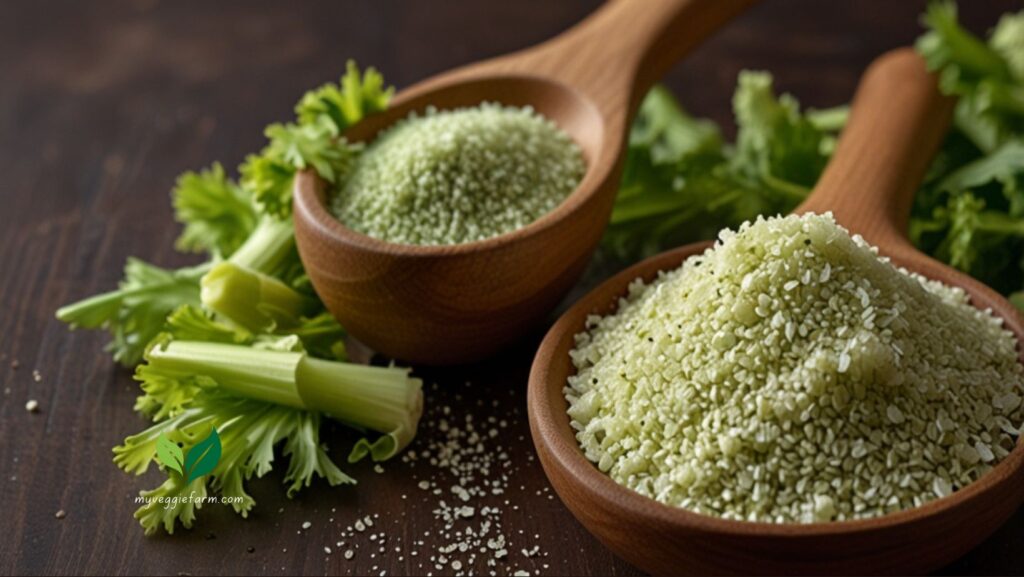
Would you be interested in knowing where celery salt comes from? From my research, I see that the United States has the highest celery salt volume in the world.
Celery salt is a seasoned salt that is used to flavor meals. Ground celery or its cousin lovage seeds are used as a flavoring agent, and table salt is the main component.
Occasionally, seed oleoresin or dried celery is also used in its production.
Celery seeds and salt are combined to make store-bought celery salt; certain types may also contain dried celery leaves and stalks.
One spice frequently used to flavor soups and salads is celery salt. The lovage and celery plants’ seeds are crushed and used as a thickening agent in soups.
Sea salt or plain table salt can be used to make celery salt. Celery salt complements a variety of dishes with its acidic, slightly salty flavor.
Celery may not have an extraordinarily high salt level, but it does have a greater sodium content than many other vegetables.
Celery does, however, still have a low salt content overall and is a good source of fiber, vitamins, and minerals.
If you’re worried about your salt consumption, it’s crucial to consider your eating habits and seek the opinion of a healthcare provider.
Find out if celery can make you sick.
Where does celery originate from
Its alleged birthplace is the Mediterranean. In the fifth century after Christ, it appears in Chinese literature.
A study detailing celery’s benefits and medical applications, composed in France or Italy in the ninth century, is the earliest known usage of the term.
The herb Apium graveolens is a member of the Apiaceae family, often known as celery.
Celery is commonly enjoyed in its cooked vegetable form or used as a subtle seasoning in various soups, casseroles, and stocks.
American appetizers and salads often use raw celery alone or accompanied by dips and spreads. American celery is second to none.
It is the top exporter worldwide, with Mexico and Spain following closely behind (according to the World Integrated Trade Solution).
Since celery is said to have originated in the Mediterranean, it stands to reason that it does best in the coastal environment of California.
Currently, 80% of the US celery comes from California, which grows on around 28,000 acres. The remaining 20% comes from Mexico, Arizona, Michigan, and Florida.
In 2022, the United States, Mexico, and Spain were the top three nations exporting celery, fresh or chilled (excluding celeriac), totaling $92.3 million, $90.5 million, and $89.6 million, respectively.
Is celery salt healthier than regular salt
Dried and powdered celery seeds are combined with normal salt to create celery salt, a seasoned salt.
The same plant from which celery stalks are harvested and consumed as vegetables also yields celery seeds.
On the other hand, the flavor of celery seeds is intense and highly concentrated.
The small seeds are ground into a powder and combined with salt to create a flavor with a distinct (and delicious, if you’re feeling fancy) celery taste.
The salt makes sure the mixture coats and distributes evenly over meals. The earthy, aromatic celery flavors are combined with the salty flavor we anticipate from salt.
Celery salt can be utilized anywhere a salty flavor is needed in savory recipes.
It works well on any surface that regular salt works well on.
The primary distinction is that whereas salt is combined with nothing but itself, celery salt combines salt and celery seeds.
Sodium and chloride combine to form the chemical molecule known as salt (electrolyte). It is the primary source of salt in our diet and is frequently used to flavor and preserve food.
The body needs sodium to assist in controlling fluid levels, but a natural diet high in nutrients usually contains plenty of sodium without extra salt.
What is celery salt good for in cooking
Celery salt tastes great on eggs, green beans, soups, yogurt, and buttered corn on the cob.
It tastes fantastic on salads like this buttermilk farro salad, shaved fennel salad, macaroni salad, and egg salad.
Most people, particularly brunch lovers, are familiar with celery salt as the rim of a Bloody Mary glass.
You know how it is when you refuse to take a drink from your friend’s Bloody Mary when they ask, but you still want to lick the rim? That’s the talking celery salt.
However, there are a ton of more uses for this condiment besides brunchtime buzz.
Other well-known spice combinations that use celery salt include: Rumor has it that it is a component in KFC’s flavor and is used in Old Bay, which is fantastic on seafood.
The subtle, earthy flavor of celery salt complements potato and egg salad well and is essential for Chicago-style hot dogs.
You may apply the substance to anything that needs a little zing or zip. I occasionally sprinkle it on myself to feel a bit more zing.
All I want is a comparable combination with my other favorite flavors, pepper and lemon.
When celery leaves or stalks are unavailable or don’t work well in a recipe, celery seed can be added to provide celery flavor.
Pickled veggies are frequently made with celery seeds. It may provide an herbal or vegetable taste to soups and stews.
Because of its powerful flavor, celery seed should only be used sparingly.
Conclusion
People have been using celery for a long time. It is referenced in the 850 BC Homer’s Odyssey! But it was already being grown for its therapeutic properties even before then.
Chinese texts from the fifth century also referred to celery.
This plant’s volatile oils play a major role in its therapeutic efficacy.
All of them are included in the seeds. Indian Ayurvedic medicine has been using celery seeds since ancient times.
These days, other than the United States, salvage is grown in Western Asia and Europe.
Both supplements and spices made from the seeds are available for purchase.
Although it might be challenging, growing garden celery in tropical climes is not impossible. Planting celery in the cooler months in your location is your best bet.
Additionally, place them where they will get at least six hours of sunlight.
If you cultivate your celery, you may be able to enjoy delicious stalks all summer long until the first frost.
Compared to commercial varieties, garden-grown celery is considerably tastier, more flavorful, and contains fewer chemicals.
Although certain short-season cultivars are available, celery requires a long, somewhat chilly growing season to produce beautiful and tall 12- to 18-inch stalks up to 140 days before harvest.
It thrives in colder climates and plants best in the early spring. Plan to plant around the middle to end of summer in warmer climates.
Celery is known to be difficult to grow at home, but because it works so well in soups, salads, stews, and stir-fries, it’s a staple in our gardens regardless of its reputation.
Although celery is usually planted as an annual, it is thought to be a hardy biennial.
Starting celery from seed indoors is the best option.