
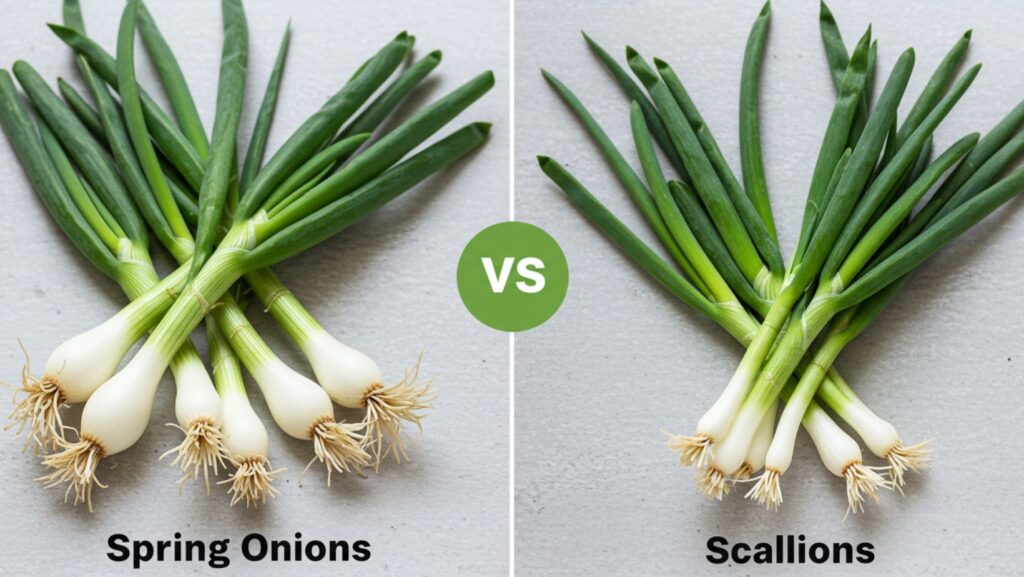
would you want to know what’s the difference between Spring onions vs scallions? Based on my experience, “Spring onions” and “scallions” are frequently used interchangeably, yet they denote the same vegetable at distinct growth stages.
Spring onions are harvested earlier, possessing a smaller, more developed bulb, which renders them slightly sweeter and milder than the more mature, slender white bulb of a scallion, characterized by a sharper onion flavor;
thus, a spring onion is essentially a younger variant of a scallion.
Spring onions are immature onions picked at the onset of bulb development. The entire plant, including the bulb and young stalks, is exceptionally sensitive.
Scallions possess an elongated white shaft, do not form bulbs, and become tough if allowed to remain in the soil for an extended period.
However, as you continue reading, I will provide greater education on the topic area.
Now, let’s get started
What are scallions
Young onions, also known as scallions, are collected before the bulb grows and are harvested at an early stage.
However, there are some sorts of scallions that originate from “bunching onions” that do not develop into bulbs whatsoever.
The white stalks have a flavor that is similar to onions in that they have a strong bite, whilst the leaves have a flavor that is more moderate and fresh.
Long and with a white stem end that does not protrude outward, scallions are a kind of onion.
They have a bite that is similar to that of onions, although it is not as strong as the bite of conventional onions (the white sections of the onion contain the most powerful taste).
They are edible in both their raw and cooked forms, and while some chefs choose to throw away the darker green tips, the entire plant can be consumed.
It is typical practice in Asian cookery to incorporate darker green tips.
Scallions are often available throughout the entire year. Check for a vibrant color, leaves that are not damaged, and stem ends that are sturdy.
What is Spring onions
These immature green onions are plucked before the white bulb has had the opportunity to develop properly and before it has reached its delicate state.
They are gentle and have a long, thin neck that is white and hollow green tips, which are the leaves.
It is possible for an onion to have a variety of flavors; there is no one way to categorize it;
it may be intense, subtle, fragrant, tear-inducing, acidic, salty, bitter, sweet, and a great deal more.
Spring onions, on the other hand, have a more mild flavor, and they almost never have a very pungent flavor. They are also suitable for eating raw due to their sweet flavor and soft texture
Whether they are employed as the foundation of a soup, a rice dish, or a noodle dish, onions lend a sense of texture and flavor to all dishes in which they are put to use.
In addition, onions may be consumed raw, which complements a variety of major meals.
Conversely, spring onions, comprising both bulbs and leaves, may be consumed raw in salads, utilized as a garnish, or cooked as an ingredient in stir-fried dishes throughout Asian and European culinary traditions.
In spite of the fact that we are unable to determine which type of onion is superior, we can say that both onions and spring onions provide us with their own unique set of health advantages.
Both vitamin C and calcium may be found in healthy amounts in spring onions.
In addition, they are an outstanding provider of dietary fiber, vitamin A, and vitamin B6, as well as a collection of minerals.
In contrast, onions contain chemicals and antioxidants that help reduce inflammation and cholesterol levels, both of which contribute to a reduction in the risk of cardiovascular illnesses.
Are Scallions and spring Onions the Same Thing
The term “green onions” refers to the same thing as “scallions.”
It is common practice to use the terms “scallion” and “green onion” interchangeably when referring to members of the Allium cepa species who exhibit the following characteristics:
Vegetables that are long and delicate
Unyielding white stalks that lack a bulb around half an inch in diameter or less
Roots that are whitish and stringy
Clusters of plants that are harvested at an early age. Additionally, they are referred to as “bunching onions.”
What’s the Difference Between Scallions and Spring Onions
The phrase “spring onion” is typically used to describe young common onions that are harvested in the spring or summer when their leaves are soft and green and their bulbs are around one inch in diameter.
During the spring and summer months, spring onions are frequently seen at farmer’s markets. Although spring onions typically have white bulbs, they can also have bulbs that are purple or yellow.
The best way to store spring onions is in the refrigerator, in contrast to mature onions, which are often dried.
When spring onions are sliced thickly and sautéed until they are soft, they become noticeably sweet.
This is despite the fact that the raw bulbs of spring onions have a more pronounced flavor and a more pronounced bite than scallions.
Roasting spring onions whole is another option, as is using them in dishes such as frittata, soup, and ragout.
When it comes to stir-fry recipes, spring onions, both the white section and the green stalks, are excellent ingredients.
How to Prepare Scallions
Throughout the year, scallions are available at the majority of supermarket stores.
Here are some suggestions for shopping:
Choose scallions that have leaves that are crisp and vibrant in color.
Trim the points at the top and bottom, and then rinse them with water. Both the green and white sections of the plant can be consumed.
If you want your onions to be as fresh as possible, store them in the refrigerator.
On salads and stews, scallions are frequently used as a component of the garnish. They may, however, be enjoyed in a wide variety of various ways!
They ought to be grilled in their entirety. To get a flavor that is simultaneously sweet and charred, apply olive oil, season with salt and pepper, and grill for a few minutes.
Pulverize them. To make the scallions, place them in a blender and add eggs, flour, and a little bit of soy sauce. Blend until smooth.
They have a flavor that is comparable to that of scallion pancakes that are provided at Chinese or Korean businesses.
They are best served with asparagus. When you want to roast these spears in the oven in the future, you should also include some scallions.
Because of the heat, the bite of the onions will be tempered, and they will become a delicious side dish.
Savor each one. The creamy soup known as vichyssoise, which is often prepared with leeks and potatoes and consumed cold, should be prepared. Change the onions or leeks in the recipe to scallions.
Where Did Scallions Come From
The term “scallion” derives from the Greek word “askolonion,” referencing the ancient port of Ashqelon in Palestine, believed to be the birthplace of the onion.
It is now common knowledge that onions originated in central Asia, yet the name has persisted.
To add insult to injury, the askolonion is also the origin of the name shallot, which can be used to refer to scallions in countries like as Australia, Canada, and the United Kingdom, but in the United States, it refers to an entirely other species. Is your skull being scratched?
It is quite possible that these mild and fragile alliums gained popularity as normal onions that were harvested early in the growing season, before the completion of their bulb development and the drying out of their green leaves.
These days, growers cultivate a wide range of onion types that have been particularly engineered to be harvested at this stage.
Some examples of these kinds are Evergreen Hardy White and White Spear.
In spite of the fact that they belong to the same species as the ubiquitous bulb onion, these scallion variants, which are sometimes referred to as “bunching” owing to the fact that they grow in little clusters, may be cultivated throughout the year, and never develop into a real bulb.
These types are the ones that are sold in supermarkets, and they are branded as both scallions and green onions.
What Are the Health Benefits of Scallions
Scallions contain several nutrients.
Riboflavin, or vitamin B2, is necessary for energy synthesis and metabolism.
Blood coagulation and healthy bones and muscles require vitamin K.
Ascorbic acid, or vitamin C, boosts the immune system.
Calcium maintains tooth and bone structure.
The oxygen that is carried from the lungs to the rest of the body is carried by hemoglobin, which contains iron as one of its components.
Potassium ensures that the kidneys, heart, muscles, and nerves are all in good health.
Food fiber reduces the likelihood of developing diabetes and cardiovascular disease.
Among the many nutrients that may be found in the green tops of scallions are:
Vitamin A is considered to be beneficial to both the immune system and eyesight.
Specifically, vitamin B6 is involved in both the metabolic process and the immunological system.
Phytonutrients, often known as antioxidants, are a vast category of substances derived from plants that are beneficial to one’s general health.
Final thought
Now that we have etsbalished the difference between Spring onions vs. scallions, On the other hand, spring onions are considered to be immature onions and are collected throughout the spring to the summer season.
Spring onions are gathered during the spring season. It is made up of a bulb that seems to be smaller and is either white or yellowish, and it has soft, long leaves that are tasty.
The aftertaste and scent are both pleasant.