
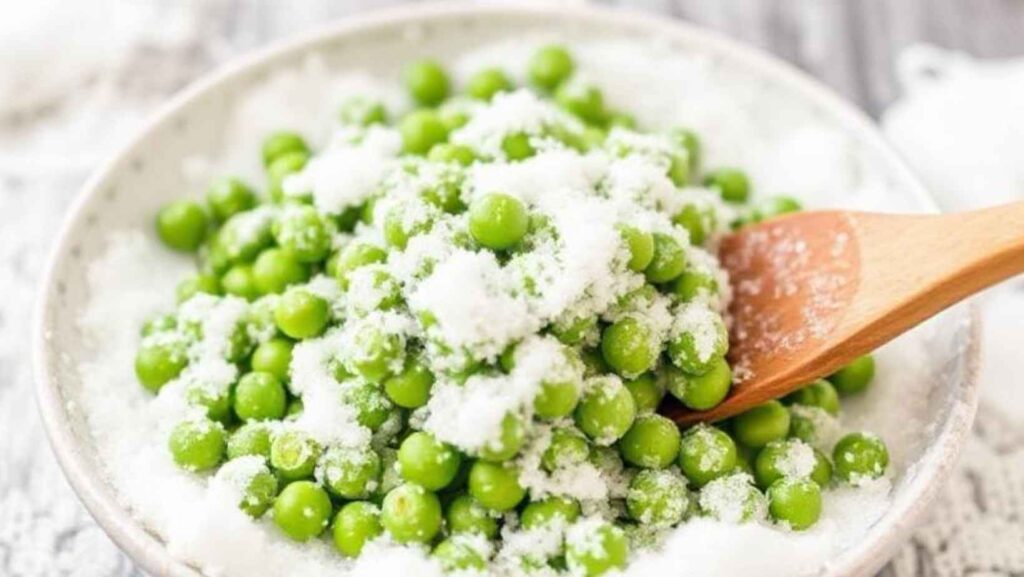
Would you want to know what snow peas are? According to my observations, snow peas are a variety of peas that have pods that are edible, thin, and flat.
They are consumed in their whole, particularly when they are young and fragile.
These vegetables are also referred to as Chinese pea pods or mangetout, and they are frequently utilized in stir-fries and other recipes that are inspired by Asian cuisine.
However, that is not all; as you continue reading, I will provide you with further information on the topic matter.
Now, let’s get started
What Are Snow Peas
One of the edible parts of the snow pea is a pod that is thin and flat. When it is still in the beginning stages of its development, it is possible to consume it in its entirety.
Snow peas are furthermore referred to as Chinese pea pods due to the fact that they are frequently utilized in stir-fries.
They have a smooth surface and contain a cluster of peas that are quite tiny.
The rough threads that run along the exterior edge of the pod are often removed before eating, although the pod itself can be consumed in its entirety.
The flavor of snow peas is on the milder side, and they may be consumed either fresh or cooked in various recipes.
The cooking time for snow peas is rather short, and they are described as having a crisp texture and a delicate texture.
If you want to prepare them for use in meals, you can serve them raw, sauté them, or steam them.
Snow peas are rich in vitamin C, A, K, iron, and magnesium.
Peas are grown with vegetables and harvested 10 days after pollination (white bloom).
Where do snow peas grow
A vast variety of areas across the world, including North America, Europe, Asia, Australia, and South America, are responsible for the cultivation of snow peas to varying degrees.
China, Japan, India, France, and California and Oregon—the top growers—grow snow peas in large amounts.
As a result of their tolerance to a wide range of temperatures and their widespread use in cuisines from across the world, snow peas are the subject of cultivation in a great number of nations around the globe.
How to Plant Snow Peas
When to Plant: Snow peas, like other green peas, are an early spring crop that should be planted in the garden four to six weeks before to the local average last frost date or as soon as the soil is workable.
For snow peas to germinate, the temperature should be between 45 and 70 degrees Fahrenheit.
Because snow peas cease growing when the temperature reaches 85 degrees Fahrenheit, you must make the most of the brief planting window.
Consider doing a second planting only for the pea shoots, which may be harvested in a few of weeks, if you like the blooms as well.
Another option is to sow an autumn crop around two months ahead of the first typical frost date.
Because powdery mildew is common in late summer, choose a cultivar that develops early and is resistant to the fungus when planting in the fall.
Choose a Planting Location:
Pick a spot with well-draining soil that receives full sun to moderate shade.
To minimize pests and illnesses, grow snow peas in a different location than other legumes planted in the previous two years and adhere to crop rotation guidelines.
Depth, Support, and Space
Plant seeds 1 inch deep and 1 1/2 to 2 inches apart. Vine height influences row spacing.
Taller types should be placed 18 to 36 inches apart, while cultivars under 3 feet tall can be as close together as 12 to 18 inches.
Remember that you should have simple access for harvesting while you are spacing rows.
Regardless of vine size, trellising snow peas is advised to maintain the vines upright toward the sun and away from the ground, where they may rot in rainy conditions.
Additionally, peas are considerably simpler to pick on a trellis since the weight of the pods causes even shorter types to collapse over.
What are the Snow Pea Plant Care
Light: Snow peas thrive in both partial shade and full sun, preferably six to eight hours of direct sunlight.
The delicate vines might be burned by too much direct sunshine.
Soil
Snow pea soil should be well-drained, rich in organic matter, and slightly acidic (6.0–6.5).
Water: Peas require a lot of water—at least one inch each week—or else the pods may become tough and stringy rather than crispy and crisp.
Keep late crops well-watered when the weather warms. Root and seed rot can result from poor drainage.
Temperature and Humidity: Snow peas can withstand the rare late snowflakes and thrive best in chilly conditions.
They are unaffected by light spring or autumn frost; however, germination takes longer if the soil temperature is about 40 degrees Fahrenheit.
They don’t do well in temperatures higher than 85 degrees Fahrenheit, just like any other pea. As long as it stays cold, humid weather is not an issue.
Fertilizer: Snow pea fertilizer is typically not required if your garden’s soil is rich in organic matter and has been modified with compost.
Pollination: Snow peas, like other peas, are self-pollinating and don’t need wind or insects to do it.
What do you need to grow your snow peas
Specifically, a thirty-by-thirty-centimeter plot that contains snow pea seeds and a nutrient-rich soil mix
Snow peas need a location that receives at least four hours of sunshine each day, as well as a trellis that they can climb on.
Utilizing the MM-Mix makes it quite simple to cultivate your snow peas. It is almost certain that you will fall short of your expectations if you grow in potting soil of poor quality.
Therefore, do not scrimp on the soil mix; instead, strive for the finest.
How do you sow and grow snow peas
The Planty Gardening app, which is free, includes snow peas. You will receive detailed instructions from the seed to harvest if you use it.
We refer to the many stages that each plant goes through as levels. The app notifies you when your plants are prepared for the next phase and provides detailed instructions for each one.
Because the app walks you through every step, you don’t need to know how to cultivate snow peas.
Level 1: Snow pea pre-sprouting
You want to assist your peas in developing their initial roots before planting them outside in your garden box. This is known as pre-sprouting.
It’s simple to pre-sprout: place the peas between two layers of moist paper towels. You may plant them straight into your garden box once they have germinated, which should take approximately 4 days.
Level 2: Pea Planting
Under the trellis, pick a square spot for your garden box’s rear row. Release the moisture MM- Combine and sow as follows:
Make eight punctures in the patch, each 2 to 3 cm deep.
Select the most attractive peas with roots.
Carefully plant one pea in each hole to prevent the roots from breaking off.
Cautiously use a soil mixture to cover the holes.
Something will appear after one to two weeks. The time of year and the weather have an impact.
It will take a bit longer in a chilly early spring. By using a crop cover, such as the MM-Muts, over your snow pea field, you may expedite the process. Birds are also kept from nibbling at the peas.
3. Pea seedlings at level three
You can tell that everything is going well when you see the first seedlings. Most likely, they won’t all appear at once, but wait a week or two.
The following step is, therefore, necessary.
Level 4: Snow pea plant maintenance
Your seedlings will grow into little plants in a week or two.
There is very little for you to do. They’ll develop rapidly on their own.
Level 5: Snow pea climbing
The plants support themselves by means of tiny tentacles. They ascend the trellis in this manner.
However, you must provide them with some assistance while they are still young.
Lead the snow pea tentacles to the trellis’s base; once they detect it, they will cling to it.
You will notice the first blossoms in a week or two.
Level 6: Snow peas in bloom
Beautiful butterfly flowers are already beginning to blossom on the vines. These blossoms will shortly give rise to the snow pea pods.
Level 7: The first snow peas are harvested
Harvest frequently and early. In this manner, the plants yield more pea pods and blossoms.
It’s common for the leaves to seem scraggly and become yellow at this point, especially on the undersides.
Final thought
Now that we have established what snow peas are, Heavy croppers, snow peas are simple to raise in potted gardens or home vegetable beds.
Snow peas are a kid’s favorite because they are crunchy and sweet, and you can eat them raw or cooked. The flat pods are also edible.
Any season other than summer is ideal for growing snow peas since prolonged exposure to temperatures above 25°C would inhibit their ability to blossom and produce.
The big size of snow pea seeds makes them easy to handle and ideal for children to plant and grow in pots or in the yard.
Since snow peas may grow up to 1.5 to 2.0 meters tall, they are best cultivated on a trellis or other modest support.