
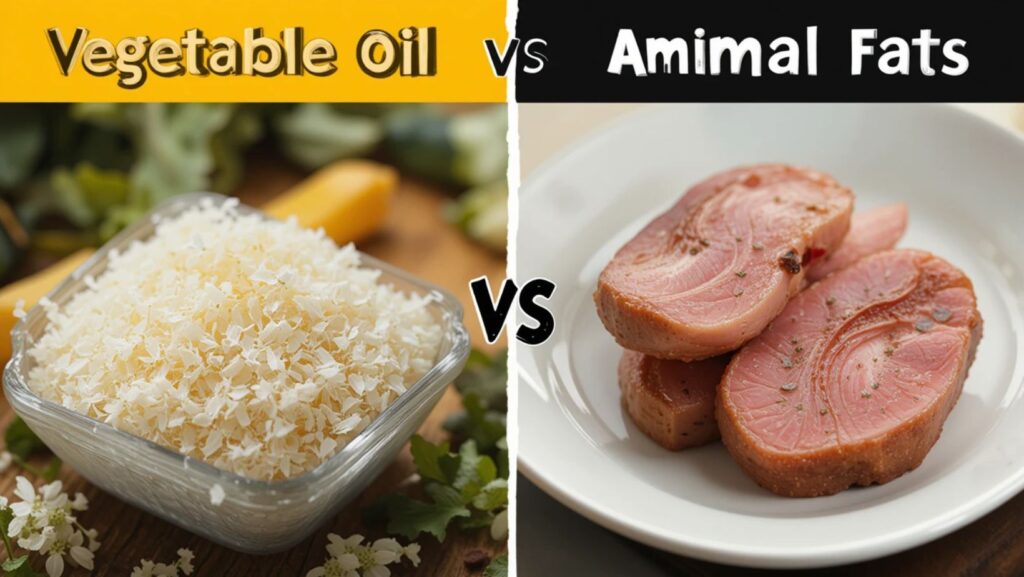
Would you want to know about Vegetable oils vs. animal fats? In my experience, the most important distinction between vegetable oils and animal fats is that vegetable oils typically contain a greater proportion of unsaturated fatty acids, which are regarded as being healthier.
On the other hand, animal fats are typically higher in saturated fatty acids, which can raise cholesterol levels when consumed in excess.
As a result, vegetable oils are generally considered to be a better choice for heart health compared to the majority of animal fats, with some exceptions depending on the particular type of oil or fat.
However, that is not all; as you continue reading, I will provide you with further information on the topic matter.
Now, let’s get started
What are the Key points about vegetable oils and animal fats
In terms of the makeup of fatty acids, vegetable oils are generally made up of unsaturated fatty acids such as oleic and linoleic acids.
In contrast, animal fats are mostly composed of saturated fatty acids such as palmitic and stearic acid.
The consequences for health:
Vegetable oils are typically thought to be healthier for heart health because of their greater unsaturated fat content.
This is because vegetable oils can help decrease LDL cholesterol, sometimes known as “bad” cholesterol.
For instance:
Oils derived from vegetables such as olive oil, canola oil, sunflower oil, and maize oil are most often used.
Animal fats include lard, which comes from swine, tallow, which comes from cow, and chicken fat, among other examples.
One notable exception is that certain vegetable oils, such as coconut oil, have a significant amount of saturated fat and should be used in moderation.
Omega-3 fatty acids, which are essential for the health of the heart, may be found in significant quantities in some types of fish oils, which are classified as a form of animal fat.
What is the Difference between vegetable oil and animal fat
The following is a list of the differences:
1. The majority of the lipids in vegetable oil are polyunsaturated, whereas most of the fats in animal fat are monounsaturated.
As a result of the presence of one or more carbon double bonds within their structure, vegetable fats are classified as unsaturated.
Due to the fact that they only contain single carbon-carbon bonds, animal fats are considered to be saturated.
Compared to animal fats, which are often solids at room temperature, vegetable oil is typically liquid at room temperature. This is in contrast to animal fats.
3. Vanaspati ghee is produced by hydrogenating vegetable oils, which results in the completion of the process.
Animal fats, which tend to raise our blood cholesterol level, are a decision that is not as healthy as these alternatives.
4. Vegetable oils are oils that have been derived from a variety of seeds, such as rapeseed (also known as canola oil), soybean, corn, sunflower, safflower, peanut, and other seeds.
Fatty acids such as butter, ghee, lard, tallow, and any other fatty acids are examples of animal fats.
What is the relationship between Vegetable Oils and Animal Fats
40 CFR 112, which has the same rules for petroleum and non-petroleum oils, governs both vegetable and animal fats.
Animal fats, vegetable oils, and petroleum oils all have comparable physical characteristics and environmental impacts.
Similar to petroleum oils, vegetable and animal fats and their components have the potential to:
Produce poisonous byproducts; Have catastrophic physical impacts, such as smothering plants and animals by suffocating them with oil;
destroy ecosystems, breeding animals, and future and current food supplies; emit rancid aromas; contaminate shorelines, block water treatment facilities, and ignite when ignition sources are present; and
create goods that persist in the environment for a long time.
Animal and vegetable oil spills have been demonstrated to kill or harm wildlife and have other unfavorable impacts, according to scientific studies and real-world spill experience.
Wildlife that becomes covered in vegetable or animal fats may starve to death, suffer from cold, or become dehydrated and ill.
The reduction of oxygen brought on by spilled vegetable and animal fats in water can drown aquatic life.
The destructive effects of vegetable and animal fat spills on the aquatic environment are comparable to or even worse than those of petroleum oil spills.
Planning and responding to spills using animal fats and vegetable oils are governed by two rules:
The Spill Prevention, Control, and Countermeasure (SPCC) Rule and the Facility Response Plan (FRP) Rule
Is animal fat better for you than vegetable fat
Thus, it is true that cooking fats like lard and calf tallow are healthier than vegetable oils like olive oil.
Prior to the rise in the now prevalent diseases of diabetes, heart disease, and cancer, they were the primary cooking fats utilized in this nation.
Furthermore, compared to many seed oils, animal fats have a greater smoke point.
The temperature at which an oil begins to degrade and release toxic substances known as free radicals is known as the smoke point.
Using low-smoke cooking oil can have negative effects on your health in addition to the flavor of your meal.
Because animal fats have greater smoke points, they are less prone to burn and release these toxic substances.
Why should we prefer vegetable oils over animal fat for cooking food
There’s a solid reason why these fats have been a mainstay in cooking for generations. In addition to adding amazing taste to food, they have several health advantages.
Certain fat-soluble vitamins, including A, D, E, and K, are abundant in animal fats, especially those derived from pasture-raised animals.
These vitamins are essential for many body processes, such as hormone balance, bone health, and immunological support. So, one excellent method to make sure you’re receiving these vital nutrients is to include animal fats in your diet.
The omega fatty acid composition of animal fats provides an additional benefit. Our health depends on both omega-3 and omega-6 fatty acids, but the ratio of the two is crucial.
Omega-6 fatty acids dominate the ratio of several seed oils, including canola, soybean, and maize oil.
Overconsumption of omega-6 fatty acids can increase inflammation, which is connected to a number of chronic illnesses.
However, animal fats often have a better-balanced ratio, which helps support heart health and lessen inflammation.
Final thought
Now that we have established Vegetable oils vs. animal fats, There are a variety of health advantages that appear to be associated with the intake of vegetable oil.
The use of vegetable oil appears to have favorable effects on decreasing lipid concentrations, particularly with monounsaturated and polyunsaturated-rich oils, when ingested at the recommended levels.