
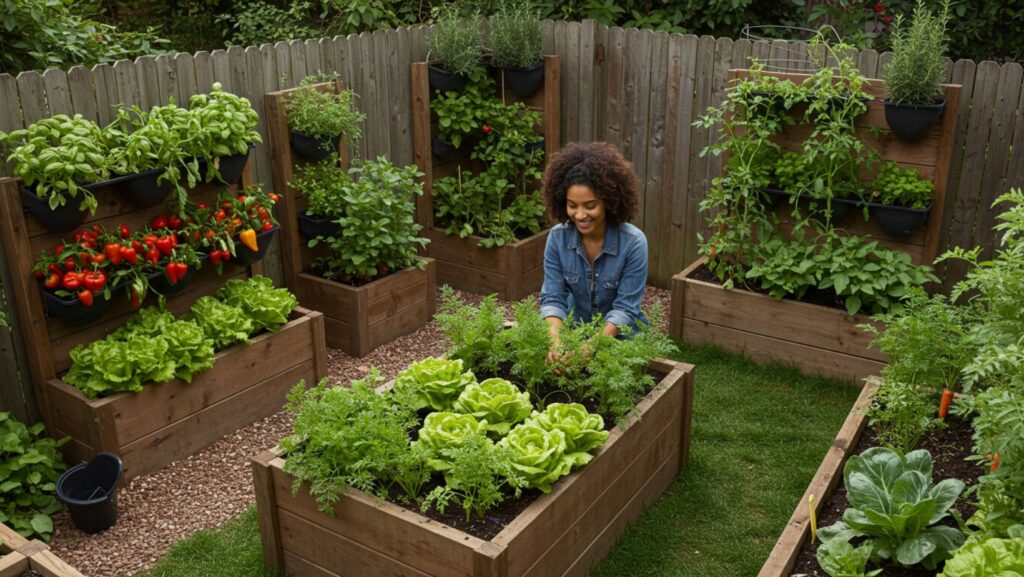
Would you want to know about Vegetable gardening in small spaces? According to my experience, there are a few things you should think about before deciding which small vegetable garden ideas will work best in your area.
For plants to properly develop, bloom, and bear vegetables, every vegetable garden, regardless of size, need soil, water, and sunlight.
Because most veggies need at least six hours of direct sunshine each day, keep in mind that buildings or trees may throw shadows over your growing area.
If the vegetable garden is being planted in pots, it is very crucial to have water close by. During warmer weather, containers need to be watered every day since they dry up rapidly.
Lastly, a healthy harvest depends on using garden or potting soil of superior quality.
Plant roots receive nutrients from the soil, which also retains water until the roots take it up and give the plant support. But that’s not all; I’ll explain more about the topic as you continue reading.
Now, let’s get started
What are the Growing Vegetables in a Small Space – 6 Tips You Can Use Today
Vegetable diversity matters. On large plants, tomatoes and squash thrive, although there are smaller types.
Consider “patio” or container-friendly kinds. Avoid “giant,” “whopper,” and similar types. Make sure your vegetable can be planted at the right time.
Go up! Trellised pole beans, cucumbers, snap, and snow peas produce a much. Pole beans and peas grow nicely on twine 6–8 feet above the ground.
You may need to guide them up the string gently, but they will learn. A slanted trellis keeps cucumbers off the ground and makes them straighter and simpler to find.
To avoid injuring the plant later, install the climbing trellis or wire when you plant.
Waste no space! Pairing slower- and faster-maturing veggies lets you produce more in one area. The fast-maturing veggies will be harvested before the two crops overwhelm each other.
After the rapid harvest is plucked, the slower crop can mature. Radish and carrot seeds can be planted together, or leaf lettuce and tomatoes can be grown in alternate rows.
Leafy vegetables can be grown in 8- to 12-inch rows instead of single plants. When the plants mature, their leaf canopy inhibits weeds and conserves water.
After a vertical crop is well-established, plant lettuce around the base. Make sure all plants in the space have enough water.
Planting successors. When one crop is done, plant another for the season. Bush beans may often be grown twice over our lengthy summer.
Plant potatoes or carrots for fall as you take down determinate tomatoes.
Multi-season growth. Spring, summer, fall, and winter are all good reasons to grow food in the San Francisco Bay Area.
Leafy greens like lettuce, spinach, and kale thrive in colder climates than our scorching, dry summers.
Cooler weather reduces pests on broccoli, bok choy, and cabbage.
Feed dirt.
Most vegetables, especially melons, squashes, maize, and cole crops like cauliflower and cabbage, are “heavy feeders” that need lots of soil nutrients.
Multiple-season vegetable farming requires more soil amendment and fertilizer than single-season gardening.
Add compost or nitrogen before planting each plant. Compost adds nitrogen and organic matter to soil texture. You can even create one!
How to Grow a Garden in a Small Space
Find the Lay of the Land: A location that receives six to eight hours of sunshine every day is ideal. Shaded areas are suitable for growing, but your selections will be restricted.
Shade is ideal for leafy greens, herbs, and some flower types, such as begonias and impatiens. However, you will need a lot of sunlight if you want to produce a variety of flowers or crops like strawberries, tomatoes, or cucumbers.
(Remember that morning light is better for your crop than hot afternoon light.)
Take into account the weight capacity if you intend to plant on a balcony or rooftop.
Potting soil and water in a dozen 12-inch containers can put a lot of strain on a space that may not be built to support the weight.
Thus, be sure before planting. Keep pathways accessible as well; a fire escape should be free of barriers, even if it may appear to be a balcony. So don’t plant a garden there.
Take into account your outdoor area’s usage as well as the amount of space you wish to set aside for containers.
Recognize Your Limits: Gardening is a time-consuming activity. You must fertilize, water, and pull weeds.
You might need to water every day or perhaps twice a day during the sweltering summer months. If enough pots are planted, it can soon become a major lift.
Therefore, in your first year, start modest, with only one or two containers, and evaluate the following season.
“Avoid taking on too much.” “Having something totally fail you is the biggest thing that can make you stop gardening.”
Obtain Some Containers: After determining your growing location, acquire some containers, aiming for a pot that is six to twelve inches deep.
Any vessel will work as long as the bottom has drainage holes. (And drill a couple if they don’t.)
Select Your Crop:
Seek out plant breeds that are suited for tiny areas, such as peppers, tomatoes, and cucumbers that grow in bush form.
Because micro-dwarf tomato types like Tiny Tim and Red Robin produce great yields despite their small size, breeders have worked hard to create dwarf tomato cultivars.
As the name implies, tumbling Tom tomatoes tumble over a hanging basket.
What is the Top Crops for Small Vegetable Gardens
Some of my suggestions are listed below, along with those of seed firms that carry out thorough testing to produce the best kinds.
Basil: There’s a solid reason why every gardener plants delicious basil. The small, fragrant leaves arouse the senses and give pesto, salad dressings, and other dishes a vibrant flavor.
Basil comes in over 80 kinds, some of which are “miniature” and ideal for small-scale gardening.
The smallest kind of sweet basil, known as Pistou, is perfect for windowboxes or pots. In a bigger container, the tight green mounds can be utilized as edging.
Basil is readily available from most seed catalogs and is simple to produce from seed.
Chard: Any garden plant that has a “cut-and-come-again” trait is welcome. In fact, harvesting leaves promotes further development. Brightly colored stems and an upright growth habit make rainbow chard a great choice for small areas.
It is simple to produce chard from seed because it belongs to the beet family, but keep in mind that the seedlings must be pruned to provide adequate spacing.
Starting using transplants rather than seeds is simpler for small pots because there is no need for thinning. Discover how to cultivate Swiss chard.
Eggplant: Oriental eggplants are a great option for pots and planters because of their compact habit. There are many kinds, making it hard to pick a favorite. Ping Tung Long eggplant is at the top of High.
“Slender purple eggplants hang from compact plants of this lovely heirloom variety,” she continues. “
The plant stays small but has the potential of producing a lot of eggplants.” The vegetable is 10″ long and narrow, making it perfect for cubing and slicing; the flavor is light, and the peel is delicate.
How to choose vegetables for small spaces
All of the factors that impact a bigger garden, such as location, environment, soil capacity, etc., are concentrated in a smaller garden. Hence, you need to pay more attention to them than you might otherwise.
The direction and exposure of your little garden should be your first concern.
The majority of vegetables require six hours or more of sunshine each day.
This can be challenging because smaller gardens are typically found in locations with walls, fences, and other structures that can both shelter the plants from the sun and reflect heat back into the garden.
If your garden is completely open, record the amount of time and sunlight it receives. Note the direction or directions it is sheltered from if it is surrounded by walls, fences, or hedges on one or more sides.
Eastern or northern-facing gardens will receive more sunlight, warm up more rapidly in the morning, and cool off later.
Gardens that are exposed to the south or west will stay cooler in the morning, receive the most sunlight in the afternoon, when it is at its brightest, and maybe continue to receive heat from the fence or wall into the evening.
You may choose vegetables and companion plants that can offer shade, support, etc., more wisely if you are aware of the exposure.
Choosing Veggies:
The good news is that, particularly if you’re starting from seed, more vegetables than ever before have been developed to thrive in small areas.
When choosing vegetables for a tiny garden, you should generally seek cultivars that are characterized as having “compact,” “bush,” and/or “container” growing characteristics.
These smaller varieties will let you include more variation in your garden than their field counterparts, which spread out, grow tall, or take up enormous spaces.
Final thought
Now that we have established Vegetable gardening in small spaces, There isn’t much space for experimentation or planting crops that won’t be used in a tiny garden.
Set priorities by sowing what you enjoy, what is special, and what will flourish.
Additionally, grow the freshest-tasting produce. I use a lot of lettuce, and it tastes best just out of the garden.
It satisfies all of my requirements for the ideal harvest. In addition, it grows quickly, looks well, uses little room, and is simple to cultivate.