
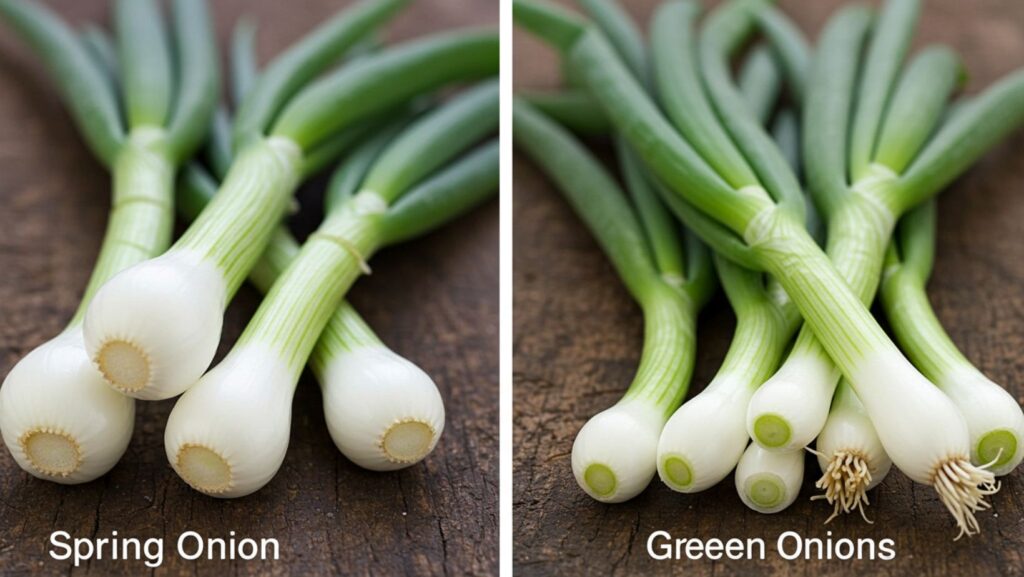
Would you want to know the difference between spring onions and green onions? Based on my experience, I would say that although the terms “spring onions” and “green onions” are frequently used interchangeably,
“spring onions” usually refer to a slightly more mature variety of the vegetable with a more developed, rounded white bulb at the base, while “green onions” can refer to a younger plant with a smaller, less defined bulb; both are regarded as immature onions with milder flavors than full-grown onions.
Certain green onions are rare types that have been created never to form a bulb at all, while others are immature versions of the beloved bulbing onions.
Both varieties frequently have whiskery roots hanging from the end because farmers harvest them by plucking the entire plant from the ground.
Compared to conventional white or yellow bulbing onions, all types have a somewhat milder onion flavor.
But you’ll discover that these plants’ white undersides have a somewhat stronger scent than their delicate green tops. But that’s not all; I’ll teach you more about the topic as you continue reading.
Now, let’s get started.
What are the differences between Spring onions and Green Onions
Although there may be a technical distinction between spring onions and green onions, they are typically interchangeable.
The main distinction between the two is whether the green onion is cultivated from a species that produces bulbs or one that does not.
The quick answer, however, is that they are essentially the same thing.
If you’re curious, here’s the geeky response: Allium fistulosum, also known as the Japanese bunching onion, is the genus and species that includes spring onions.
This particular onion species does not develop a bulb.
However, much as rectangles may be squares, green onions can also be another name for spring onions.
However, they may also be Allium cepa, the Latin name for the red and white onion bulbs that come to mind when you hear the phrase “bulb” onion.
It simply indicates that your green onion was picked before the white onion bulb developed in this instance. Allium fistulosum makes up the majority of the green onions you’ll find in the supermarket.
The appearance of spring onions and green onions is identical; they both have tiny white stems and long, hollow green stalks.
Both taste milder than ordinary onions. The only difference you could detect when cooking is that a green onion that is Allium cepa may taste stronger than a spring onion.
How to Use Spring onion s or Green Onions
These thin onions are quite adaptable.
As a garnish: “Spring onions are frequently used to adorn foods like bao buns, soups, and chillis.” Within Cooked Fillings
The onion is especially good in raw preparations like sushi or cooked stuffing for dishes like dumplings.
In Condiments:
“Spring onions, especially when grilled before use, are a wonderful addition to vinaigrettes or salad dressings.
They also taste great in marinades for Asian-inspired foods and dipping sauces like ginger spring onion sauce or soy dumpling sauce.
Using Starches:
In starchy recipes such as fried rice, soba noodles, potato salad, and spring onion pancakes, spring onion is a perfect addition.
In order to preserve their texture, spring onions are usually just very lightly cooked, even when they are included in a cooked meal.
How to Growing Green Onions
Green onions may be sown from seed into well-prepared beds when the soil warms up in the spring.
In the first few weeks, weeding may be minimized by covering the soil’s top with a layer of weed-free potting soil, but as the little plants take root, you will still need to remove weeds.
The majority of gardeners, including me, save the time-consuming indoor seed starting for onions that develop into large bulbs, but you may also start seeds indoors and plant the seedlings when they have three leaves.
If you want the sweetest green onions, start with a tried-and-true kind like Guardsman or Ishikura and schedule your harvest so that you pick most of the plants between 10 and 12 weeks of age, which is when onions’ leaf sugars are at their peak.
In midsummer, start a second batch of seeds to ensure a robust supply until the autumn.
Green onions are rich in calcium, vitamins A and C, and chemicals that support heart health and may help prevent cancer.
You may use them in cold salads or sprinkle them over egg drop soup. Other onions also have the same health advantages, but strong alliums need to be cooked in order to be consumed.
Green onions, also known as spring onions, welsh onions, or whatever you choose to name them, are mild enough to consume raw while still having all of their health benefits.
They could thus be the healthiest onions you can cultivate.
What are the Other Onion Substitutes for Green Onions
It is not a problem if you do not have any green onions left. Your favorites can be substituted with a wide variety of different cousins that belong to the allium family.
Take into consideration the following options:
Chives (plural) If you are going to use your spring onions or green onions raw or as a garnish that is sprinkled on top, chives will be a milder choice that is still entirely suitable.
Shallots (slang) Similarly mild, shallots are a form of onion that may be used both raw and cooked, and they can also be substituted for other onions.
(Despite the fact that they are purple rather than green, they will cause a little alteration in the colour of your meal!)
The leeks Due to the fact that they require some cooking time to become more pliable, these long-bulbed onion substitutes will function most effectively in meals that involve the use of spring onions or green onions.
Mustard, either red or yellow. Fresh spring onions can be substituted with red onions, which have a more robust flavor.
Yellow onions, on the other hand, are also best prepared by sautéing them for a short period.
How do you buy green onions and spring onions
Due to the fact that they are a crop that thrives in chilly temperatures, you will most likely discover these green beauties from the end of winter into spring.
In spite of this, you can come across them once again in the autumn or even throughout the entire year, depending on where you reside and the weather conditions.
Spring onions are nearly always sold in bunches if they are purchased from either the supermarket or the farmer’s market.
You check to see if the greens are lovely and firm and that they are a dark green colour without any fading.
For the highest possible level of freshness, it is essential to select a bunch that still has the roots intact.
Place them in the crisper drawer of your refrigerator with a wet cloth to prevent moisture from escaping once you have brought them home.
You may also store them for around a week in a jar with some water, either inside or outside of the refrigerator.
Just make sure to place a bag over the top of it in a loose manner.
Final thought
Now that we have etsbalished the difference between spring onions and green onions, no allium or onion cannot be used in its entirety.
There is a possibility that the green portion of older plants may be difficult, and you may not want to consume that part raw.
However, you can use tough onion greens in braises or stocks, or you can slice them and use them in soups or stews.
My spring onion greens were used to make a pesto that I produced. I used this recipe and substituted the onion greens for the scapes. I followed the instructions exactly.
Onions harvested in the spring are tasty and delicate. Please include them in salads or sandwiches in their raw form.
Adding some spring onions to the veggies that you are roasting is a good idea. Not only did I roast my spring onions, but I also included the fennel that we had acquired this week.
This will be an excellent complement to a Buddha bowl or a grain salad; alternatively, you can add a vinaigrette to it, and you will have a really fantastic side dish.