
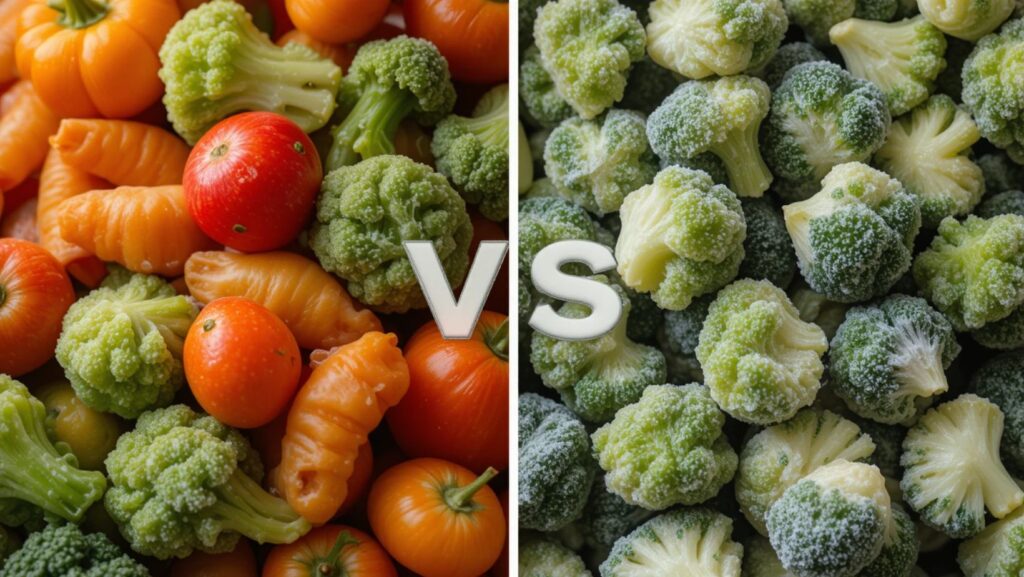
Would you want to know The difference between fresh and frozen vegetables? In my experience, I have found that although both fresh and frozen veggies have the potential to provide nutritional advantages, frozen vegetables are often harvested at their optimum ripeness and frozen in a short amount of time.
This allows them to better keep their nutrients than fresh vegetables, which may be stored for longer periods of time before being consumed by the user.
However, that is not all; as you continue reading, I will provide you with further information on the topic matter.
Now let get started
What are the Pros and Cons of Picking Frozen Veggies over Fresh One
The Benefits of Frozen Food Over Fresh:
The Longer Shelf Life of Frozen Vegetables
Vegetables lose their freshness after a certain amount of time in the refrigerator or on your counter. The majority of fresh veggies keep well for one to two weeks.
Since bad vegetables are dangerous for humans to consume, they should be thrown in the trash.
In other words, you may consider every vegetable you discard to be a waste of money.
The bottom line: You may eat your vegetables whenever you want because frozen vegetables can be kept in your freezer for several months.
The good news is that you can eat your favorite vegetables. All Year Long:
Because frozen veggies have a longer shelf life, they are convenient to carry from one location to another.
For that stir-frying dish you’ve been dying to try, you might be able to find the out-of-season green beans in the freezer section, even if you can’t see them in the fresh produce section.
The Cost of Frozen Produce Is Lower:
Generally speaking, frozen veggies are less costly than their fresh counterparts.
In addition to being less expensive, frozen veggies may come in larger portions than their fresh counterparts. You can get more for your money as a result.
Convenient: Depending on your intended use, preparing fresh vegetables might take some time. For instance, before being added to a recipe, potatoes need to be cleaned, peeled, and chopped.
Meal preparation may take longer as a result, and your pile of dirty dishes may increase.
A wide range of frozen veggies are available in various cuts, sizes, and forms. These frozen veggies frequently arrive ready to cook, requiring no preparation on your part.
Therefore, that bag of frozen broccoli could be a wonderful choice for a daily dosage of vitamins and nutrients if you’re in a hurry and need a fast vegetable side dish.
A lot of frozen vegetables come in microwave-safe packaging, and some companies even have packages that are ready to steam in just a few minutes. They may thus be prepared in a microwave oven.
The drawbacks of eating frozen vegetables include the possibility that they are less healthful.
As previously said, frozen veggies will have fewer nutrients than their fresh counterparts. When contrasted with fresh veggies, the amount of nutrients lost is negligible.
Frozen Vegetables May Change in Taste and Texture: Similar to many other frozen items, you could observe that the texture or flavor of your frozen veggies differs from that of the fresh kind.
Use fresh veggies rather than frozen ones if texture is a key component of your recipe.
When buying frozen veggies, bear in mind that each vegetable is affected differently by the blanching and freezing procedures.
Frozen Produce may Include Additives: Look for frozen veggies that include additives when you’re shopping.
Spend a few moments reading the ingredient list on the back of the package before making a purchase.
Seasonings, salt, sugar, and other components can all be considered additives.
Don’t allow the fact that not all frozen veggies have additives to deter you from selecting frozen over fresh.
Are Frozen Vegetables Healthy
Healthy veggies may be found in frozen form. When the harvest is at its peak, raw vegetables that are destined for freezing are harvested and then frozen.
As a result of this technique, the nutritious content of vegetables is not significantly diminished.
Vegetables are snap-frozen relatively quickly after they are gathered, which helps to preserve their nutritional value.
There is no difference in the nutritional content of nutrients such as vitamin C, vitamin A, potassium, folic acid, and fiber when they are reheated since these nutrients do not suffer from the effects of freezing.
veggies that are fresh can be frozen, however, not all frozen veggies will have the same flavor as fresh vegetables.
The reason that the frozen veggies that you see at the grocery store are there is because they are the greatest vegetables to freeze.
Both fresh and frozen veggies have their advantages despite the fact that frozen vegetables may appear to be more limited.
What are the Benefits of Frozen Vegetables
In the long term, frozen veggies can save money in addition to tasting fresh when cooked. While frozen veggies can last for months in the freezer, fresh vegetables spoil within a few days.
The following is a list of some of the top frozen veggies available:
- Broccoli with Asparagus
- Carrots with Brussels sprouts
- Carrots with green beans
- Corn Peas
In actuality, frozen fruits and vegetables are harvested at their ripest and then snap frozen in a matter of hours.
Actually, according to some research, processed fruit could have more vitamins and antioxidants than fresh Produce that has been refrigerated for two or three days before consumption.
The type of food being frozen also affects how nutritious fresh vs frozen food is.
Vitamin C content is greater in frozen maize, blueberries, and green beans than in their fresh counterparts.
However, frozen broccoli has more of this B vitamin than fresh broccoli, whereas fresh peas have more riboflavin than frozen ones.
What are the Benefits of Fresh Vegetables
There are more veggies with different nutrients available to us since we can get a greater range of organic or locally grown vegetables throughout the year.
One may argue that fresh veggies are healthier than frozen ones simply because of their diversity, but not all vegetables provide the same vitamins.
Nonetheless, scientists have found no nutritional distinction between a particular vegetable’s fresh and frozen forms.
Frozen and canned vegetables are great choices for ensuring you obtain your recommended daily intake of vegetables.
Fresh vegetables have a taste and can be reasonably priced, especially when they are in season.
Conversely, canned and frozen vegetables are year-round (even in January) reasonably priced, handy, and easy to keep.
The ideal option ultimately relies on your cooking style, tastes, and demands. Even vegetables of all kinds may be used to provide variety and enjoyment to your meals.
Increasing your regular consumption of vegetables is a great approach to promote your health and maintain the vibrancy of your mealtimes, regardless of the version you use.
What are the Top 5 health benefits of frozen fruit and vegetables
1. Just as nutrient-dense as fresh
When comparing the nutritional content of fresh and frozen fruit and vegetables, they are nearly identical.
Although there may be small changes, they are often insignificant. For instance, cooked frozen peas have 12 mg of vitamin C per 100g, whereas fresh peas have 16 mg.
In contrast to fresh peas, which provide 19 mg of calcium per 100g, frozen peas have 37 mg. Blanching vegetables before freezing helps them avoid browning and preserves their phytonutrients, such as flavonoids and carotenoids.
Fruits and vegetables that are frozen may have somewhat greater amounts of sugar and salt. For instance, fresh peas have 1.2g of sugar per 100g, but frozen peas have 5.9g.
2. Are a nutritious method of preserving fresh Produce
Many people believe that freezing is a superior long-term preservation technique to canning or drying since it preserves many of the qualities associated with freshness.
Freezing is a good approach to prolong the life of fresh food because it doesn’t require any preservatives or other substances.
To be sure that commercially frozen food doesn’t include added sugar, salt, or other flavorings, it’s worthwhile to read the labels.
3. Are an important source of nutrients during the off-season.
During the winter months, freezing fresh Produce while it’s in season is a great method to get minerals like vitamin C.
Those who incorporate frozen food into their diets typically consume more fruits and vegetables in general.
4. Are a quick and healthful meal
Known for their ease of use, frozen fruits and vegetables usually need less preparation and waste.
They are a practical and healthful choice because they don’t need to be washed, peeled, or chopped, and they cook quickly.
5. Increases the number of persons who can get fruits and vegetables
Generally speaking, frozen food is less expensive than its fresh counterpart, particularly when it’s out of season.
Because there is less waste and you may utilize exactly how much you need, frozen Produce is more affordable and available to a wider audience.
Are frozen fruits and vegetables safe for everyone
It is widely accepted that most people may safely eat fruits and vegetables. However, certain people may be allergic to a specific food, whether it is frozen or fresh.
Frozen Produce does not need to be defrosted before cooking, but before serving, make sure the internal temperature reaches around 135C.
This is due to the fact that fresh vegetables may still contain germs like Listeria even after being blanched before freezing.
Keep in mind that adding frozen veggies to a composite meal, such as a stew or tagine, can cause the temperature to drop, extending the cooking time required overall.
What are the reasons to buy frozen vegetables and fruits
1. They are equally nutrient-dense as fresh
Produce is immediately frozen after being harvested at the height of its freshness.
Advice: Look for frozen vegetables with minimal or no added sugar, saturated fat, or salt by reading product labels.
2. You can save money.
When frozen Produce is on sale, you may buy more of it. Examine the fliers at your neighborhood food shop and evaluate costs.
3. They help you save time.
You don’t have to perform the trimming or washing. Look for frozen food that is whole, sliced, or chopped according to your needs.
Advice: To make meal or snack preparation quick and simple, try keeping one or two types of frozen fruits and veggies on hand.
4. Food waste can be decreased.
Do you need a fruit or vegetable for a dish but are unsure if you’ll use it all? With frozen vegetables, you may utilize what you need and put the remainder away for another time.
5. You have more options.
There are some fruits and vegetables that aren’t always fresh. You may increase your diversity throughout the year by purchasing frozen fruits and veggies.
6. They may be used for a variety of purposes.
Fruits and vegetables that are frozen work well in a variety of dishes. For instance, make a puréed soup with frozen butternut squash chunks.
Use thawed frozen berries in your preferred muffin or loaf recipe.
In the winter, sauté frozen veggies for a stir-fry or steam and season them as a side dish. In the winter, add frozen peach slices to yogurt for summer flavors.
7. Half of your supper should consist of these.
You may consume more fruits and veggies each day by using frozen fruits and vegetables.
8. They endure longer
Compared to fresh fruits and vegetables, frozen products do not deteriorate as rapidly.
9. Compared to fresh veggies, they cook more quickly.
Before being frozen, a lot of veggies are blanched. Blanched veggies save time since they cook rapidly.
Advice: In the final minute of cooking, add frozen broccoli to a pot of boiling pasta. After straining the pasta and broccoli, drizzle your preferred spaghetti sauce over them.
10. They have flavor throughout the year.
When the flavor of fresh Produce is at its best, it is frozen.
There are several reasons to adore frozen fruit and veggies. Why do you adore frozen Produce?
What are the Best Vegetables to Buy Fresh vs. Frozen
Depending on what’s in season and how you want to use the vegetables (fresh raw veggies with crunch work best in salads,
for example, while frozen greens work well in smoothies), you may choose to buy fresh or frozen vegetables at the grocery store.
For instance, while fresh corn is better to buy during the busiest harvest seasons (late summer and early fall), frozen corn is of superior quality during off-seasons like winter and spring.
Here are certain vegetables to avoid freezing completely and some to think about keeping in the freezer to prevent spoiling.
Top Frozen Vegetables
Vegetables’ texture and flavor may change when frozen, but their nutritional value may not.
When veggies are frozen, their water expands, breaking down their cell walls and giving them a mushy feel when they defrost.
As a result, the veggies that freeze the best have less water in them. These consist of the following:
- Carrots and asparagus
- Corn
- Green beans
- Peas
Top Fresh Vegetables to Savor
Vegetables with a high water content don’t freeze as well, so if texture is a concern for you, you’ll prefer to eat them fresh. Among them are the following:
- Cucumbers
- Green onions
- Other salad greens, such as lettuce
- Tomatoes (apart from cooked or juiced)
Final thought
Now that we have mastered The difference between fresh and frozen vegetables, Despite the fact that frozen vegetables preserve the highest possible vitamin levels, there are several advantages to consuming vegetables in their fresh form.
At the end of the day, the only approach that is considered to be “wrong” when it comes to eating veggies is not to consume enough of them.
You may have the best of both worlds and increase your consumption of vegetables by combining the availability of frozen choices that are more affordable and visually appealing with fresh vegetables that are more flavorful and visually appealing.