
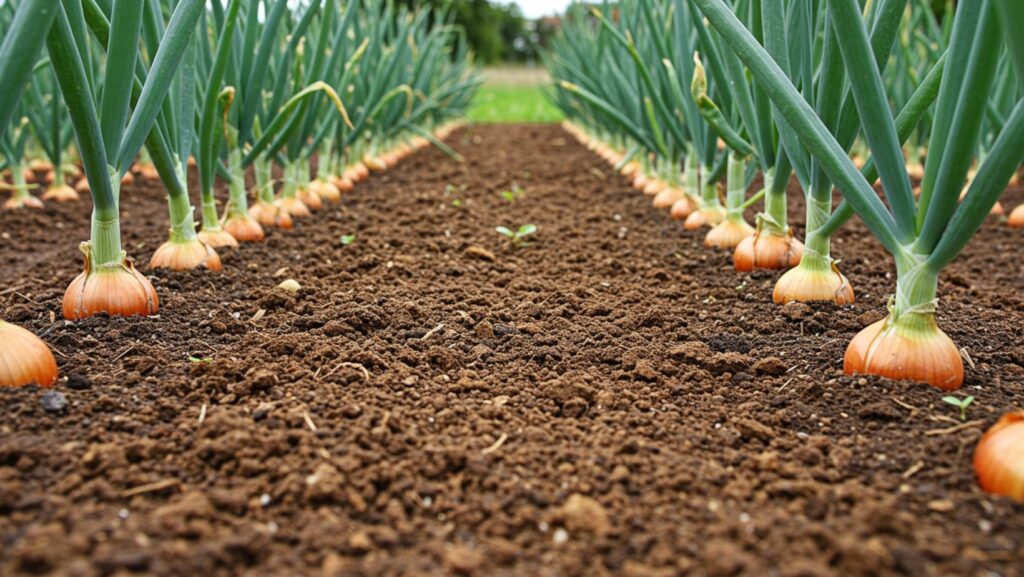
would you want to know the best soil for onions? Onions may grow in sandy or clay soils, but they may need additions like compost to increase drainage and texture.
In my opinion, the ideal soil for onions is loamy, well-drained soil with a high organic matter content and a pH of 6.0 to 7.0.
Full-sun, loose, well-drained, rich, sandy-loam to silt-loam soils with lots of organic content are ideal for onion growth.
High acid soils readily impact onions like soil pH levels between 6.0 and 6.8, and them.
Steer clear of thick clay soils since they hold onto water longer after irrigation and rain. But that’s not all;
I’ll explain more about the topic as you continue reading.
Now let’s get started
what are the best soil conditions and preparing it for onion farming
You should educate yourself on the ideal soil conditions and other pertinent aspects of onion cultivation before you plant any onions.
For growing onions, red loam and sandy loam are ideal. Even if you do not have such kinds of soil
you can use organic materials to enrich your soil. However, in the majority of situations, it is not advised.
Most onions may be grown in any soil, but the ideal soil is loose, well-drained, and rich in nitrogen.
Assess the pH and other soil nutrients to ascertain the current state of the soil. For optimal onion growth, the pH range of the soil should be between 5.5 and 6.5.
What are the Best Potting Soils for Onions
Over the years, I’ve come to two potting mixes that I like to use for growing onions, whether you’re growing them in raised beds or containers or want to switch up the soil in your yard.
You don’t need to worry about anything else when utilizing any of these; all you need to do is add the soil to your raised bed or container.
Although it is the simplest method for obtaining the proper dirt, it is also somewhat more costly.
SunGro Black Gold All Purpose Mix and Fox Farms Happy Frog are the two commercial soils I purchase.
Usually, I purchase both and combine them. Both have the proper nutritional combination and pH values for onions.
I think that the controlled-release fertilizer in the Black Gold combination is ideal for my onions.
I’ve experimented with many soils, but for my clay pots and raised beds, I always return to these.
What are the Best Soil For Green Onions
The exception to most of this is green onions, often known as bunching onions.
Although they also thrive in sandy-loam soils that have enough drainage and aeration, I’ve discovered that they don’t care as much about the kind of soil.
It’s probably because we don’t grow them for large bulbs. Green onions are something I’ve cultivated everywhere.
Frequently, I will plant seeds in various spots throughout my yard and let them grow amongst other plants.
This is a photo of some green onions that are growing in my yard amongst some strawberries. I’ve never altered the soil in any way, and I never fertilized them. They keep getting bigger.
How to Amend Clay Soils for Onions
My soil is made out of rock and clay if you live where I do. In addition to forming a hard crust on top that keeps water from penetrating the soil, it becomes hard when dry and retains water like a sponge.
Onions won’t respond to it. I tried it and have been there. Growing up in those things is not what you want.
My whole crop rotted one year due to the pure clay soil. Here’s my solution, though, so don’t worry.
I normally begin preparing my soil months before I intend to grow onions in clay.
I start by removing between one-third and half of the clay from the area where I plan to grow.
The compost from my Hot Frog Composter is then used in its place, and I thoroughly mix it in with the clay, paying particular attention to the top 6 to 8 inches of soil. My goal is 50% clay soil and 50% compost.
In the process, I break up thick dirt clumps and remove any huge roots or pebbles. This will enhance the soil’s drainage and aeration.
Sometimes, my compost hasn’t decomposed yet. I frequently bury my food wastes about 6″ beneath the clay and let the worms and microbes do their thing if I have a few months to spare.
I’ll then combine everything before planting, and I typically get a similar outcome.
How to Prepare the Soil for Planting Onions
The condition of the soil is crucial for plant growth; therefore, don’t neglect this essential stage.
Selecting a Garden Bed:
Choosing the garden location in the autumn and beginning to improve the soil quality is a fantastic idea for spring onions. Ensure that the garden is situated in a full-sun region.
Use a silage tarp or cardboard to cover the garden bed. A covering of cardboard makes a sterile seedbed, prevents fresh seeds from taking root, and acts as a barrier to destroy any existing plants.
Additionally, the cardboard will decompose and enrich the soil with organic matter and nutrients.
These simple steps will show you how to make a cardboard garden bed. Wait until spring planting to take off any silage tarps you may have used.
Loosen the Soil: In the prepared garden space, rake out rows when you’re ready to plant. Additionally, rake down any elevated or uneven areas in the garden.
Add Compost: Cover the rows with a layer of compost that is one to three inches deep. As you water, the nutrients and bacteria from the compost will seep into the soil.
What are the Soil Preparation for Onion Plants
Many gardeners neglect to prepare the soil before planting, yet healthy, well-drained soil is essential for the healthy growth of onions.
Prior to planting, always test your soil to check for deficiencies in any vital nutrients and/or minerals and to find out the pH level.
Using one of our digital meters to do a soil test or having one conducted by your neighborhood County Extension office is simple.
In order for water to effectively drain away from your plants, the other objective of soil preparation is to remove any compacted soil and make it friable (crumbly and aerated).
When to Get Your Soil Ready:
Anytime the ground is not too wet (or frozen), soil preparation can be carried out. Even in very chilly (but not freezing) weather, you can plant your onions.
Planting is generally okay as long as your soil is workable, but make sure your soil is as good as it can be before you plant.
Types of Soil:
Understand your soil! Even from township to township, every part of the nation is unique. Determine your soil type and make any necessary amendments. Loamy, crumbly soil is ideal for onions’ growth.
Very tiny particles make up clay and silty soils. When wet, they feel sticky and slippery.
Although clay and silt are good at retaining moisture, they are resistant to water seeping in, particularly when they are dry.
On clay or silty soils, puddles frequently occur and are quickly compacted.
Sand, silt or clay, and organic materials combine to form loam. Loam soils seem rich and black and are loose.
Moist loam will compress into a ball in your fist and break apart when you probe it with your finger.
Typically, loam soils are good at retaining moisture and absorbing it. The ability of loam soils to absorb and retain rainfall varies depending on whether they are sandy or clay-based.
Large, often light-colored particles that are visible to the unassisted eye are found in sandy soils. Sand does not roll up when pressed in your fist and feels gritty, whether wet or dry.
Sandy soils don’t hold moisture for extended periods, but they do stay loose and let water in quickly.
You can always build a raised bed if your soil is so bad that it cannot be amended. As long as it’s big enough to accommodate the quantity of onion sets you wish to plant, it can take on whatever shape you desire.
The minimum depth of the bed should be 6 inches.
You may even plant onions in a container (use one gallon or more) and place the pot in an area that will receive 6 to 8 hours of sunlight every day.
Compared to full-sized bulbs, scallions (very young onions, also known as green onions or spring onions) are more suited for container gardening.
pH of the soil:
Knowing if your soil is alkaline (pH over 7.0) or acidic (pH below 7.0) is also beneficial.
The ideal pH range for onions is between 6.2 and 6.8. You can use one of our digital soil pH meters or get a soil test done by your local county extension agency.
Add ground limestone if your soil is too acidic and peat moss if it is too alkaline.
Final thought
Now that we have established the best soil for onions, Since they have shallow roots, onions need a lot of water to thrive well.
Keep an eye on rainfall and watering as necessary because they require a thorough soaking once a week (more if the soil is sandy).
To keep weeds out, onions can be hoed in between rows, but don’t dig too deep. To cut down on the quantity of weeding and cultivating you perform, you might cover your rows with organic material.
Straw and grass clippings work well, but make sure your material is clear of weeds, or it will be useless.
We have pine shavings on hand, so this year, we’re trying them.
However, keep in mind that pine shavings will make your soil more acidic. Since onions prefer a little acidity, I’m not concerned about this, but I wouldn’t spread it around my garden.