
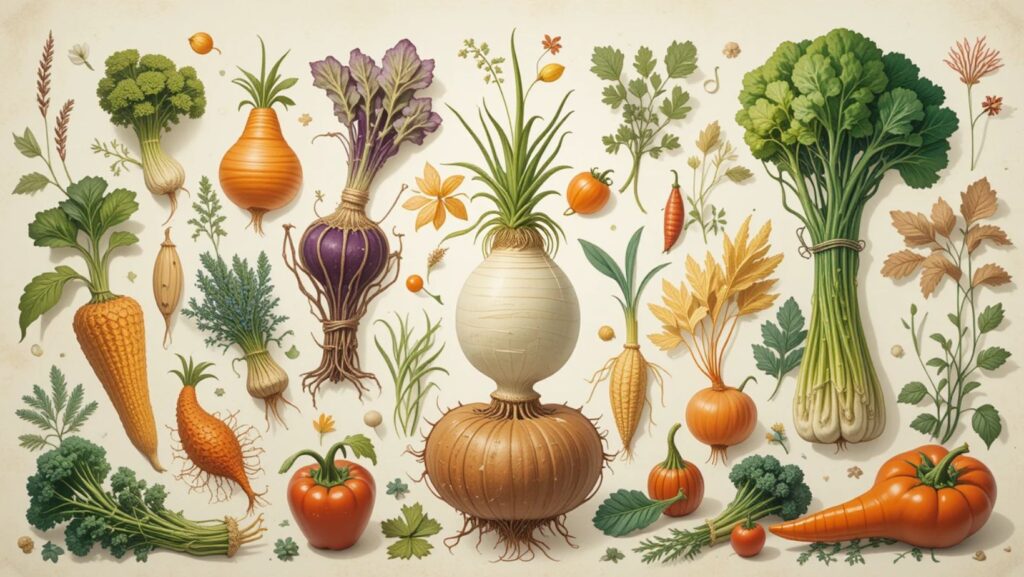
Would you want to know about Symbolism of vegetables in myths? The usage of vegetables as symbols in art and mythology has been documented to represent a wide range of concepts, including fertility, abundance, and expansion, according to my own experience.
Roots, stems, and leaves are all components that may be found in vegetables.
Vegetable and vegetables are categorized according to their flavor from the point of view of the culinary arts.
For example, beets, carrots, rutabagas, and turnips are all vegetables that have a naturally sweeter flavor than other vegetables.
However, that is not all; as you continue reading, I will provide you with further information on the topic matter.
Now let get started
What are Vegetable Myths,
The first myth is that green potatoes are extremely toxic.
The nightshade family, which includes several hazardous members, includes potatoes and tomatoes.
Many European explorers were hesitant to cultivate or consume the crop when they returned from the New World.
The glycoalkaloid toxin solanine is found in nightshade species.
The green portions of nightshade plants, as well as their leaves, stems, and light-exposed tubers, contain the toxin.
Myth #2: Eating carrots improves vision.
We were all instructed to consume carrots as they are healthy for our eyes and can help us see better.
That’s partially true. Vitamin A, which is abundant in carrots, is essential for healthy vision. Therefore, eating carrots may improve your vision if you are deficient in vitamin A.
However, vitamin A deficiency is extremely rare in the modern world.
This story originated when the British Royal Air Force created a new, covert radar technology during World War II.
This made it possible to target German bombers before they could cross the English Channel. The British disseminated a misleading narrative because they did not want the Germans to learn about this new technology.
They asserted that British pilots’ superior night vision, which they attributed to eating a lot of carrots, was the reason for their success.
Myth #3: By counting the lobes on peppers, you may determine their sex.
One strange rumor that is circulating is that the number of lobes on a bell pepper may be used to distinguish between a male and a female. Females have four lobes, whereas men have three or less.
False. A pepper is just an ovary that has matured. The variety and growing environment, not the vegetable’s sex, determine how many bumps there are.
When it comes to asparagus, sex does matter. There are two types of plants: male and female. In the world of asparagus, male plants are favored.
Females also produce little red berries with seeds, although both will produce blooms. This depletes the plant’s resources and may eventually lead to smaller spears.
Additionally, a lot of asparagus volunteers are produced when all those berries fall off the stalks, which is not what you want.
Myth #4: Compared to canned or frozen veggies, fresh vegetables are always healthier.
It varies. The closer a vegetable gets to maturity, the more nutritious it is.
Therefore, if you collect them when they are at their best and consume them immediately away, veggies from your garden or the farmer’s market are about as nutrient packed as they can be.
In order to send them thousands of kilometers to the grocery store, fresh veggies that are bought in the midst of winter were gathered when they were less ripe.
Not only does an early harvest lower initial nutritional levels, but transportation also loses considerably more.
Usually harvested at their ripest, frozen veggies are prepared in a matter of hours.
Quick blanching in hot water, rapid cooling, and freezing are the steps in the procedure. Salt may be added to canned veggies, but they are also processed rapidly.
What do vegetables symbolize
Vegetable and vegetables have been used for generations to symbolize fertility, love, and desire in various regions of the world.
In addition to being nourishing, they have cultural significance in both ancient and modern societies.
Apple
Europeans employed apples in love rituals throughout the Middle Ages because they thought they had aphrodisiac properties.
A lady would sleep with an apple under her arm and get a man to eat it the next day if she sought his affection. It was thought that after eating the apple, he would fall in love with her.
Fig.
Figs are linked to Priapus, a satyr who represented sexual desire, and Dionysus, the god of wine, in Greek and Roman mythology.
The pomegranate
Brides wore pomegranate wreaths during weddings because, to the Romans, the pomegranate represented marriage.
Pomegranates are presented as wedding presents in China, where they represent fertility and signify “a hundred seeds,” or more accurately, “a hundred sons.”
The strawberry
The strawberry is a symbol of perfection in Victorian floral jargon. Love is what a double strawberry will deliver!
you will fall in love with someone if you split a double strawberry in two and share it with them.
Garlic
Although it might seem like a strange option for romance, garlic is a fertility and luck sign in China.
Ancient Chinese kings also employed it as an aphrodisiac!
Spinach
Have you have a secret crush on someone? In Japan, hidden love is symbolized by spinach. Presents were wrapped in spinach-green paper as a passionate gesture.
Carrots
Carrots are considered a fertility sign and an aphrodisiac. Carrots cooked in sugar were used by males in Teheran as an aphrodisiac in the 1870s.
Domhnach Curran, or Carrot Sunday, is a holiday in Scotland. A few days prior to the St. Michael feast, women would go to the fields to buy carrots.
As a fertility symbol, women would offer carrots to males on Carrot Sunday, the Sunday after the celebration.
Whata is the Symbolism of vegetables in myths and legends
In a great number of myths and stories, vegetables have been used to represent a variety of ideals, including love, fertility, wealth, and prosperity.
It is both fertile and abundant.
The cornucopias
These are a representation of prosperity and abundance since they are brimming with vegetable and vegetables.
Red pomegranates
The presence of exposed seeds is a symbol of fertility and the possibility of experiencing new life.
vegetal shapes resembling phallic
Cucumbers and carrots are two examples of foods that are symbolic of male fecundity.
Vegetable are ripe and split.
The fecundity and sensuality of women are represented by these in a variety of creative traditions.
What does it mean to dream about eating vegetable and vegetables
Three-vegetable dreams might be intriguing because of their symbolic meaning. These situations frequently convey broader lessons about choices, abundance, or the good and bad parts of life.
One, several, or all of the above might be the meaning of your dream.
1. Wholeness and Completion: Three is frequently linked to wholeness, balance, and completion.
If you dream about three vegetable, it might represent achieving a state of balance in your life or a sense of fulfillment.
2. Choices and alternatives: three vegetable might stand in for the alternatives and choices you have.
The dream may represent choices you must make or the various options available to you.
3. Desire Manifestation: Three is occasionally associated with creation and manifestation.
Three vegetable in your dream might represent the accomplishment of your goals or the fulfillment of your wishes.
4. Trinity and Spiritual Themes: The number three is connected to spiritual ideas and themes such as the Holy Trinity in some civilizations.
Three vegetable in your dream might have spiritual meaning or represent a relationship to your spiritual convictions.
5. Symbolic Qualities: The dream may have characteristics related to the vegetable, depending on the kind of vegetable.
For instance, oranges may stand for vigor and energy, while apples may indicate knowledge or temptation.
6. Steps and Progress: Three can also stand for phases of growth or advancement.
You may be going through several stages in a certain area of your life, according to the dream.
7. Dream Themes: Examine further dream-related themes and components.
Three vegetable might be included in a broader story or message.
8. Personal Associations: Consider the associations you personally have with the number three and vegetable.
Deeper understanding of the significance of the dream may be gained from your personal experiences, convictions, and emotions.
9. Interactions with Symbols: In the dream, observe the vegetable’ interactions with you or their environment.
What is Vegetables, their symbols, their rites and their beliefs
Vegetables are an everyday source of energy and wealth. They are essential to our nutrition as well as the meaning of our dreams, which represent our goals and our pursuit of family harmony.
Possibilities and Opportunities: In our dreams, vegetables frequently stand for chances for development and success.
They contend that now is the ideal moment to take advantage of fresh opportunities in a variety of spheres of life, including love, happiness, and employment.
Growing veggies may be interpreted as a show of commitment and diligence, indicating a desire to accomplish certain objectives.
The significance of vegetables in dreams is that they often stand for emotional equilibrium, good nutrition, and health.
They may be a sign of personal development or the need to look for one’s inner health. These depictions of vegetables frequently emphasize fertility and plenty in the dreamer’s life.
Hidden Messages in Vegetable Dreams: Symbolism related to vegetables can also disclose wishes or hidden elements.
For instance, seeing a range of vibrant veggies in your dream might represent a multitude of experiences or prospects.
Vegetables may also represent developing endeavors or areas of life that require greater focus.
Having a dream about eating vegetables is sometimes seen as a portent of future fortune or good health. It could also be an indication of a concern for a healthy diet and way of living.
Other hints on the meaning of the veggies may be found in the circumstances in which they are consumed in the dream.
Dreaming of Vegetable Growth: Dreaming of vegetable growth conveys a sense of personal progress. It may have to do with a project’s completion or the result of a lot of effort.
The garden frequently represents imagination and the mind’s capacity for growth.
Final thought
Now that we have established Symbolism of vegetables in myths , Although the Lunar New Year originated in China, thus its popular name, the Chinese New Year, it is observed in many Asian nations, including South Korea (where it is known as Seollal) and Vietnam (where it is called Tet).
While the continent’s celebrations have many commonalities, such as gift-giving and ancestor honoring, each nation has its own unique customs, rituals, and, of course, food to welcome the new year.