
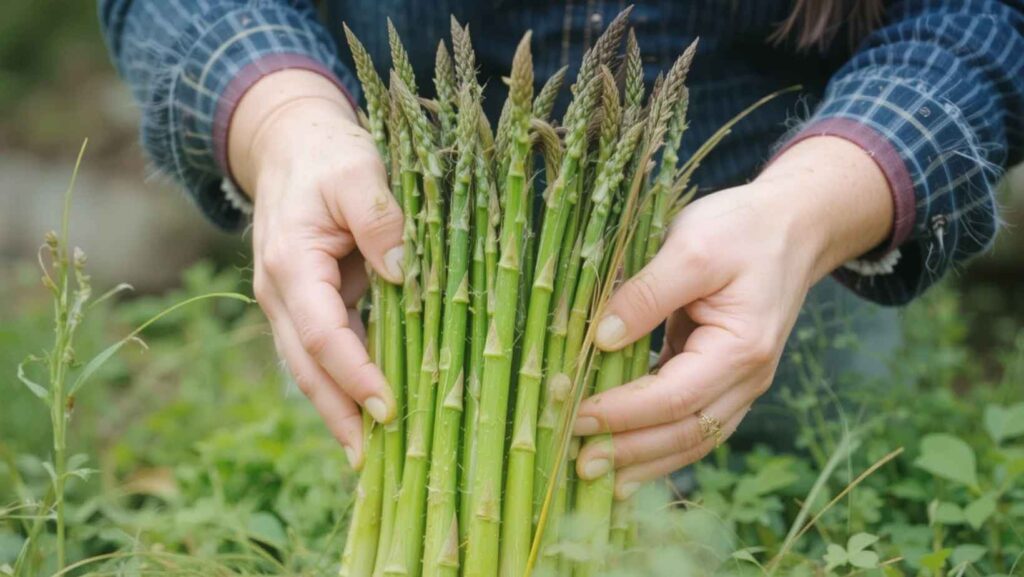
Would you want to know if asparagus is a fruit or a vegetable? My observations have led me to the conclusion that asparagus is a vegetable, more specifically a stem, and not a fruit because it is not the portion of the plant that bears seeds, despite its name.
Asparagus is a vegetable that is not only simple to prepare but also abundant in various nutrients.
Folates, which are commonly referred to as vitamin B-9, are abundant in asparagus. During the process of cell formation, this vitamin plays a crucial role.
However, that is not all; as you continue reading, I will provide you with further information on the topic matter.
Now, let’s get started.
Is asparagus a vegetable or fruit
Although there are several distinctions between the botanical and popular classifications of fruits, this one is very straightforward because neither definition involves any fruit.
The freshly sprouting shoot, which we see as a vegetable, is the portion of asparagus that we consume the most frequently.
If this branch is given more time to grow, it will eventually develop into the plant’s stem.
The plants ultimately bloom under natural conditions, and the female plants bear little red berries. The asparagus plant produces the berries.
Unless you grow asparagus from seeds or sow ancient heritage types, it is uncommon to see asparagus fruits or seeds because the majority of asparagus that is now farmed originates from male-only clones.
Harvested unripe before it branches and hardens, asparagus is the branch of the asparagus plant. There are two varieties of asparagus: white and green, depending on the production techniques used.
It stays nicely in a jar or container and works well in a variety of recipes. It is a meal that gives the body hardly any nutrition.
White and green asparagus are cultivated. The growth technique has a greater influence on color than variation.
Because white asparagus is buried, it does not receive light, which prevents it from producing chlorophyll, the pigment that gives it its green hue.
Triguero asparagus, which is a type of wild asparagus derived from various asparagus species, is another variety.
Although asparagus is currently farmed worldwide, China accounts for around 80% of the global output, making it the largest producer.
Despite having poor nutritional value, its significance stems mostly from its high fiber content and low-calorie content, which makes it suitable for low-calorie diets.
It has diuretic qualities due to its high water content and low mineral content.
Is asparagus a vegetable or non-veg
It is not true that asparagus is a root vegetable. The plant is considered a perennial vegetable since it develops shoots that can be consumed.
When asparagus is harvested from the ground, the young stalk that emerges is the portion of the plant that humans consume.
The edible portion of the plant is located above ground and is classified as a stem vegetable despite having a root system.
The vegetable asparagus, particularly white asparagus, is a seasonal vegetable in its most basic sense.
However, due to its relatively high price, it is economical to cultivate it for export in regions where it is not generally consumed or native to the area.
Within the region of Central Europe, asparagus is only accessible between March and June.
However, during other seasons of the year, it is possible to purchase imported asparagus from China or Peru, which is often green in color.
As a result of the fact that the quality of asparagus begins to deteriorate almost immediately after it is harvested, the latter is only of any real value when it is flown in. Then it is, of course, quite costly.
Asparagus can also be purchased in canned or frozen form; however, it is only suitable for use in soups and similar dishes, with canned asparagus being a questionable option even for these purposes.
It goes without saying that potatoes are also a seasonal food. Potatoes, on the other hand, are readily available throughout the year, as they can be stored effectively under the right conditions.
Why is asparagus the king of vegetables
The history of asparagus, which dates back to the ancient civilizations of Greece and Rome, is so extensive that it is sometimes referred to as the “Food of Kings.”
It has been stated that King Louis XIV of France gave the order for the construction of specialized greenhouses so that he might eat asparagus throughout the entire year.
In the event that you are unable to cultivate asparagus at home due to time or space restrictions, or if you have already harvested your crop and consumed it on the way back to your house, you may hunt for these delectable spears at a farmers market in the vicinity.
The preparation of asparagus is surprisingly easy. It may be cooked in many different ways, including as steamed, sautéed, roasted, served with pasta, in a salad or frittata, or even eaten raw.
There is one more thing to keep in mind regarding this royal vegetable: due to the fact that it is laden with amino acids and vitamins, it has the potential to contribute a strong odor to your urine.
Don’t freak out! You should consider this typical side effect a badge of honor for having treated yourself to a wonderful, natural, and nutrient-rich food. It will pass, and until it does, you should treat it as such.
Does everyone agree that asparagus is the finest vegetable, and if so, why
Everyone knows that asparagus, particularly the white type, is “the king of vegetables” in Germany.
There is an asparagus frenzy at the beginning of the season, which extends to unexpected places, such as fashion advertising.
People purchase so much of it that late shoppers sometimes notice the empty box beneath the price label, despite the fact that it costs more than the other vegetables in the supermarket—you seldom find it for less than 6 euros per kilogram.
Even if they may eat asparagus every day for a week, my coworkers complain about “not enough variety” when the canteen serves pig steaks two days in a row.
When he finds out that the canteen has hidden fruit pieces in the desert, one of them is upset because he never touches veggies unless they have been in a can.
However, he gladly consumes the asparagus as a main course.
Please understand that I enjoy asparagus. Although it has several intriguing applications, the flavor is nearly too subtle to be eaten as a main course.
However, I’ve always questioned why it’s thought to be so superior to other vegetables.
It has historically been considered a superior alternative to turnips, potatoes, and cabbage, all of which are commonly grown in Germany.
However, my age has been influenced by imported bell peppers, champignons, and tomatoes.
Furthermore, the majority of people are likely eating asparagus, which tastes far from ideal, because it is significantly more vulnerable to poor cooking methods—let’s face it, many homemakers and husbands tend to overcook things.
It is actually nothing exceptional when you add the “hollandaise” from the Tetra pack.
Yes, no one ever imagines that asparagus may be used in any way. By default, it signifies hollandaise (or a variant of it). That frequently comes with some gammon as well.
What’s the difference between fruit and vegetables
Quite obvious. It must be a fruit if it is juicy and sweet, like a strawberry. It must be a vegetable if it has a taste similar to that of a carrot and is fibrous.
However, is that the official definition of these two food groups? Or are there any additional factors that should be considered?
As you may have heard, tomatoes are regarded as fruits by some. However, tomatoes are sometimes classified as vegetables and other times as fruits.
This is because the precise definitions will vary depending on whether you work as a chef or a gardener.
Here, we’ll discuss what, by many definitions, qualifies as a fruit and what, by definition, is a vegetable. You could be taken aback!
The majority of individuals will approach the problem from a gastronomic perspective. Fruits and vegetables are then sorted according to their flavor and scent.
According to this description, vegetables are milder and savory, whereas fruits are typically sweet or sour. Additionally, the culinary applications of these two food groupings will differ.
Vegetables will be a component of a substantial side dish or the main meal, whereas fruits will mostly be added to desserts, smoothies, or juices.
To a botanist, however, the definition of fruit and vegetables will be quite different. Fruits are structures that carry seeds and grow from a blooming plant’s ovary.
Thus,’vegetables’ such as maize kernels, beans and pea pods, squash, pumpkins, eggplants, tomatoes, cucumbers, and peppers are true fruits.
Vegetables, on the other hand, are any edible parts of plants that aren’t fruits, such as the leaves (spinach, lettuce, and cabbage), the roots (carrots, beets, and turnips), the stems (asparagus), the tubers (potatoes), the bulbs (onions), and the blossoms (broccoli and cauliflower).
Language and place of origin may also influence how you view fruits and vegetables.
Twenty percent of US-based adult respondents considered rice a vegetable. Spanish people were more likely to refer to rice as a vegetable than English speakers.
Chinese speakers, however, were less inclined to do so. Opinions also differed on beans, which are frequently included in the vegetable category.
English speakers were more likely to identify them as veggies than Spanish speakers.
Final thought
Now that we have established that asparagus is a vegetable, There is no such thing as a plant that is not a vegetable. A variety of plant parts, including roots, stalks and stems, leaves, fruit, legumes/nuts/beans/seeds, grains, germs, and flowers, are all considered to be sources of food.
The classification of plants as either fruits or vegetables is an artificial distinction; under this classification, asparagus, in its stalk form, would be considered a vegetable.
There is a small amount of protein and oils in plants, particularly in the grain germs and legumes, nuts, seeds, and beans. Plants are almost entirely composed of carbohydrates.
However, a human being may obtain all of the needed nutrients from the plant in its whole (or from a range of complete plants), with the exception of vitamin B12.