
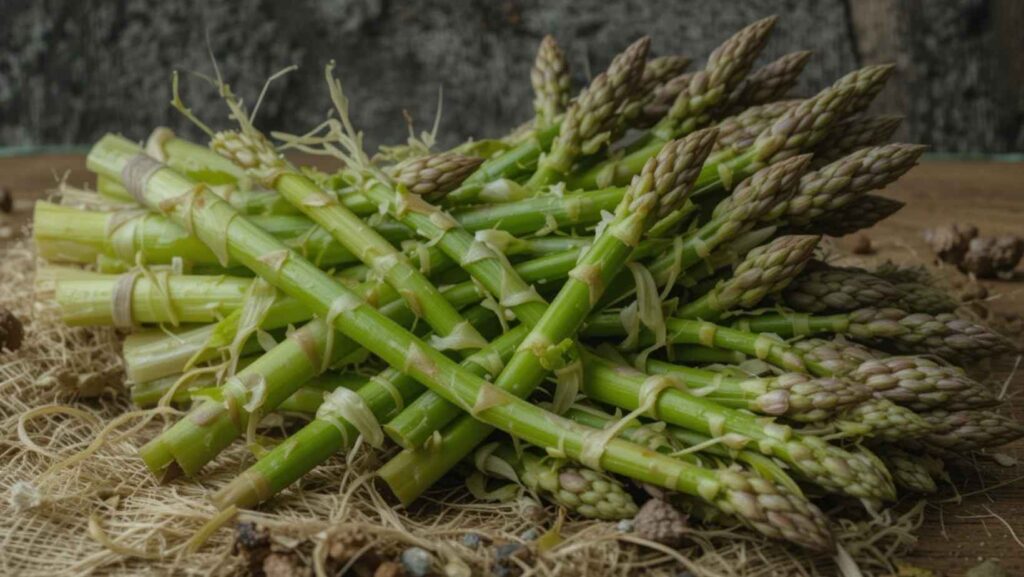
Would you want to know How to tell if Asparagus has gone bad? Based on my experience, Asparagus that has gone bad will have a few obvious signs: the tips will turn soft and potentially black, the stalks will become limp and mushy, and there could be a foul or rotten smell.
If the tops of the Asparagus are falling off or if the stalks have a slimy appearance, this is another indication that the Asparagus is no longer fresh.
Additional indications: There is a problem with your Asparagus. When you realize that the tips have become black, you will also note that they are fully squishy and possibly smell a little strange as well.
If your Asparagus has a slimy or sticky texture, a taste that is mushy and soft, a fragrance that is unpleasant, or obvious symptoms of mold,
it is time to throw it away. Although this is not everything, I will continue to educate you on the subject matter as you request additional information.
Now, let’s get started.
Does Asparagus go bad, and how long does it last
As you are already aware, this vegetable does spoil, but how quickly does it do so? The first factor is the product’s freshness at the time of purchase.
Fresh vegetables may often be kept in the refrigerator for a few weeks.
These green stalks should be eaten no later than five days after purchase if you purchase the vegetable in a store and you are unsure of how long it was on the shelf.
Vitamins A, C, E, K, and B6 are found in Asparagus, along with minerals including calcium, iron, copper, folate, fiber, and protein.
Some of this vegetable’s primary health benefits include the following: It helps decrease blood pressure and promotes digestive health since it is abundant in nutrients and antioxidants and low in calories.
It is also beneficial for pregnant women and, of course, for those who want to lose weight.
How to tell if Asparagus is bad or good for consumption
: Let’s examine in more detail how to determine whether Asparagus is terrible by touch, appearance, and smell.
#1 A poor batch of Asparagus will be mushy and limp. The buds of fresh Asparagus will feel stiff to the touch and are tight and rigid.
The Asparagus has started to lose its freshness if the tips are mushy and squishy when lightly pushed.
However, if the stem is hard and just the tip is soft, the fresh parts can be used by chopping off the soft parts or the tips.
The Asparagus should be thrown out if the stem is also mushy and limp.
#2 Bad asparagus, like many fruits and vegetables, has a terrible odor. Here’s a quick way to tell whether Asparagus has gone rotten.
Even before you touch or closely inspect the vegetable, this is said to be the most efficient method of determining if it has gone rotten.
You can determine if the Asparagus is excellent or terrible by smelling it before you even open the package.
#3 Discoloration may be a sign that Asparagus has spoiled. The hue of fresh Asparagus is deep green. Spoiled Asparagus would often have a deeper hue.
This might be a tint of dark green or something more like black.
The color of the Asparagus darkens with age, a sign that it is becoming unfit for human consumption.
You can determine whether parts of the stem can be utilized or if the entire stem needs to be discarded based on the discoloration.
What are the Signs that Asparagus has gone bad
There are several indicators when Asparagus is beyond its best or has gone rotten. Sometimes, you can save the Asparagus, but most of the time, you have to toss it out.
1. Shriveled or limp stems
The stalks of fresh Asparagus should stand up straight and feel strong to the touch. Their texture will be crisp when eaten uncooked.
Limp stalks are one of the first indicators when Asparagus has gone rotten. Since they have started to dry out, they may feel tender and appear shriveled.
Conclusion: Although Asparagus with limp stalks may not be visually appealing, they are technically safe to consume. To cover up their softer texture, try using them in soups and bisques.
2. Tip discoloration
When the tips of Asparagus, which are typically brilliant green and firmly closed, begin to become dark green or even black, it’s another classic indication that the Asparagus has rotted.
Asparagus starts to decompose after being stored at the store, in your refrigerator, or on your counter for an extended period, which is why it has become discolored.
Conclusion: You can save the stalks by chopping off and discarding the asparagus tips if there are no other signs of rot.
You may use the stalks in spaghetti and salads by cutting them into 2-inch pieces.
3. Slimy or mushy tips
An obvious sign that Asparagus has gone bad is when the tips begin to get sticky and mushy. Any change in texture indicates rotting, as fresh asparagus tips are typically crisp and sturdy.
The veggie is slimy because germs are growing on it and making it rotten. It frequently comes with an unpleasant odor, which is a dead giveaway of decomposition.
Conclusion: It’s preferable to throw out the entire bunch of Asparagus if the majority of it has slimy or mushy tips. You might save the remainder of the bouquet if only a few of the stalks have slimy tips.
4. An unpleasant smell
The aroma of fresh Asparagus should be subtle and grassy. However, Asparagus may develop a strong, disagreeable odor with a faint fishy aroma as it begins to spoil.
As the bacteria break down the Asparagus, they emit gasses that give it its unpleasant odor. Typically, the smell is accompanied by additional decaying symptoms, such as mushy tips and a slimy texture.
Conclusion: Don’t eat Asparagus that stinks. Trust your nose; if something doesn’t smell right, it’s generally not safe to consume and won’t taste very good either.
5. Growth of mold
Mold development is the last and most noticeable indication that your Asparagus has gone bad. Molds are tiny fungi that may be dangerous to your health and grow best in warm, humid conditions.
Vegetable mold typically has a fuzzy or powdery texture and is available in various colors, including green, white, black, or gray.
What are the Important tips when learning how to tell if Asparagus is bad
1. Stems of Asparagus that are not stiff are said to be over their eat-by date and should not be consumed.
In this case, it is essential to distinguish between a loss of stiffness caused by rotting and a lack of rigidity resulting from tight packing.
Stores, for example, use thread and elastic to keep bunches of asparagus stalks together. This occasionally entails applying pressure while securely tying the bunch in thread or elastic. The Asparagus may occasionally seem limp or bent from a point as a result of this.
In order to determine whether Asparagus is rotting, you should always examine many stems.
Please don’t make a decision based only on a few stems; they may have been subjected to additional wrapping pressure since they were on the exterior of the bundle.
#2: Stems of Asparagus that exhibit obvious mold growth should not be utilized. Under such circumstances, no part of the asparagus stem may be used.
An inedible state is indicated by Asparagus that appears slimy or glossy. If the Asparagus has reached that point, using it as an ingredient is unsafe and may cause disease.
With a better understanding of how to determine whether Asparagus is rotten, it’s time to learn some storage tips that will help you use it to its full potential.
What adverse consequences of eating asparagus should not be mistaken for harmful ones
It’s critical to comprehend the negative consequences of asparagus and how to assess its toxicity.
This is required since you may mistake the adverse effects of eating Asparagus for the consequences of eating rotten Asparagus.
It’s important to understand the differences between the two.
Although there are several adverse effects, a few are included here to prevent confusion with eating rotten Asparagus.
Stool odors: Asparagus contains a lot of sulfur and antioxidants. As a result, after eating Asparagus, there is a chance that your stools will smell foul.
The unpleasant odor is transient and will subside within two days after eating Asparagus.
Keep in mind that eating Asparagus will only temporarily produce a strong, unpleasant stench; it won’t permanently alter the scent of your feces.
Flatulence and burping: Asparagus is a great source of carbs and nutritional fiber. The excessive accumulation of gas is the cause of the existence of raffinose, a complex carbohydrate.
Because the human body lacks the enzymes necessary to break down the components of complex carbohydrates, fermentation takes place, leading to the accumulation of gas.
Then, this gas is expelled as farts or burping. Making the distinction between eating rotten Asparagus and experiencing such side effects is crucial when learning how to determine whether Asparagus is bad.
Urine that smells awful: Eating Asparagus can cause urine that smells bad, much like nasty feces. The presence of a sulfurous chemical is the cause of this.
Certain chemicals are produced during the breakdown of the compound in the digestive system, which results in an unpleasant odor.
Depending on how much is drunk and how many times you use the restroom, this foul stench can linger for a little over half a day.
Final thought
Now that we have established how to tell if Asparagus has gone bad, the most typical indicators that Asparagus is beyond its best or has gone bad are mold development, mushy or slimy tips, discolored or limp stalks, and unpleasant smells.
In certain situations, Asparagus can be saved by removing any mushy, slimy, or discolored portions.
However, if the Asparagus has a bad smell or you notice extensive mold growth and decay, it’s better to discard it.
To keep your asparagus fresh for as long as possible, store in the refrigerator either upright in a jar with an inch of water or wrapped in a damp paper towel.
You might choose to freeze Asparagus for long-term storage.