
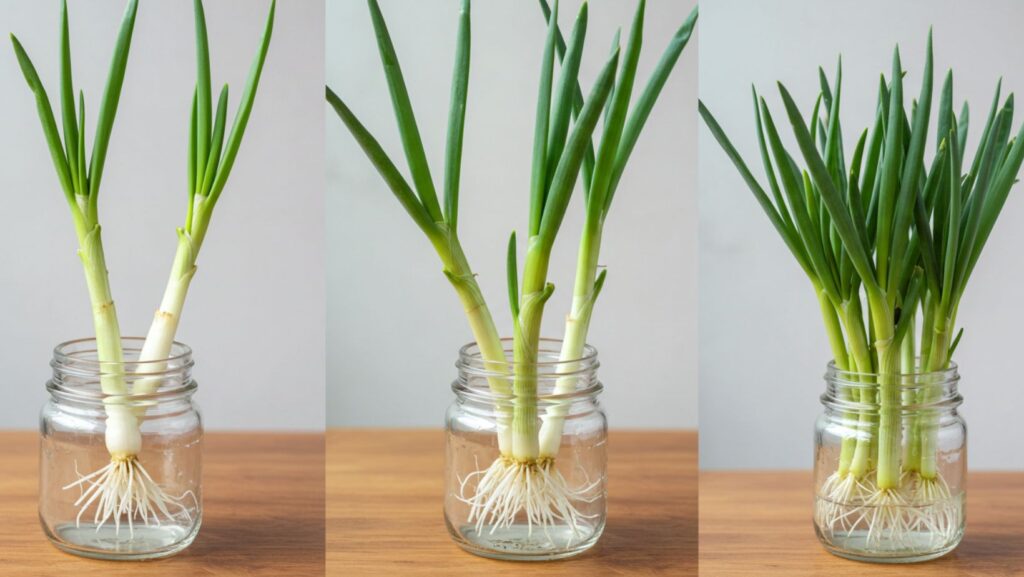
Would you want to know How to regrow spring onions from scraps? On the basis of my previous experiences All that is required to replant spring onions from leftovers is the white bulbous piece of the onion that still has its roots intact, a cup of water, and a window that is close to a source of light.
In order to ensure that the white bulb is able to stand on its own in the cup, I like to leave off around one to two inches of it.
In most cases, I observe spring onions beginning to produce more spring leaves within the first twenty-four hours.
Nonetheless, this is not the entirety of the subject; as you proceed, you will get other insights on the matter.
Now let get started
Can I regrow spring onions from the roots
Yes, if the root end is removed and submerged in water, spring onions can sprout again.
Home gardeners and cooks who desire a steady supply of fresh spring onions frequently use this straightforward method of propagating spring onions.
Use these procedures to grow spring onions again in water:
Save approximately an inch of the spring onion’s white portion after cutting off the root end.
Put the white portion of the root end in a glass or jar of water.
Keep the glass or jar in a bright spot and replace the water every two days.
New spring shoots should begin to appear from the onion’s top after a few days.
You may use the shoots like any other spring onion after cutting off the tops when they are around 4-6 inches long.
As long as you maintain the onion in water and give it sunlight, it will keep growing new shoots.
Keep in mind that the spring onions may lose their flavor and strength after several rounds of regrowth.
After a few cycles of regrowth, you may move the spring onion into soil to prevent this.
Why Regrowspring Onions
In the event that you are interested in planting and cultivating spring onions, your initial ideas may include planting seeds outside or beginning them indoors in the early spring for the purpose of transferring them into the garden.
It is also possible to cultivate additional spring onions by making use of the spring onions that you purchased from the shop.
By upcycling your vegetables, you will not only decrease some of the trash that you produce (which is always a good objective! ), but you will also have a fun project seeing new shoots emerge.
What are the steps in Regrowing Spring Onions
Step 1: Get Ready
Choose spring onions with their roots still in place.
About an inch and a half from the bottom, cut off the base.
To encourage stem development, submerge in water for three to four days.
Plant in the ground.
Step 2: Recipe Inspiration
When cooking, spring onions can be used to add flavor and texture. When added to mashed potatoes, they taste fantastic.
The dial goes up a notch when spring onions and a little butter are added to a baked potato.
Step 3: Establishing
It’s simple to plant; simply dig a hole, plant the roots, cover with dirt, and water. I’m cultivating them in a planter box that is fastened to the interior railing of my balcony.
Step 4: Make an excessively short cut
When these spring onions were first planted, they were trimmed too near the root. Compared to if 1 to 1 1/2 inches of stalk had been left, they will take longer to grow, assuming they develop at all.
Step 5: Get the Growth Started
Cut the spring onions about an inch and a half from the root, then submerge them in water to encourage development and hasten the sprouting process.
Growth is shown in the pictures after one and five days.
Plant in the dirt three to five days later. As is evident, regeneration will take a much longer if they are trimmed at the very bottom.
Step 6: The Impact of Too-Short Cuts
After ten days, here is the change. The ones that are trimmed too short are just beginning to develop.
Conversely, the ones that are cut an inch and a half from the root and immersed in water for five days prior to planting are Some of the steams were chopped and put to mashed potatoes after four weeks of growing. The potatoes gained flavor as a result.
Step 7: Gathering
Some of the steams were chopped and put to mashed potatoes after four weeks of growing. The potatoes gained flavor as a result.
Step 8: What Vegetables Do Well in Planters
Known as the “Boarder Collie” of veggies, silver beet is the most popular crop to grow in planters.
I started several from seeds and have been pulling and twisting them as needed to break off a leaf from the base of each plant.
In this manner, the leaves continue to develop and you maintain a ready supply. It pairs nicely with scrambled eggs in the morning.
Parsley grows nicely from seed as well. Although the spring onions I planted are doing nicely, it seems preferable to simply plant the cut-off base as mentioned above.
How to Regrow your own spring onions at home
Like herbs, spring onions are simple to produce at home and may be harvested as needed.
A container, some potting mix, and a bouquet of spring onions from the grocery store are all you need.
Slice the spring onions from the root by two to three centimeters.
Simply put the root pieces in a planter with potting mix after using the stems in whatever you are preparing.
A small portion of the stem should remain above the dirt when the roots bury themselves. Let it develop and water it frequently.
When they reach adulthood, you can cut off the base as needed. If you leave the roots in the ground, they will come back around four more times before you have to start over.
Another option is to let one of the spring onions to develop, bloom, and yield seeds.
You may also grow them in water if you don’t have any soil.
Slice the spring onions from the root by two to three centimeters. Place your cutting’s root end in a little water container.
Store on a balcony or in a sunny area of your home. Replace the water once a week and keep the roots immersed in it.
How to regrow spring onions & reduce food waste forever
Let’s be honest, spring onions are amazing! The modest spring onion is essential for combining flavors and textures that we adore, whether you’re making san choi wow, a veggie pie, or Singapore chilli crab.
But regrettably, they are also frequently wasted when you might be cultivating your leftover spring onions indefinitely.
Yes, you might never need to buy spring onions again, and at Grow It Local, we’re very committed to minimizing food waste.
It only takes a few easy steps.
Step 1: Trim the bottoms of any spring onions you cultivate or purchase.
Step 2: Put the cuttings in a water jar for three to five days, or until roots start to show.
Step 3: Place the cuttings in a well-composted soil garden bed or container.
Step 4: Savor your freshly grown vegetables whenever you want and share it with others.
Final thought
Now that we have established How to regrow spring onions from scraps, There is a possibility that you may receive between two and five harvests from a single spring onion, depending on the method that you used to transplant it (from a simply watered medium or from soil).
If you remove a spring onion, it will sprout from layers within the stem that it was originally attached to, which means that it will continue to add new layers as it develops.
It is possible that these stems will be thinner than the spring onion that was originally planted;
nevertheless, I have discovered that if you transplant them in soil, they will become more robust.