
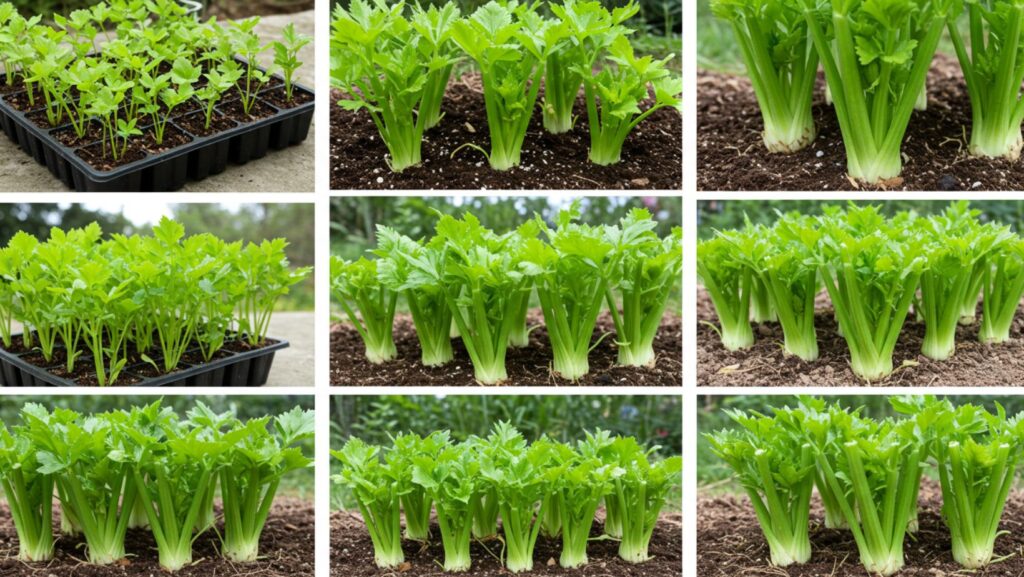
Would you want to know How to grow Celery? In light of my experience, In order to cultivate Celery, sow seeds indoors in the early spring and move seedlings outdoors as the weather warms.
Make sure the soil is well-drained, has a high organic matter content, is consistently moist, and receives plenty of sunlight.
Thin plants frequently allow them to grow, and use stakes to support them as the celery stalks lengthen.
Harvest by trimming the stalks at the base as needed during the growing season.
Additionally, if you produce Celery from seed, you may experiment with some exciting and unique varieties.
Adding pink Chinese Celery to a dish of crudités is a beautiful way to combine color and flavor.
Cultivating celery enables the enjoyment of fresh celery during winter by excavating and overwintering plants in containers within a root cellar or a non-freezing cold frame.
Or perhaps the excitement of overcoming the obstacle will drive you to develop it.
However, that is not all; I will continue to educate you on the topic as you read on.
Now, let’s get started
How to Grow Celery
Throughout the growth season, celery plants require frequent irrigation. Keep the soil uniformly wet but not soggy; do not let it dry out.
In the morning or late afternoon, could you give it a thorough watering? To prevent fungal infections, do not irrigate plant leaves.
No further fertilizer should be required if the soil was prepared correctly.
Applying a balanced fertilizer or one designed for fruits and vegetables might help improve bad soil or give your plants an extra boost:
When transplanting or when the seedlings are 5–10 cm tall, use slow-release fertilizer at the prescribed rate.
During plant fruiting or blooming, apply liquid fertilizer at the prescribed rate and interval.
Blanching celery plants enhances their flavor and softness.
By putting opaque containers around the plant, mulching heavily with straw, or hilling the dirt up around the bases of the plants, you can block off the light.
What are the Tips for Growing Celery
Water: Celery gets stringy and bitter if it dries out. Additionally, dry conditions result in stems that are hollow or pithy.
Provide a steady flow of moisture to plants. Incorporating compost into soil improves water retention.
Mulch: Covering celery plants with a layer of mulch keeps the soil moist for longer and prevents the drying out of shallow roots.
Fertilizer: Use a balanced fertilizer, like fish emulsion or 5-10-10, to feed Celery throughout the growing season to maintain steady growth.
In the second and third months of the crop cycle, fertilizer should be applied once. Additionally, you may use manure tea to water plants once a week.
Weeding: Due to its thin roots, Celery is not a good competitor for weeds. Keep weeds out of the planting area. Mulch can aid in weed suppression.
How do I grow Celery in a pot
Select a container long enough to accommodate extra celery plants spaced 10 inches apart and at least 8 inches deep.
If at all possible, avoid using unglazed clay pots since Celery likes to stay moist and dry out rapidly. In this case, plastic containers are a fantastic option since they keep things wet.
Add a lot of organic compost to the soil to help it retain moisture eight to twelve weeks before the final frost plant seeds.
It takes around two weeks for germination to occur. Lightly cover the seeds with dirt and plant them only 1/8 to ½ inch deep. Plant five seeds in an 8-inch container, with 2 inches between each seed.
Cut the smallest seed in half after the others have sprouted. Reduce the number of plants to one when they are three inches tall.
With temperatures between 60-75 F (15-23 C) during the day and 60-65 F (15-18 C) at night, make sure the plants receive at least six hours of sunlight each day.
How to Growing Celery From Seed
After seeing how little the seedlings were and learning that it can take up to 90 days from seed to transplant size—though the seedlings can be moved a little sooner under ideal weather conditions—a gardening acquaintance recently showed interest in growing Celery.
Despite their small size, celery seedlings of both varieties are robust little creatures that are simple to transplant and harden off.
However, as the seedlings frequently do not start consistent development for three weeks, the celery grower then faces another sluggish period.
Throughout this time, they need to be kept weed-free and given enough water to keep the soil consistently wet.
What are the Celery growing Varieties For The UK
In order to block out the light, Victorian gardeners wrapped cardboard or other similar materials around the celery plant stems, blanching them.
They sometimes ground the crop up, much like we do with potatoes. Similar to how some other vegetables are blanched while growing, this produced a white stem. Cardoons, for instance.
I’m not in favor of earthing up because it made the crop filthy.
Then, self-blanching variants appeared. Additionally, light is avoided if the crop is heavily planted. I built and continue to grow Lathom’s Self Blanching.
There are additional types with green stems, in which the amino acid is used to keep the stem’s color bright green.
Some nations cultivate variants that are red or pink.
A historical celery cultivar, Fenland celery is mainly produced in Cambridgeshire’s Fens.
The most prominent farmer uses labor-intensive, traditional methods to cultivate up to 15 hectares annually. This type is planted in June and harvested in October.
What are issues with celery growth
Nematodes, carrot rust flies, and parsley worms are the primary pests of Celery. The tiny yellow caterpillars with a single white stripe that makeup celery leaf layers are controlled by hand selecting.
Brown, sunken spots or black joints are signs of tarnished plant bug attacks.
Pink rot, which manifests as water-soaked stem spots and white or pink coloring at stalk bases, and early and late blight, which both start as tiny dots on the leaves, are common illnesses that impact celery harvests and other vegetables.
The best control is crop rotation.
A boron-deficient soil may be indicated by distorted leaves and broken stems; treat by misting plants with liquid seaweed extract every two weeks until symptoms go away.
How to Grow Celery from Scraps + STEM
Children may quickly learn that our foods are plant components by growing Celery from waste. The whole plant is edible and delicious.
The roots, stems, and leaves are edible. To cultivate Celery from leftovers, you’ll need:
A celery bundle’s chopped end (the fresher, the better)
A transparent glass or jar
flower container with water and potting soil
Step 1: Put the celery bundle’s cut end in a jar. Fill the jar with water, but do not fill it. Keep the Celery’s top portion sticking out of the water.
The Celery will drown if you cover it completely. Wait while the jar is placed in a bright window. You should notice some roots sprouting in about a week.
After a few days, you ought to notice some leaves sprouting as well!
Step Two: The celery plant should be moved to a flower pot as soon as it begins to develop roots and leaves.
The plant now needs the nutrients present in the soil. Water the celery plant as required and keep it in a warm, bright window.
Take care not to overwater. The plant will be drowned by too much water. If you inadvertently overwater the flower pot, you can set it on a plate or dish to assist drain the water.
Step Three: Your celery plant will continue to develop if you give it the proper care. It can grow to the point where you have to move it into an enormous container or plant it in your garden.
Celery may grow to a height of 12 to 18 inches when completely grown.
Step Four: Gather your Celery and savor it! You can harvest as much Celery as you need at the appropriate time; you don’t have to pick it all at once.
Many stalks have been removed from this plant, yet it continues to grow.
Final thought
Now that we have established How to grow Celery, To keep the soil wet, Celery has to be watered often. It can get moisture-stained and have stringy, bitter stalks if you let it dry up.
To assist in retaining moisture, cover the soil with an organic mulch, such as sugar cane or pea straw.
Despite being a sign of a thriving plant, Celery’s brilliant, dark-green stalks have a harsh taste due to their rich color.
You will need to blanch the stems in order to sweeten them. Cover the lowest stems with a thick piece of cardboard or a milk carton that has had the top and bottom cut off.
If at all feasible, place the milk carton over the top of the plant or wrap the card over the base. In the last weeks before harvest, do this.