
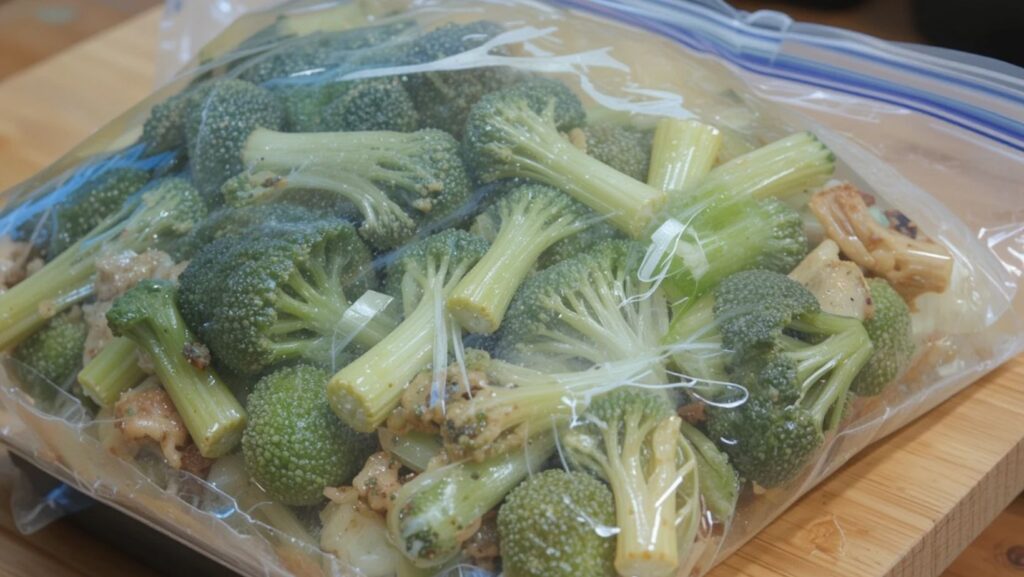
Would you want to know How to freeze vegetables without losing nutrients? In my experience, blanching veggies in boiling water for a short time and then shocking them in ice water preserves their nutrients.
Make sure to properly package and freeze them to avoid freezer burn and preserve their freshness.
Blanch vegetables by submerging them in steam or hot water. Dry pack and tray pack are the two fundamental packing techniques that are advised for frozen veggies.
Most veggies may be kept at 0 degrees F for 12 to 18 months, but that’s not all. I’ll go into more detail about this topic as you read on.
Now let get started
How to Keep the Nutrients in Your Veggies
All veggies have carbs. Starchy and non-starchy veggies are commonly classified. Both are solid options for frequent meals.
Because they have little carbs, non-starchy veggies don’t affect blood glucose. For effective meal planning, aim for ½ of your plate to be non-starchy veggies. You must eat veggies, but how?
Fresh:
Freshly harvested vegetables provide the most nutrition. Buy fresh local vegetables to cut down on harvest time.
Prepare fresh veggies by washing them gently but not soaking them. Soaking reduces water-soluble vitamins. Cooked veggies are nice if you don’t like raw ones.
Cooked:
To add fiber and minerals to veggies, eat the skin. Instead of peeling, wash and consume potato, carrot, zucchini, and beet skins.
Prep veggies immediately before cooking to reduce oxygen and light-induced nutritional loss.
Cooking reduces vegetable nutrition. Nutrient loss increases with higher temperatures and longer cooking periods.
Conversely, cooking can boost nutritional availability. Lycopene from tomatoes is more absorbed when cooked.
Cooking increases calcium and magnesium availability. Cooking improves carotenoid absorption in red, yellow, and orange vegetables.
Steaming veggies preserves water-soluble vitamins better than boiling. Steaming covered reduces cooking time and prevents overcooking.
Pressure cooking, stir-frying, and microwaving are healthful fast cooking methods.
Roasting is faster than baking. Roasting veggies in oil speeds up cooking and boosts fat-soluble vitamin absorption.
Fresh greens or other raw veggies in soups, stews, or sauces are my favorite method to “cook” vegetables. In a slow cooker, this preserves nutrients.
Cooked vegetables shrink, so you can eat more.
Frozen:
Many assume frozen veggies are less healthful than fresh. False—frozen veggies are selected ripe. Wash, blanch, and freeze.
Frozen veggies have equal vitamin, mineral, and phytonutrient content as fresh. Frozen vegetables make adding vegetables to meals easy and fast.
What is the best way to store vegetables to maximize the nutrients available
It is possible for a vegetable to lose part of its vitamin and nutritional content whenever it is kept, regardless of whether it is cooked, raw, or frozen.
However, minerals and fiber are not affected by this process. On the other hand, this would be rather little and might not even be considered relevant from a nutritional standpoint.
Does it really make a difference, for instance, if the vegetable has 130% of vitamin A and then drops to 127% when you only require 100% of it anyway?
As a matter of fact, I prefer to blanch the entire bunch of broccoli raab so that it is ready to be sautéed or stir-fried for supper throughout the week. This is done for the sake of convenience.
To me, it is of far greater significance to make certain that it is simple to use and that it is consumed than it is to worry about any potential loss of nutrients that may or may not occur as a result of having been cooked and then stored in the refrigerator.
Whether or not you want to freeze the food that you are not going to consume is totally up to you; however, if you are going to freeze the veggies, you should consider blanching them first.
It should be safe to store cooked vegetables in the refrigerator for one to five days (this is something that I do frequently).
What are the Freezing instructions for specific vegetables
Globe Artichokes
Choose tight-leafed globes that are compact. Take off all of the leaves, choke, and fuzzy parts. The heart is the part that remains at the base. Trim any woody parts and cut off the stem immediately below the center.
Drain and wash hearts in cool water. Let the water blanch for seven minutes. Leave no headroom after cooling, draining, and packing.
Close and put away.
Jerusalem (Sunchokes) artichokes
Choose medium-sized, young sunchokes. Scrape or peel, then wash. Depending on size, blanch in water for 3 to 5 minutes. Drain, pack, freeze, and cool.
The asparagus
Pick young spears that are delicate. Sort into sizes after giving everything a good wash. Using a sharp knife, trim stems and remove scales. To fit containers, cut into uniform lengths.
Small spears should be water-blanched for two minutes, medium spears for three minutes, and giant spears for four minutes.
Small spears should be steam-blanched for three minutes, medium spears for five, and giant spears for six. Cool, drain, package, seal, and freeze as soon as possible.
Green, snap, or wax beans
When the seed initially forms, choose fragile immature pods. Use cold water to wash. Slice lengthwise or into 1- or 2-inch sections.
Blanch in water for 3 minutes and in steam for 5 minutes. Cool, drain, package, seal, and freeze as soon as possible.
Lima, butter, or pinto beans
When the seed is still green, harvest it. Clean, shell, and arrange in size order.
Small beans should be water-blanched for two minutes, medium beans for three minutes, and giant beans for four minutes.
Small beans should be steam-blanched for three minutes, medium beans for five, and giant beans for six. Cool, drain, package, seal, and freeze as soon as possible.
What are the Six Steps to Freezing Vegetables
If you follow this procedure exactly, you may preserve a lot of vegetables:
Get the produce ready.
In the following weeks, for instance, chop the veggies to the size you want to use in a pasta salad.
1. Let the veggies blanch.
Flash-cook your vegetables in hot water for 1 to 2 minutes before freezing. For every pound of veggies, use a minimum of one gallon of water.
The enzymes that maintain the ripening process are stopped by blanching.
Additionally, it improves the color, preserves the nutrients, and aids in the removal of dirt and bacteria. (Note: Do not do this if you are freezing tomatoes.)
2. Submerge them in chilly water.
When the veggies are blanched, quickly submerge them in a dish of ice water until they are absolutely cold.
3. Pat dry after draining the water.
Take off any water droplets that can cause the vegetables to get soggy.
4. Put veggies in a single layer of frozen food.
Position the vegetables in a single layer on a baking sheet or within a freezer-safe container and freeze until solid.
5. Put veggies in storage bags.
Use a vacuum sealer or place them in freezer bags once they’re frozen. By the time you thaw them, “off” tastes will have developed, so you don’t want them to come into touch with air.
6. Freeze well-thawed veggies.
When cooked, the majority of veggies will stay crisp and delicious even if frozen. However, certain veggies will not freeze well, either in terms of appearance or flavor.
They will become limp and acquire an oxidized color, taste, and scent after thawing.
The following vegetables should not be frozen when being stored: Cabbage
- Celery Cress
- Cucumbers
- Endure
- Radishes and Lettuce
- Irish potatoes
Additionally, either baked or boiled, Irish potatoes are not the best vegetables to freeze. They get mushy, crumbly, and soggy after thawing. Some varieties of potatoes freeze considerably better.
How to Preparing Vegetables for Freezing not to lose nutrient
Products should be frozen as soon as possible for optimal results.
Set your freezer’s temperature control to the lowest setting several hours before you want to put food in the freezer to speed up the freezing process.
In certain freezer instructions, the coldest shelves are identified, and items are advised to be placed on them.
For information on the recommended quantities of unfrozen goods that can be frozen at one time, see the freezer handbook before loading the freezer.
There should be two to three pounds of food per cubic foot of freezer space each 24 hours.
A long, sluggish freeze and a subpar product are the results of packing the freezer full of unfrozen goods.
Blanching
The initial step in preparing vegetables for home freezing is blanching. Blanching is the technique of temporarily immersing vegetables in hot water.
In addition to cleaning the surface of dirt and organisms, blanching brightens the color, helps delay the loss of vitamins, softens and facilitates packing, and prevents enzyme activity that can result in a loss of flavor, color, and texture.
Supplies and Equipment:
produce scale (optional) kitchen timer knife, chopping board, vegetable peeler, freezer bags, solid freezer containers, or glass jars with a waterproof marking for freezing
For heating vegetables, use a big pot with a lid and a wire basket or metal colander that fits within or a blanching kettle with a basket and lid.
To chill veggies, use a big bowl or pot colander, lots of cold, fresh water, and optional ice cubes.
final thought
now that we have established How to freeze vegetables without losing nutrients When it comes to preserving vegetable, freezing is one of the most straightforward, simple, and time-efficient of all the ways available.
When compared to other known techniques of preservation, freezing is superior in terms of maintaining the original color, fresh flavor, and nutritious characteristics of the majority of foods.
Despite the fact that freezing does not sterilize food, the severe cold slows down the growth of germs and slows down chemical changes that might alter the quality of food or cause it to go bad.