
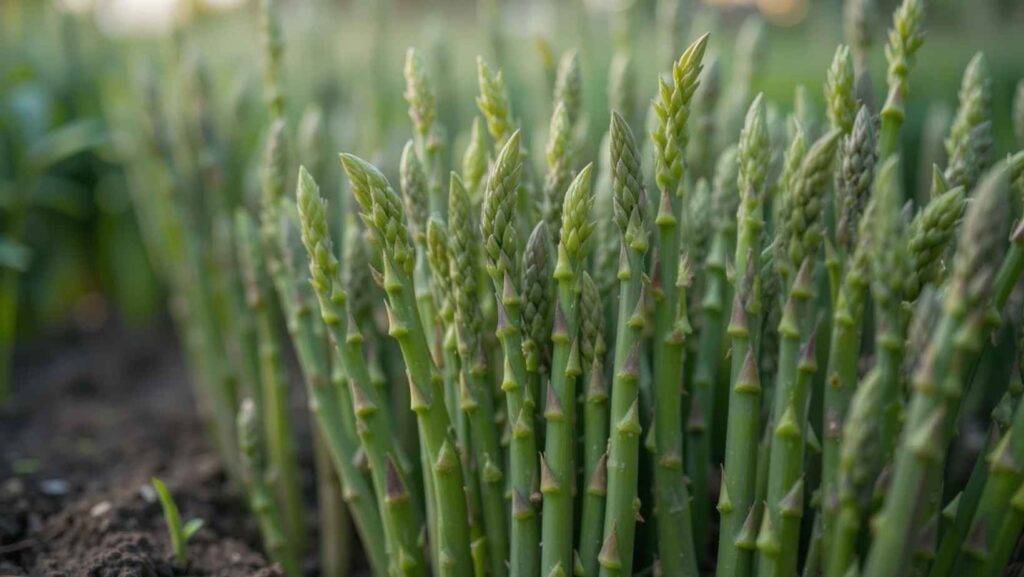
Would you like to know how profitable asparagus farming is? Based on my personal experience, I can say that asparagus farming has the potential to be lucrative and offers significant revenue opportunities; however, it does require a substantial initial investment and careful management.
The earliest years of a farm’s existence can be quite expensive despite its potential to generate considerable revenue.
However, that is not all; as you continue reading, I will provide you with further information on the topic matter.
Now, let’s get started.
How many times can you harvest asparagus
At the beginning of the season, you could pick spears that are seven to nine inches long every two to four days.
It is expected that the frequency of harvesting will increase to once or twice a day as air temperatures continue to rise.
After you have harvested up to 24 times over the season, you may then let the crowns of the fern grow out to their full potential.
Whether to harvest asparagus by snapping it or by cutting it is a heated topic of discussion.
One thing to note is that cutting asparagus with a knife below the ground does not offer any benefits or advantages.
There is a possibility that this might cause damage to the buds on the crown that are responsible for producing new spears.
The optimum method of harvesting involves snapping a spear that is between seven and nine inches long and slightly above the ground level.
After snapping, the short stub of asparagus that remains in the soil soon dries out and disintegrates due to the effects of the drying process.
The key to success is timing:
When harvesting asparagus, it is crucial to do so at the optimal time. Prolonged durations between harvesting lead to a decrease in the quality of the spear.
To put it another way, the tips of the spears begin to loosen, a process also referred to as “ferning out,” and fiber starts to grow at the base of the spears, causing them to become more robust.
How long does asparagus take to grow
1. Begin with dormant crowns.
Although asparagus may be started from seed, it is often grown from one-year-old crowns, as it takes three years for the plants to mature.
However, it’s worth the wait, as the plant may continue to produce for ten years or more.
When the soil is workable in late winter or early spring, you may begin planting. The number of plants you need depends on how much asparagus your household likes.
Ten plants per person is a good starting point. You should grow extra if it’s a family favorite or if you intend to freeze any for later.
2. Plant in rows
Asparagus should be grown in an area with adequate drainage. Create trenches that are 6 to 12 inches deep and around 6 inches broad.
Next, distribute the roots along the ridge by making a mound in the trench and spacing the crowns 15 to 18 inches apart.
Mix the native soil from the trench with compost or garden soil (such as Miracle-Gro Garden Soil for Flowers & Vegetables) in a 50:50 ratio, just as you would when planting individual plants in the ground. Then, cover your asparagus plants with 2 inches of the soil mixture.
As the crowns begin to grow a few inches, fill the trench with an additional 50:50 soil mixture.
3. Eat Healthily
One of the heavy feeders is asparagus. Use a continuous-release plant food, such as Miracle-Gro® Shake ‘n Feed® Tomato, Fruits & Vegetables Continuous Release Plant Food Plus Calcium, in the spring before development begins and again three months later, after harvest, to promote thick spears.
Apply a 3-inch layer of mulch to promote moisture retention, and water the soil regularly to maintain a consistent moisture content.
4. Savor Asparagus Each Year
The first year is not the time to harvest. To allow the crown to develop itself, let the plants grow.
In the second year, you can begin picking your asparagus sparingly.
When the new spears start to emerge in the spring, remove the old fern growth from the previous year, which consists of the thin leaves that grow above the stalk.
Only the spears thicker than a pencil should be harvested, and the bed should be kept up for the upcoming years.
Make careful to let some spears turn into ferns at the end of the harvest so that the nutrients are restored for spear production the following year.
Is asparagus a profitable crop
When you are in the first four years of growing asparagus, it is not a profitable crop, as you are still establishing it.
In the event that asparagus production begins, the price at which it can be sold is the primary factor that determines profitability.
Two charts are provided below, illustrating the potential earnings from asparagus at varying prices per pound for two different yields.
Lastly, regarding the charges, all of your setup fees are paid in advance. It is, therefore, unnecessary for you to be concerned about those once they have been sunk.
After that, the weeding project will be your primary annual expense.
If you want to reduce the amount of weeding you have to perform, you may want to investigate some deep mulching techniques.
If you can achieve yields of one pound per square foot, then growing asparagus on most small farms is definitely a good idea.
Suppose you have a very small area and are accustomed to turning your beds numerous times during the season. In that case, asparagus is generally not going to be able to compete with what you can produce from other crops.
If you have a medium-sized farm and typically harvest each bed only once a year, you can likely make a profit from growing asparagus if you can collect at least $7.50 per pound.
Where does asparagus grow
In temperate locations, when there are either low temperatures or dry conditions that give the plant a “rest” phase, asparagus is a plant native to such regions.
Only Washington, California, and Michigan are responsible for the commercial production of asparagus in the United States.
However, asparagus growth is also possible in several other states.
Asparagus is most successful when grown in sandy loam soil that has good drainage, and it must be planted when the soil temperature reaches 50 degrees Fahrenheit.
how an asparagus farm works
Before starting an asparagus farm, it is essential to understand how it operates and its key cash streams.
This will show you the profitability potential of your enterprise and help you determine if it’s right for you (skills, savings, cash, and family obligations).
Creating an asparagus farm may be a good idea, but not for you.
Successful entrepreneurs often seek assistance from experienced asparagus farm owners before launching their own business.
Work on an asparagus farm to gain experience.
Attend appropriate training
We’ll examine each possibility further.
Following the counsel of seasoned asparagus farm owners
Established business entrepreneurs have “seen it all” and may provide tips and advice from their own experiences.
Because of their achievements and disappointments, they now know how to create and maintain a profitable asparagus farm.
Working on an asparagus farm
Industry-specific expertise gives you the information, network, and insight to overcome obstacles and make smart business decisions if you want to create an asparagus farm.
You’ll also be able to determine if this company concept fits your lifestyle (extended working hours may interfere with parenting small children).
Work experience can help you develop industry relationships and understand clients’ expectations, which will be useful for starting your asparagus farm.
Attend appropriate training:
A training course is another approach to learning about your potential company strategy before making a decision.
You can take online courses to learn practical skills or enroll in training courses to earn a certificate or degree.
Before launching your business,
Before starting an asparagus farm, you should know what it will take:
(Do you have any of these talents to operate the business?)
Does a typical workweek fit your schedule?
The asparagus farm’s revenue and long-term growth potential (compared to your desire)
What choices await you after retiring (or selling the firm)?
This business model and limitations analysis can help you determine if starting an asparagus farm is a suitable fit for your entrepreneurial profile.
If a match is identified, you can form your company’s starting team
How much money do I need to start an asparagus farm
We must first examine the resources required to start and maintain your asparagus farm in order to provide an answer to this important topic. Let’s examine what that comprises.
It is hard to provide an average budget for beginning an asparagus farm because every endeavor is unique.
When reading estimates online, we strongly recommend giving them significant thought. The following are the greatest questions to ask yourself:
Is my project comparable in terms of location, concept, scale, and other relevant factors?
Is the source of this information reliable?
Is the information current or outdated?
You can then calculate the cost of each item and incorporate it into your financial projection (which we’ll examine later in this book) by considering the investments and human resources required to start and operate the firm.
When the prediction is finished, you will have a clear understanding of the initial outlay of funds needed and the prospective profitability of your company concept.
Investments and startup expenses for establishing an asparagus farm
First, let’s talk about the investments. The following things can be included in the initial operating capital and investments needed to start an asparagus farm:
Land and Property: This covers the cost of purchasing or renting land for your asparagus farm, as well as any necessary structures or infrastructure required to operate the business, such as processing machinery, storage spaces, and irrigation systems.
Farm Machinery & Equipment: To plant, harvest, and process the produce, asparagus farming calls for specialized machinery.
Tractors, tillers, harvesters, and packaging supplies may be examples of this. These things can cost your farm a lot of money.
Greenhouse or High Tunnel: To safeguard your asparagus plants and extend your growing season, you may need to make an investment in a greenhouse or high tunnel, depending on your location and climate.
Although these structures may be costly, they can also enhance your profitability and productivity.
Automobiles: Moving the harvest from the field to the marketplace or processing plant is a common part of growing asparagus. Trucks or other vehicles may need to be purchased in order to convey this.
Additionally, if you want to deliver fresh asparagus, you would need to purchase refrigerated vehicles.
Housing for Labor: You may need to offer lodging for employees on or near your asparagus farm if you plan to recruit them.
This may involve the construction or acquisition of dwelling units, as well as ongoing maintenance and upkeep expenses.
Naturally, you will need to modify this list to meet the unique requirements of your business.
Final thought
Now that we have established how profitable asparagus farming is, Commitment is really necessary for growing asparagus.
It may take two to three years for those crops to yield satisfactory harvests.
You have to commit to tending to those fragile shoots for a considerable amount of time when there is not much immediate benefit.
People who persevere, on the other hand, are likely to experience a sense of immense satisfaction when those thick spears eventually begin to emerge from the ground.
When it comes down to it, all of that perseverance and patience really does pay off in the end.