
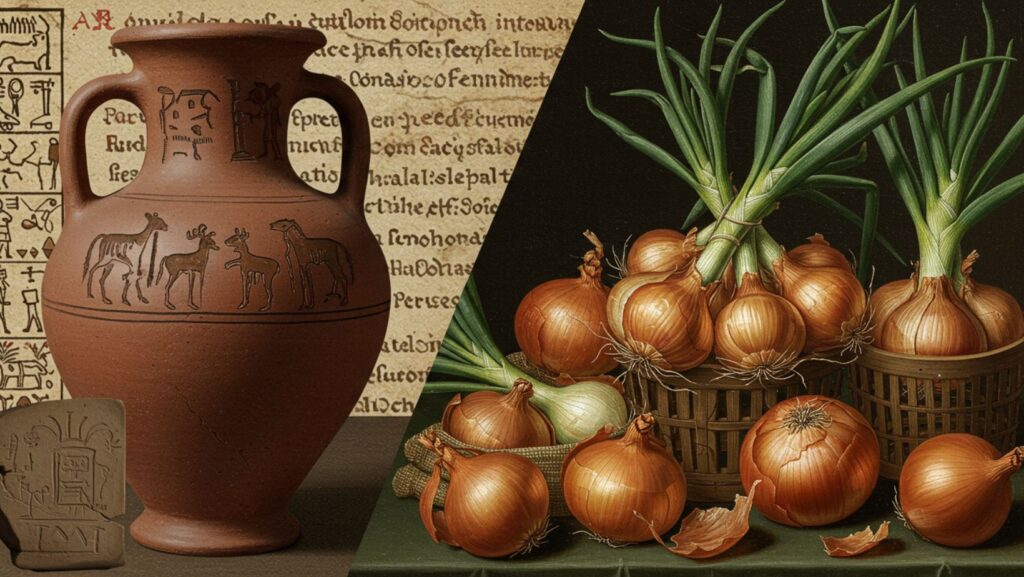
would you want to know about the history of onions? To my knowledge, many archaeologists, botanists, and culinary historians think onions originated in central Asia.
Other evidence says Iran and West Pakistan grew onions earlier.
Long before farming or writing, our ancestors may have discovered and eaten wild onions. This simple vegetable was likely an ancient mainstay.
Most academics say onion cultivation dates back at least 5000 years. Onions grew wild in many locations; therefore, they were likely consumed and domesticated worldwide for thousands of years.
Because they were less perishable than other foods, transportable, easy to produce, and adaptable to many soils and climates, onions may have been one of the first farmed crops.
Onions were also life-sustaining. Onions alleviated thirst and could be dried and stored for food shortages.
Many early sources highlight the onion’s value as a food and its usage in art, healing, and mummification, but its origin is unknown. Many restaurants across have perfected onion cooking.
However, I will explain more as you read on.
Now, let’s get started.
What is the origin of the onion
As previously stated, onions originated in the Middle East. This probably included a portion of southern Russia and the region between Iran and West Pakistan.
To the east and west, the onion was then dispersed even more.
There are passages in the Bible and Quran that demonstrate how significant onions were as a meal in ancient Egypt.
The Greeks first learned about onions in about 1000 BC, thanks to the island of Crete. The Romans were aware of the onion about 400 years before Christ.
The onion only became relevant in the Netherlands considerably later on.
Unhygienic food:
In India, garlic crops were forbidden to anybody pursuing a higher spiritual life since they were seen as an impure meal.
Ancient texts state unequivocally that it is banned to eat these crops.
Only the use of certain herbs to treat illnesses was permitted. It is a common idea that plants with a strong odor are resistant to evil.
The Romans, for instance, utilized onions to ward off bad spirits.
In Europe throughout the Middle Ages, only a few people consumed onions. More of these goods were eaten in Europe only after 1300.
Onions were sent to England in the fifteenth century, and the bulb crop is being used more often in traditional recipes.
Fruit and onion consumption began to rise in the 18th century, and it wasn’t until the 19th century that Dutch cooking books began to include onions. But frequently, it’s also used as an optional spice in food.
What are the Traditional Uses of Onions
During the Anglo-Saxon era, onions were a staple meal in England, and their powerful taste and gentle antibacterial properties made them highly prized.
They were thought to stop those who went through from spreading the disease, therefore they were hung over entrances with garlic.
When humans ate rich foods, onions were utilized in conjunction with sage to aid with digestion.
When John Gerard wrote his book Herball in 1633, there were already a number of known onion types in England.
The therapeutic effects of each onion type were likely comparable because Gerard did not specify which ones should be utilized for treatments.
Sniffing onion juice up the nose clears the head and causes a lot of phlegm to come out.
Additionally, onions were used to heal gout, protect against a crazy dog’s bite, and promote hair growth in bald people when their heads were massaged with onion juice in the sun.
Evidently, the juice was also beneficial for onions, a plant that didn’t require any explanation.
The applications were numerous and diverse, including relieving coughs and aiding in the removal of dry or stuck phlegm, boosting appetite and thirst, easing bowel movements, treating bites from dangerous animals such as crazy dogs, and curing worms in children.
Onion vinegar might be applied to the ears and used to address skin imperfections.
Onion honey was believed to be effective in treating asthma, and onions may be used to cure tinnitus and discomfort. Leeks are comparable to onions but less potent.
As World War II progressed, the Russians used onions as an antiseptic to combat wounds.
Onions are an effective antiseptic. Roasted onions can be used to treat tumors or earaches, onion syrup can be used to treat colds and coughs, and onions macerated in Holland’s Gin can be used to treat gravel, which are urinary system stones, and dropsy, which is swelling brought on by fluid retention.
What is the origin of the onion? Why is it associated with the God (s)
Ancestral onion species’ histories are poorly recorded. The geographic origin of onions is unknown because ancient records of their use span both western and eastern Asia.
However, west or central Asia is most likely where domestication occurred.
, onions originated in central Asia, Iran, and Pakistan.
Onion traces found in Bronze Age Chinese villages indicate that onions were utilized as early as 5000 BCE, not only for their flavor but also for the bulb’s resilience during transportation and storage.
The onion bulb was highly regarded by the ancient Egyptians, who saw its spherical form and concentric rings as representations of endless life.
Traces of onions discovered in Ramses IV’s eye sockets provide proof that onions were utilized in Egyptian tombs.
How did the name “Onion” come about
The Latin word “unio,” meaning “one” or “single,” is where the term “onion” originates. This is because the onion plant only yields one bulb, in contrast to garlic.
The onion is a member of the genus Allium, a plant family that also contains chives, garlic, leeks, scallions, and spring onions, among hundreds of other species.
These onions have a powerful smell that may make you cry since they are high in sulphuric compounds.
What is The unknown history of Onions
Onions were first cultivated systematically circa 3,500 BC. At this point, a number of ancient societies started to rely heavily on this common vegetable.
It was simple to grow onions in a variety of weather situations and soil types.
Ancient Egyptian, Babylonian, Indian, and Chinese civilizations all found it valuable. It served them by preventing thirst, acting as a major source of energy, and having therapeutic qualities.
Onions could also be readily dried and stored for periods when other perishable items were hard to come by.
Because of their advantages, onions soon made their way into the sacred rituals of many ancient societies.
Onions were rapidly incorporated into Egyptian funeral rites because they were seen as a sign of perpetual life.
Because of its circle-within-a-circle arrangement, the onion’s anatomy was seen by the Egyptians as having endless life.
They painted onions on the walls of their tombs, pyramids, and other buildings for this reason.
Additionally, they began incorporating it into their meals, feasts, and sacrifices to God. In the well-known Egyptian mummification procedure, onions were also utilized.
In ancient Greece, doctors, warriors, and athletes also utilized onions because they thought they might give them the vigor of the gods.
In addition to eating a lot of onions, the Romans brought them to England, Spain, the Balkans, and much of Central Europe.
The staple foods of all Europeans following the fall of the Roman Empire were beans, cabbage, and onions.
Onions were utilized as food and medicine in those days, and they were frequently worth more than cash.
When the Golden Age of Sail’s new commercial routes arrived, onions were transported to every continent.
This made it possible for both indigenous people and European colonists to cultivate this amazing produce in a variety of soil types.
Final thought
Now that we have established a history of onions, An essential component of our culinary experiences is onions. They excel in prepared foods, particularly ones that require robust flavors.
They are used in a variety of everyday foods, such as pizza, spaghetti sauces, casseroles, quiche, soups, and stews.
In addition, they are fried, roasted, sautéed, caramelized, and creamed.
As early as 5000 years ago, onions were grown in Chinese gardens, and some of the earliest Indian Vedic texts mention them.
Onions have been grown in Egypt since 3500 B.C. As early as 2500 B.C., there is evidence that the Sumerians were cultivating onions. The city governor’s onion patch was plowed under.
Onions were truly considered a sacred vegetable in ancient Egypt.
For the Egyptians, who buried onions alongside their pharaohs, the onion represented eternity.
Because of its circle-within-a-circle arrangement, the onion’s anatomy was seen by the Egyptians as having endless life.
In both the Old and New Kingdom tombs, as well as on the inside walls of the pyramids, there are paintings of onions.
Both enormous, peeled onions and thin, immature ones are seen on the banquet tables of the grand feasts, and the onion is mentioned as a burial sacrifice. They were displayed on the gods’ altars.