
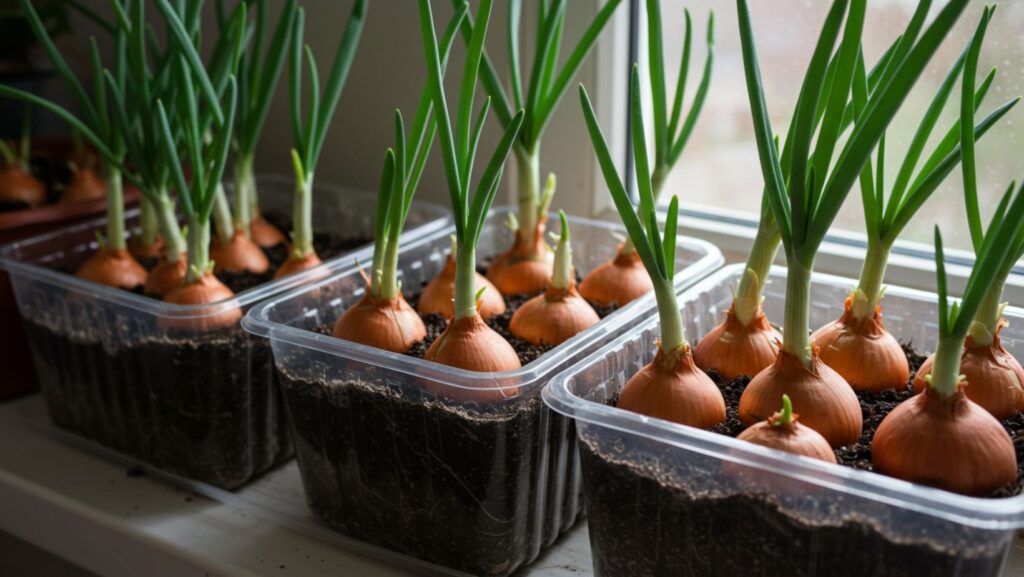
would you want to know to growing onions indoors? My own experience has led me to the conclusion that if you’re going to cultivate onions indoors, you can either plant onion sets or sow seeds in a shallow tray that is filled with compost.
Place the tray in a position that is both warm and well-lit.
It is important to ensure that your onions have sufficient space and light while you are growing them indoors.
In order to ensure healthy root development and bulb production, onion plants require a depth of between six and ten inches.
Maintain a distance of three inches between each onion plant. Scallions or other types of lesser size can be grown in closer proximity to one another.
Depending on whether they are long-day or short-day onions, onion plants require anywhere from 12 to 16 hours of light every day before they can flourish.
Artificial light can be used to supplement natural light if it is required.
In spite of the fact that you can begin with onion seeds or sets, it is not difficult to transform any leftover onion bulbs or sprouting onions from your kitchen into an indoor garden.
But that is not all; however, as you read further, I will educate you more on the subject matter.
Now, let’s get started
How to Grow Onions Indoors
Due to the fact that onions may be used in a wide variety of culinary applications, gardeners are eager to have a good supply of fresh onions at their residences.
Among the several alternatives available, seed starting, transplanting, and growing onion sets are all viable choices.
The most time-consuming method of growing onions is from seeds, while the most challenging method is developing bulb sets.
The quickest method is transplanting. Whatever the case may be, if you have a basic understanding of how to care for onions properly, it is not too difficult to learn how to cultivate them at home.
Onions are a common ingredient in the kitchens of many households, and many individuals have expressed an interest in cultivating their onions.
We regret to inform you that this is not always the best option for people who do not have a lot of room to create their garden.
The option for people who are interested in vegetable gardening but do not have the land to cultivate their vegetables is to learn how to grow onions by growing them inside.
The cultivation of onions inside does not appear to be the most suitable choice for many individuals.
Nevertheless, there are a lot of advantages to cultivating vegetables inside as opposed to growing them in an outside location.
Understanding how to cultivate onions at home may be accomplished via the application of a variety of various approaches.
Some of these techniques merely need a trip to the grocery store, which is a significant improvement over the alternative of spending hours at garden centers searching for various onion seeds, onion sets, or transplants.
How to Grow Onions at Home from Seeds
When it comes to cultivating onions indoors, two distinct ways may be used.
It is recommended that you plant green onions indoors during the early spring, eight to ten weeks before the date of the last frost if you intend to transfer your pots outside during the growth season.
This is the most effective method for producing green onions.
To ensure that the seeds are able to survive the winter, you might consider planting them in the late summer or early autumn if you reside in a more southern zone.
Now that you have decided the onion seeds you want to cultivate, it is time to plant them. When you are starting the seedlings in pots, use containers that are four inches deep and have drainage holes.
When growing onions in containers, first fill the pots with seed-starting potting soil and then sprinkle the seeds on top of the soil in an equal manner for optimal growth.
When planting onion seeds, it is necessary first to spray the seeds with water and then cover them with more potting mix that is approximately one-eighth of an inch deep.
Applying light pressure to the soil will guarantee that the seeds come into touch with the moist soil, which will promote germination.
Place the tiny containers in a warm location, such as a sunny windowsill or under grow lights, where the temperature is maintained at around 70 degrees Fahrenheit.
Cover the containers with a humidity dome or a container.
It is time to remove the cover and continue to maintain the seeds under grow lights after they have begun to sprout.
The onion seedlings are ready to be transferred to a larger container in order to develop into bulbs after they have reached a height of around three inches.
How to Grow Beautiful Big Green Onions Indoors in Water
1. As a first step, get a “bunch” of healthy green onion stalks (three to ten single green onions will serve),
but wait to wash them until you are ready to utilize the top green sections in a meal that you are preparing (I use them in my scrambled eggs every day).
In the event that you do not have the opportunity to set up your indoor garden immediately, you might consider storing the full, unused onion stalks in tin foil to help keep them fresh.
The tin foil keeps them fresh for 75% longer than other materials.
2. Second, once you have utilized the top green sections of the stalks (see below), place the white end that has roots into a container that has fresh, cold water.
I used this great vintage spice rack, but you could also use a jar.
3. Third, place your onions in a window that is bright and receives INDIRECT sunlight.
I believe that they will be OK if the sun shines on them for a number of hours; however, you should limit the amount of direct sunlight that they are exposed to and instead place them in strong indirect light.
One of my favorite things to do is to see the transformation as I am doing the dishes.
4. Four, be sure you change the water every day. If you have to skip a day or two, that is nothing to worry about, but after that, it will get sticky and unpleasant.
In order to ensure that all of my test tube containers were effectively rinsed out with clean water, I held them immediately under the cold water.
I consistently performed this, and they flourished in a short amount of time; you will notice improvements practically immediately.
The appearance of your green onions will return to how they seemed when you first purchased them within two to three weeks, with fresh onions blooming everywhere.
Prepare yourself because depending on the quantity of onions you use, you will have onions shooting out of your ears.
Therefore, this takes us to yet another helpful piece of advice about the long-term storage of green onions.
How to Grow Onions Indoors with Only Water
The cultivation of green onions, which are a bunching plant, involves growing them inside, which is one of the most straightforward gardening methods for vegetables.
It is recommended that you fill a glass with approximately three inches of chilly water when you bring spring onions home.
Setting the roots of the onion into the water and placing the glass on a windowsill in the light will allow the onion to sprout.
Alternatively, you may remove the greens from the plant whenever you choose, and you should change the water every few days.
You may continue to utilize the green onions for as long as you wish since they continue to grow.
What are the four easy ways to grow onions indoors. growing onions
Indoors is not only a simple method to have fresh onions when you need them, but it is also the ideal way to have them.
Additionally, it is a straightforward method for preparing onion plants for the growth season that takes place outside.
Here are some simple methods that you may use to cultivate onions inside if you have soil or plant onion bulbs.
Find new uses for old light bulbs in water. Green onions should be placed in water. The seeds of onions can be grown.
How to Grow Onions Indoors from Seeds
It is possible to cultivate onions from their seeds as well. For this project, you will require a container, seeds, and potting mix soil. A guide on growing onions from their seeds.
The first step is to fill the container(s) with potting and soil. Put a few seeds into the jar and set it aside.
The seeds should be covered with approximately half an inch of dirt. In order to ensure that the container receives seven to eight hours of sunshine, position it next to a window.
As the plants require it, water them. The sprouts of your onions are ready to be replanted after they have reached a height of around three and a half to four inches.
How to Care for Onion Plants
Onion plants are low-maintenance, straightforward crops. Fertilize your onions to ensure optimal maintenance.
Since onions need some nitrogen, fertilizing them with compost or a nitrogen fertilizer every few weeks will help the bulbs become big and healthy.
Give them time to breathe. Don’t try to cover the onions again since they will rise above the ground as bulbs.
Because maggots love damp soil, loose dirt creates a drier atmosphere, which is beneficial for the growth of your onions. Additionally, your soil (or garden bed) should be able to drain effectively.
Give them water. Water your onions about 1 inch a week (a little more for sweeter onions). On the other hand, you will require less watering if you decide to place mulch in between your onion rows.
Let them get some sunshine. Full sun is ideal for onions. To guarantee that your onions receive direct sunlight, keep them out of the shade.
Look for bugs. Onions are excellent companion plants for controlling pests, but they are also vulnerable to pests. Two insect pests that harm onion crops are thrips and onion maggots.
Thrips consume the leaves of onions, which can harm those that use more of their upper portion, such as scallions or green onions, and they can be treated with pesticides.
Your crop is destroyed when the larvae of onion maggots burrow into the onion root after the eggs are deposited.
Egg laying at the base of your growing crops may be avoided by covering them with mesh netting.
Onion maggots can also be controlled with parasitic nematodes. In order to prevent the females from producing eggs, you can also add ground cayenne or chili powder, dill, or ginger as a repellant.
How to Choosing Which Onion Varieties to Plant
For the purpose of planting onions, I selected a number of different types of onion seed, with the major emphasis being placed on onions that are great for storing onions, also known as storage onions.
In the event that these varieties of onions are harvested and cured, they will remain in storage throughout the whole winter season.
Sweet onions such as Walla Walla and Vidalia are delightful, and I often cultivate a limited quantity of them for the purpose of consuming them fresh.
Onions, on the other hand, are not the ideal option for preserving them for an extended length of time, if that is something.
Final thought
Now that we have established how to grow onions indoors, after setting up your growing setup, be sure to provide your onions with adequate light so they may develop healthily.
Onions will bulb at particular times of the day because they follow precise light cycles.
Because of this, your onions may not receive enough light from your windowsill to thrive; therefore, you need to add artificial light to your plants.
Onions also require periods of darkness, so you won’t want to keep your lights on constantly, but having a light close by will provide you with more growth options.
A complete onion should be ready in 90 to 120 days, and your tops should be prepared in a month. To get ready for the harvest, it’s a good idea to stock up on mesh onion bags.
Onions are a tasty and nutritious food, which is why cultivating them is so enjoyable.
You should be prepared to tackle this task after reading our brief instructions on growing onions indoors.