
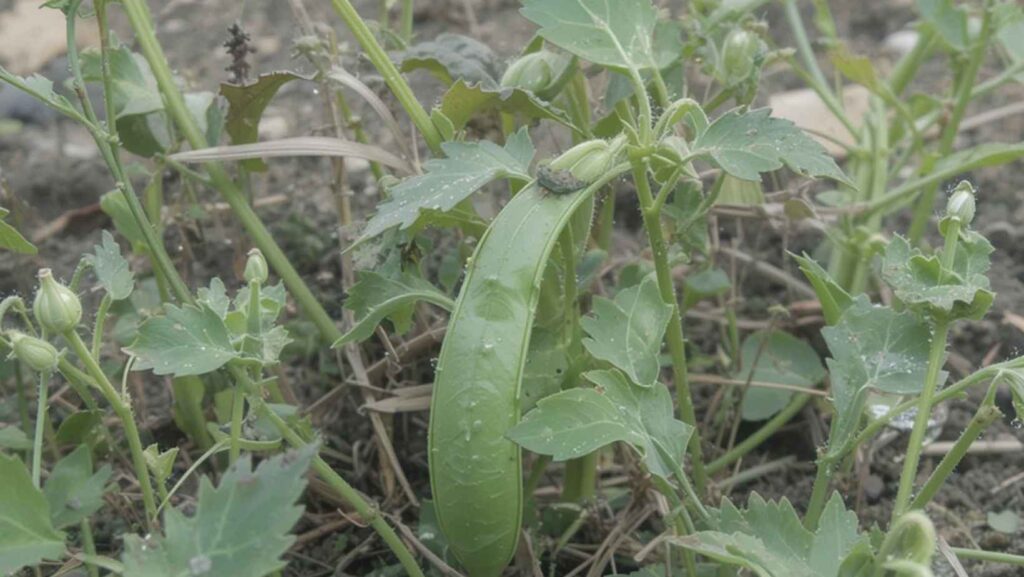
Would you want to know if snow peas regrow after harvest? In my experience, snow peas do not self-regenerate after harvest, much like the majority of crops.
Because it is an annual crop, harvesting pods promotes continuous production, but ultimately, the plant will cease producing and die.
Even if the plants are harvested often, they will eventually cease producing on their own. You will need to sow more seeds either consecutively or for the next year to guarantee a continuous supply.
After many weeks, the snow peas begin to show signs of wear and tear. No matter how frequently you collect them, the leaves will eventually lose their color and stop producing peas.
This is only the life cycle of a snow pea. But that’s not all; I’ll explain more about the topic as you continue reading.
Now, let’s get started.
Can snow peas regrow after harvest
As opposed to other perennial vegetables, snow peas do not organically regenerate after harvesting in the same manner that other vegetables do.
They are plants that are considered to be annual, which means that they finish their life cycle during a single growing season.
After they have produced their pods, the plant will naturally die off, and in order to obtain a new harvest, you will need to sow new seeds.
To explain why:
An annual cycle of growth:
Due to the fact that snow peas are an annual plant, they only deliver a single crop throughout each growing season.
In order to obtain a new crop, it is necessary to sow new snow pea seeds or seedlings each year. This is known as seed propagation.
Seeds may be saved from ripe pods for planting the next year. You can do this by setting aside the seeds.
In spite of the fact that snow peas generate a number of pods throughout their life cycle, the plant itself will not continue to produce after its normal growth cycle has been completed.
What are Common problems when growing peas
Fungus has overtaken every pea crop I have ever cultivated. For a few weeks, it gradually climbs through the foliage from the base of the plant.
The plants eventually die after being devoured in their entirety. It always occurs. Sometimes, the fungus takes a long time to spread, while other times, it does so quickly.
However, it is unavoidable. Though I do use several techniques to lessen the effects, it has never prevented me from receiving a nice harvest of peas:
Trellising is an excellent tactic since it helps to minimize these fungal infections.
Selecting the right kind is crucial since some are more hardy than others. The time of year has a significant impact.
In a mild temperate region, snow peas can be grown at any time of year, but in a humid summer, the plants will perish far more quickly than in a crisp winter.
Your succession planning must thus take that into account.
How to Grow Peas
Peas will satisfy your desire to play in the garden after a long winter.
Depending on your USDA hardiness zone, you can plant peas in the moderate weather of late winter or early spring because they can withstand lower temperatures.
When to Plant Peas:
After the soil temperature reaches at least 45° F, plant seeds 4–6 weeks prior to your final spring frost.
Emerging pea plants won’t be harmed by snow, but they could be by many days of high temperatures.
However, a late freeze might harm pea blossoms, which will decrease your crop. If you anticipate exceptionally severe conditions, think about adding a bit of insulation with a row cover.
Pea seeds are often sown directly by gardeners, although young plants are also available.
Choose plants in biodegradable pots and plant the full container because peas don’t enjoy having their roots disturbed.
Young pea plants should be spaced five inches apart.
Peas should be planted in a spot with full light and soil that is rich and well-drained.
Peas thrive in in-ground gardening, sunny raised beds, and containers.
For growing in containers, look for compact cultivars.
Choose cultivars with a shorter vine, such as 12 inches, for hanging baskets.
Where & When to Grow
As a cool-season crop, peas thrive at temperatures between 12 and 20 degrees Celsius (55 and 70 degrees Fahrenheit) throughout the growing season.
Some claim that the term “snow pea” comes from its ability to tolerate mild snow and frost, which is essentially accurate given that snow peas can tolerate temperatures as low as -2C (28F).
Winters in my humid subtropical region are barely chilly enough for snow peas.
In order for the final harvest to mature in late spring, when it is too hot for them, we start our seeds in mid-late autumn, after the humidity and summer rains have subsided, and continue until around July.
Any garden bed may be used to raise peas. As long as the soil is healthy, they will thrive in containers, raised beds, and the ground.
Snow peas grow well on a sturdy metal trellis that is reachable from all sides. By attaching themselves to it with their tendrils, the peas are able to develop rapidly and robustly in addition to being easy to pluck.
Peas are grown on a trellis benefit from improved airflow or aeration through the vines, which reduces the accumulation of moisture and humidity.
As a result, typical leaf diseases like powdery mildew are significantly reduced. Since peas might be damaged by wind, you might need to hold the plants flat against the trellis with some string.
This keeps the plants from being bent over and damaging the crop in the event of a severe wind.
When to harvest peas
The majority of peas mature in 50–70 days. Knowing when a pea is ready to be harvested can be difficult, and a lot relies on your preferences or whether you want to eat them fresh or store them.
Check the pods daily and take samples as you go after they begin to develop (you can see the peas inside).
Instead of being crunchy, the peas or pods should taste sweet and delicate. However, be advised that days do matter.
The pea is either rough and chewy or immature after two to three days in either direction. A mature pea is often a little bigger than the one you planted.
Wait until the pods of snow peas reach the appropriate length as specified on the seed packaging. It should contain microscopic peas that are hardly perceptible.
Snap peas should be harvested 5-8 days after flowering before the pods are completely developed.
Seek out full-size pods that have crisp meat, tiny seeds, and the ability to “snap.” For three to four weeks, snap peas can be gathered on a regular basis.
Garden peas should be harvested 18–21 days after flowering or when the seeds are plump. For optimal flavor, shell the peas and consume them right away.
Final thought
Now that we have established do snow peas regrow after harvest, over a few weeks, the snow peas begin to show signs of wear and tear.
At some point, the leaves will lose their color, and regardless of how frequently you harvest them, they will no longer produce any more peas.
Just the snow pea life cycle is being described here. Following that, it is time to plant fresh peas.