
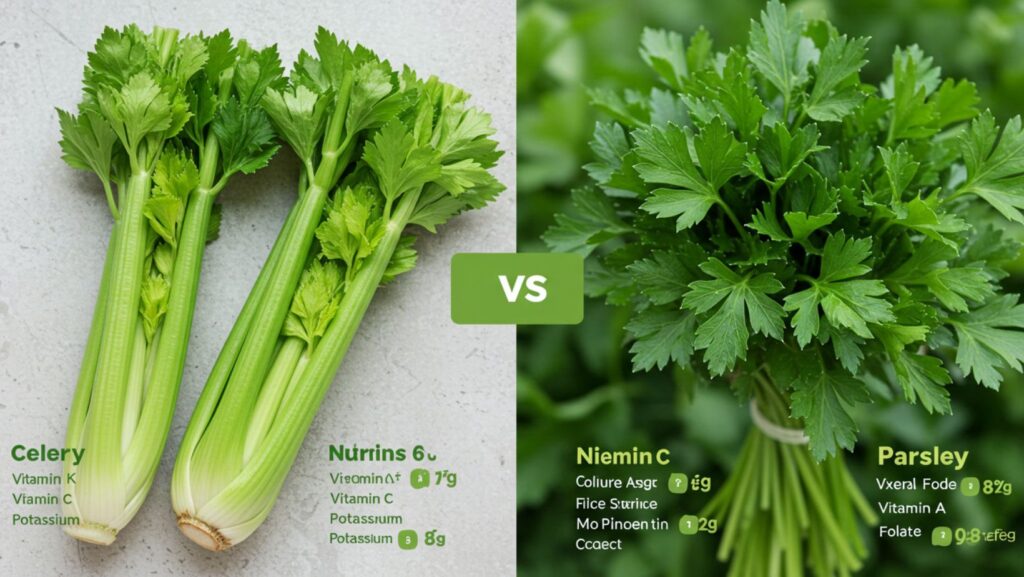
Would you want to know about Celery vs. parsley nutrition? According to my experience, Celery and parsley are both regarded as nutrient-dense vegetables, but Celery is mainly made up of water and fiber, which means it has a lot fewer calories than parsley,
It usually packs more mineral and vitamin punch per serving, particularly in terms of vitamin C, vitamin A, and vitamin K.
Carrots, parsnips, dill, fennel, and hundreds of other familiar plants are members of the same botanical family as Celery and parsley.
While the plentiful, fragrant green leaves of fresh parsley are very different from the crisp, fibrous stalks that comprise a standard head of Celery, the two items are closely related.
It is evident from comparing Celery and parsley that each herb has unique properties and may be utilized in a variety of recipes.
However, because of its high fiber and vitamin content, Celery leads the pack in terms of nutritional value.
However, parsley can help with digestion and has a higher concentration of antioxidants.
Notably, these herbs may be utilized to improve the nutritional content and flavor of food.
In the end, everything boils down to individual taste and the dish’s particular requirements. That is not all, though, and I will explain more about it as you read on.
Now, let’s get started.
Are Parsley and Celery the Same
No, actually. You could mistake leaf celery, also called herb celery, for flat-leaf or Italian parsley because of its skinny stalks that are bursting with vibrant green leaves.
Leaf celery may be eaten raw or very gently cooked, and it has a taste that is comparable to parsley.
Chinese Celery resembles a hybrid of flat-leaf parsley and regular Celery and is frequently seen in Asian markets.
Celery
The most popular Celery among Americans is Pascal celery, a well-cultivated kind that is far less stringy than wild Celery.
Celery leaves are edible and, like parsley, have a strong flavor despite the fact that the plant’s leafy green top is frequently thrown away.
Celery is a low-calorie food that is high in dietary fiber, potassium, and vitamin C. It may be added to cooked foods or eaten raw.
Parsley:
Generally used to enhance or flavor other dishes, fresh parsley is regarded as a herb.
The plant is prized for its vivid green leaves, which are low in calories and high in vitamins A, C, K, and folate, as well as iron, potassium, and dietary fiber, even if its long, thin stalks are delicious.
Parsley may be added to cooked foods right before serving, or it can be eaten raw.
What are the Key Differences between Celery vs. parsley nutrition
Calories:
Because of its high water content, Celery contains a lot fewer calories per serving than parsley, which makes it a suitable option for weight control.
Fiber
While both contain fiber, Celery contains more fiber per serving than parsley.
Vitamins:
Celery has more vitamin B6 and folate, whereas parsley has more vitamin K, vitamin A (as beta-carotene), and vitamin C.
Minerals:
Celery also includes some minerals, albeit at lower levels, whereas parsley is a significant provider of calcium and potassium.
Which is more healthy, parsley or Celery
Vitamin E is found in parsley, which also lowers inflammation, improves cardiovascular health, and encourages good blood coagulation.
Antioxidants, dietary fibers, and other nutrients found in celery support healthy digestion, metabolism, heart and bone health, and cancer prevention.
Nonetheless, Celery and parsley are both nutrient-dense veggies that may provide a number of health advantages.
Iron, vitamins A, and C are found in parsley.
includes antioxidants that might aid in preventing cell damage.
has flavonoids, which may lower the chance of developing some types of cancer.
includes apigenin, a vitamin with potential anti-cancer effects.
Contains antioxidants called carotenoids, which may lower the risk of heart disease.
Celery
provides calcium, potassium, and the vitamins C and K.
has fiber, which may be good for the heart and digestive systems.
contains flavonoids, which might be advantageous for the heart.
includes antioxidants that might help prevent illness.
Celery and parsley belong to the Apiaceae family, which also contains celeriac, carrots, and parsnips.
What organ does Celery help
1. Could promote heart health
Despite having a high water content, Celery is packed with heart-healthy vitamins and minerals, such as calcium and potassium.
Additionally, it includes vitamin K and folate, both of which are necessary for the production of red blood cells and efficient blood coagulation.
Celery has vitamins and minerals, but it also contains flavonoids, which are plant components that protect the heart and have positive effects on the circulatory system.
A decreased risk of heart disease is also linked to diets rich in fiber vegetables, such as Celery.
2. Could enhance memory
Celery extract seems to prevent the cognitive deterioration linked to depression and aging.
Similarly, rats with Alzheimer’s and dementia showed improvement in research examining the neuroprotective properties of celery extract.
Once more, animal models have been used in a large portion of the study to date, and further human trials are required.
What organ is parsley good for
Kidney health: Parsley is good for the kidneys. Parsley may help lower the danger of kidney stones and lower the body’s acidity.
Parsley may benefit the kidneys and help eliminate bacteria since it is a diuretic and aids in the removal of bodily fluids.
The diuretic properties of parsley are attributed to two substances found in its oil: piol and myristicin.
Gallstones and kidney stones can be eliminated from the body with the help of the herb.
Joint and bone health:
Parsley has a lot of nutrients that help build bones.
Vitamin K, which is abundant in parsley, aids in the formation of bones by combining with calcium, vitamin D, phosphorus, and magnesium.
A vital element that increases bone density and shields the bones from cracks and fractures is vitamin K.
A person’s skeletal structure benefits from parsley’s ability to decrease bone resorption.
Final thought
Now that we have established Celery vs. parsley nutrition, Both Celery and parsley belong to the Apiaceae family and are frequently used in similar recipes. They may, however, significantly alter a dish’s flavor because of their disparate textures and tastes. A bright green herb, parsley is often garnished or used to flavor soups, sauces, and salads.
It is crisp and tastes fresh with a hint of bitterness. In contrast, Celery is a crisp vegetable that is frequently used to stir-fries, salads, and stews.
It has a fibrous texture and a moderate, mildly sweet flavor.