
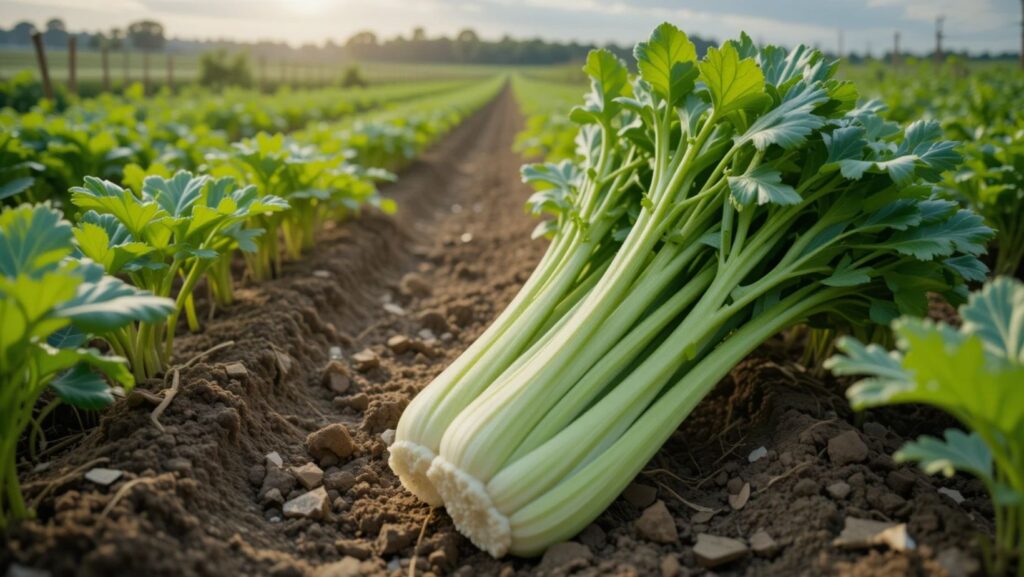
Would you want to know about celery and organic farming? My understanding is that chemical fertilizers, pesticides, and herbicides are not used in the production of organic celery.
You may reduce your exposure to possibly hazardous chemicals that are frequently utilized in traditional agricultural methods by selecting organic.
Additionally, The shelf life of celery varies greatly depending on the temperature of your refrigerator and how long it was at the grocery store before you purchased it!
Celery usually keeps for two weeks when left whole, or longer if you’re lucky!
The typical shelf life of cut celery is around four to five days. But that’s not all; I’ll explain more about the topic as you continue reading.
Now, let’s get started.
What are the Benefits of organic celery
Organic celery is devoid of dangerous chemicals and preservatives, which means that it reduces the amount of exposure to chemicals.
Celery that is cultivated organically is rich in a diverse array of nutrients, such as dietary fiber, vitamins, and minerals.
The use of organic agricultural methods has a positive influence on the environment since they improve soil health, biodiversity, and water conservation.
Some individuals believe that organic celery has a flavor that is more natural and fresher than conventional celery.
Is organic celery good for you
Yes. Celery is abundant in a wide range of anti-inflammatory plant components and antioxidants, which help decrease inflammation and prevent cancer by eliminating free radicals.
the leaves and seeds of celery are the most effective portions of the vegetable for lowering inflammation.
Caffeic acid, p-coumaric acid, ferulic acid, apigenin, luteolin, tannin, saponin, kaempferol are some of the plant chemicals found in celery that have been shown to be effective in providing relief from inflammation
What’s the difference between celery and organic celery
organic celery has a number of advantages, including 85% less residue from synthetic chemicals, more antioxidants, a healthier fatty acid content, a taste that some people like, and a higher profit margin for farmers.
Nonetheless, there is a plentiful supply of both conventional and organic celery as long as its nutritional and environmental requirements are satisfied.
Carbon, hydrogen, nitrogen, phosphorus, potassium, sulfur, and other inorganic minerals necessary for development are the most vital nutritional components for the plant.
Celery grows well in rich, loose soil with a pH of 6.5 to 7.5, seven hours of direct sunshine, and a temperature of about 50 degrees Celsius for both conventional and organic cultivation.
The flavor, look, color, scent, size, and stiffness of the two varieties of celery cannot be definitively compared using any one approach.
Whereas conventional farming places more focus on production volume, organic farming prioritizes the use of natural goods and supporting techniques.
There is a conflict between the need to fulfill the demands of the expanding global population and the desire to return to traditional farming methods by employing natural fertilizers.
The decision is mainly based on personal tastes because there is no apparent distinction between celery that is cultivated organically and conventionally.
The assessment approach is invalid in the instance of the claim that “organic celery tastes better” since the plant has varying amounts of phenolic chemicals, which make it bitter and deter insects.
Another illustration is given when comparing the concentrations of minerals such as chromium, phosphorus, magnesium, iron, nitrates, vitamin C, vitamin K, and celery.
celery that contains more than 95% water will be more diluted.
What are the Tips for Growing Organic Celery
Start celery seeds indoors early, then transfer them to a moist, well-drained soil amended with compost or aged manure.
Weed regularly, keep the soil consistently moist, and consider blanching—a technique where the soil is hilled around the stalks to promote tender growth—during the middle of the growing season.
Use organic fertilizers all through the growing cycle, and keep an eye out for pests.
Important considerations for growing celery organically:
Preparing the soil:
Select a sunny location with soil that drains properly.
Before planting, mix the soil with a good amount of compost or well-rotted manure.
Celery seeds should be started indoors eight to ten weeks prior to the final frost.
Keep the soil wet and use a seed starting mix.
When the weather is warm enough, and the seedlings have a few genuine leaves, move them outside.
Planting and spacing: Arrange celery plants in rows 10 to 12 inches apart.
To make blanching easier later, think about planting in a shallow trench.
Fertilization and watering: Celery needs steady hydration; do not overwater; instead, keep the soil uniformly moist.
Throughout the growth season, use a liquid organic fertilizer on a regular basis.
Seaweed extract, compost tea, and fish emulsion are examples of organic fertilizer options.
Weed control: To avoid competition for moisture and nutrients, regularly pull weeds from surrounding celery plants.
Blanching (optional): Start blanching in the middle of the season by progressively raising the soil around the plants until the stalks are covered in delicate celery.
Pest control: Keep an eye out for pests such as carrot flies, snails, and aphids.
Employ natural pest management techniques like as row coverings, insecticidal soap, and handpicking.
Or Make use of supporting techniques and natural products.
Grow on loose, fertile soil that has a pH of 6.5 to 7.5.
Give them seven hours of direct sunshine.
Keep the temperature at about 50°C.
Dig a shallow trench that is one spade deep and long enough to allow for a foot between each celery plant.
Spread a layer of plant mix or compost manure over the trench’s bottom.
Maintain a wet soil.
Halfway through the growth season, fertilize your plants with organic fertilizer.
Weed your celery plants on a regular basis.
A versatile vegetable, organic celery may be used in casseroles, soups, stews, and salads.
Is celery better organic or not
It should be made clear that the several pesticides used to cultivate non-organic celery make it unhealthy.
Make careful you use organic celery at all times.
Due to its frequent inclusion on the “Dirty Dozen” list, which identifies celery as one of the most severely pesticide-treated food products, organic celery is often seen as “better” when purchased.
Important details regarding organic and celery options:
High pesticide residue: It’s crucial to buy organic celery whenever feasible because of its porous nature, which allows it to absorb a lot of pesticides.
Working Group on the Environment (EWG):
Celery is frequently listed as one of the most contaminated vegetables by the EWG, with
Final thought
Now that we have esatablished celery and organic farming , When it comes to cultivating celery, the ideal soil is abundant in organic matter.
When you want to alter the soil in your garden, add compost and worm castings.
It is crucial for the effective growth of celery plants to have soil that is both well-drained and able to hold excess moisture.
celery does best on soil that has a pH level that falls between 5.8 and 6.8.