
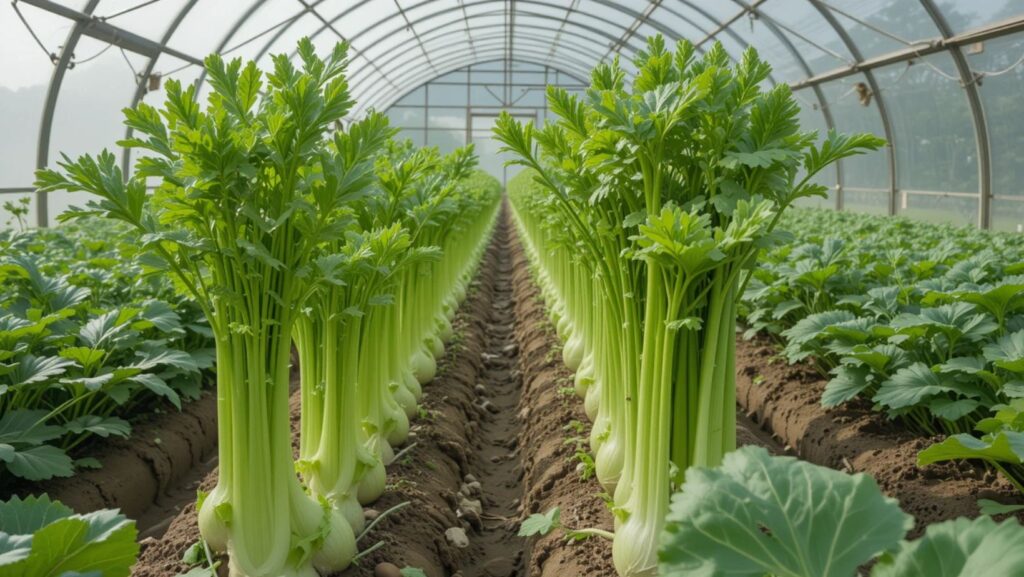
Would you want to know about Celery and greenhouse growing? Celery may be started from seed or transplanted, and it can be grown in a greenhouse all year round, according to my experience.
Cerely can be planted in a frame or greenhouse in the spring and then planted straight into the ground two months later.
When blanching ribbed Celery, it’s crucial to tie the leaves together. But that’s not all; I’ll explain more about the topic as you continue reading.
Now let get started
Can Celery be grown in a greenhouse
Yes. But You must supply enough water and light if you want to produce Celery in a greenhouse. Ensure that the plants are exposed to at least five to seven hours of sunshine every day.
The plant celery is quite vulnerable to frost. If it is exposed to low temperatures, it will bolt. To prevent it from freezing, you might also need a cloche or row cover.
Make sure there is adequate lighting in the space where you plan to grow Celery before you start. Aim to maintain the soil’s moisture content and compost enrichment.
Celery should be at least 12 inches apart to avoid blight. In order to keep the soil cool, you should mulch the region.
The soil should be loose and high in organic matter since celery roots are delicate.
Harvesting Celery can be done in small or huge volumes. Harvesting should begin as soon as the stalks are 8 inches tall, as a general rule.
Before planting, you may trim your seedlings to make sure your seeds get off to a good start.
Although celery seeds can be planted straight into the ground, they must first be allowed to harden off for a week or ten days.
What are the best conditions for growing Celery
Although Celery thrives in a variety of soil types, it prefers rich, moist, well-drained sandy loam that has been well prepared and has a mild acidity.
It requires some wind protection and loves the sun or mild shade.
In a crop rotation system, Celery is an excellent “fill-in” crop since it doesn’t require annual relocation.
Plants should be spaced 20 to 25 cm apart in a block to promote the growth of longer, fleshier, and somewhat paler stems and to help suppress weeds.
Avoid moisture stress by keeping well-watered and mulching.
Reducing fungal issues can be achieved by watering the ground level in the morning. Since Celery grows quickly, it needs to be fed frequently. Every two weeks, I feed it some liquid manure, worm juice, or weed tea.
What are the Tips for growing Celery in a greenhouse?
Despite being a cool-weather crop, Celery is sensitive to high temperatures. Both cold weather (below 40°F) and hot weather (over 75°F) can cause it to bolt! Because of this, it’s a fantastic addition to your greenhouse garden, particularly during the cooler shoulder seasons.
Choose a location away from any direct heat sources that stay cool all day while growing Celery in the greenhouse. Proper greenhouse siting, air circulation, and other factors can help you keep your greenhouse at a constant temperature.
You might be asking if you can grow Celery in pots in a tiny greenhouse, and the answer is yes! Growing Celery in pots not only saves room but also allows you to transfer the plant if the weather becomes too hot or cold.
When greenhouse celery sprouts into a seedling, it may be moved onto a raised bed or a container that is at least 8″ wide. Typically, greenhouse celery begins its life in a pot or seed tray. You can grow Celery any way; however there are benefits to both. You’ll need to water your Celery more frequently because containers tend to dry up quickly.
How to care for greenhouse-grown Celery?
Celery is actually relatively simple to cultivate, except for the fact that it requires constantly cold temperatures and has a long growth season. Remember these pointers to ensure the success of your greenhouse-grown Celery:
Give celery seedlings plenty of space on all sides and loose soil.
Give celery plants at least 6 to 8 hours of sunlight every day; if necessary, supplement with grow lights in the winter.
Celery has to be watered consistently and evenly. In between waterings, let the soil drain.
Mound earth around trenching types’ stalks after seedlings are 3–4 inches tall to blanch them, or use sleeves and collars as a substitute.
To promote denser growth and facilitate the natural blanching process, tie the tops of self-blanching Celery together.
What is the Timing Process of a Fall Celery Garden ?
Let’s discuss timing. In February, I plant my spring and early summer celery in preparation for transplanting it in April or May. The plants in 3-inch pots are robust and prepared to flourish in the garden at this time. They thrive during the milder late spring weeks, which are ideal for their establishment and growth.
Generally speaking, seed producers advise planting Celery 10–12 weeks before to the onset of frost (either spring or autumn). My spring celery is sown 13–14 weeks before the final frost. Additionally, my experience has shown that this is a bit late for fall; therefore, I advise planting it 18–20 weeks prior to the final frost. Yes, I am aware that it coincides with our last frost date for some of us. This is the perfect example of succession planting. I believe you may get away with having your first autumn frost closer to 12 weeks for those in warmer and gentler locations, but I would still advise at least 14 weeks to account for some people’s sluggish germination rates.
I have experimented with planting Celery in mid-July (12 weeks before to frost), late June (10 weeks), and last year during the week of June 10 (16 weeks prior to frost). Even though the Celery we cultivated in June was harvestable, it would have been bigger and better developed if we had sown it earlier. This year, I will plant my fall celery two weeks earlier than I did last year, during the week of May 23. After the Fourth of July, I want to move it outside in the garden at the same time that I move the autumn cauliflower and cabbages that I saw in June.
Final thought
When the weather outside is too cold, a greenhouse might be an excellent spot to start Celery for the first time. It is also possible to cultivate Celery for harvesting in a greenhouse, provided that you take care not to allow it to become very heated. By supplementing the soil with well-rotted leaf mold, compost, or aged manure, you should pay particular attention to the nutritional requirements of the plant, whatever the situation may be. The addition of compost tea or manure will also be beneficial to it.