
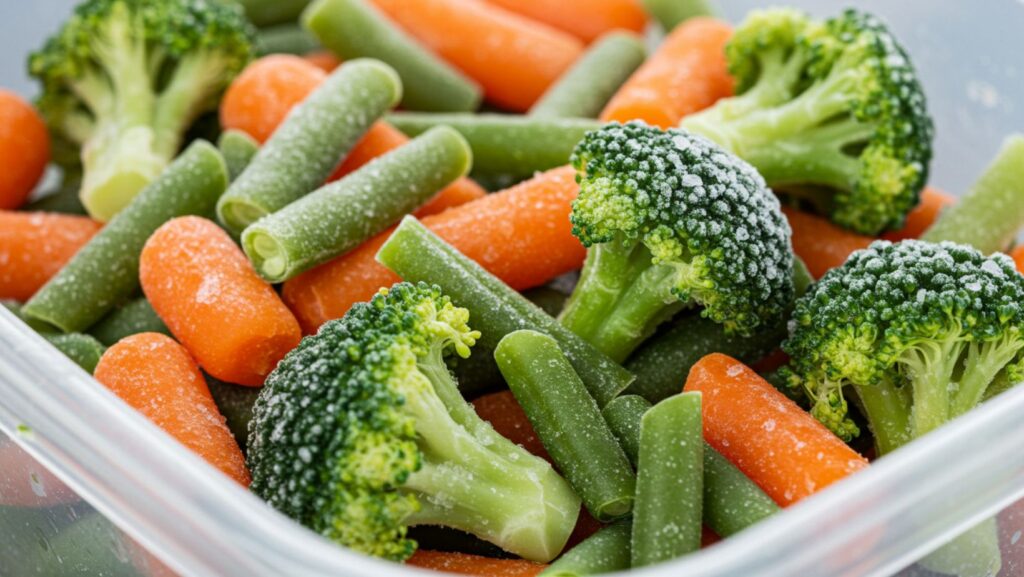
Would you want to know if you can freeze cooked vegetables? Based on my experience, the majority of vegetables benefit from being blanched (baked for a short time) before freezing in order to maintain their texture and color.
However, it’s crucial to take into account the type of vegetable and how it was prepared because some may not freeze well and may become mushy.
One of the finest methods to preserve the nutrients and flavors of veggies is to freeze them.
Always choose premium veggies that are at the height of their texture and flavor. This will ensure that the frozen veggies are of high quality.
Harvest your veggies in the morning while they are still cool, and freeze them as quickly as you can if you are growing your own.
Blanching veggies before freezing is the key to excellent frozen vegetable outcomes. This procedure will eliminate the majority of potential germs and prevent the enzymes that break down the veggies.
Blanching is the process of immersing vegetables in boiling water for a few minutes.
Blanching vegetables removes dirt, enhances their color, and helps prevent vitamin and mineral deterioration.
But that’s not all; as you continue reading, I’ll provide additional information on the topic.
Now, let’s get started
Do vegetables need to be blanched before freezing
Blanching aids veggies in preserving their flavor and texture after freezing. To blanch veggies, thoroughly clean and cut them, then submerge in salted boiling water for two to three minutes.
Maintain uniformity in vegetable size and blanch only one variety at a time, as various vegetables have varying blanching speeds.
To halt the cooking process, immerse the blanched veggies in cold water. Permit to cool entirely prior to packaging and placing in the freezer.
Blanching fruit is unnecessary, as the majority is consumed raw. All vegetables may be frozen uncooked; however, certain varieties, like carrots, may lose their sharpness upon thawing.
Frozen veggies can be prepared by immersing them directly in hot water.
Which vegetables can you freeze
It’s safe to freeze most types of fresh vegetables, but once they have been cooked, take extra care when separating your leftovers, as some may not freeze as well as others.
In terms of vegetables that don’t freeze well, you might want to skip peppers, courgettes, cabbage, and butternut squash.
Typically, vegetables with a high water content will become mushy after defrosting and can lose their flavor.
But leftover items from your Christmas dinner, such as potatoes, parsnips, carrots, and Brussels sprouts, can all be quickly frozen and reheated for a later date, so long as they have been appropriately thawed before cooking.
When freezing the veg, make sure to allow them to completely cool before storing them in an airtight container or zip-top freeze bag within two hours of cooking.
And don’t forget to label and date each one.
How long can you freeze them for
Although this varies per vegetable, the majority may be securely stored in the freezer for a duration of 8 to 12 months.
When choosing to thaw your leftover vegetables, meticulously examine them for freezer burn.
This transpires when food is subjected to air during the freezing process; although it remains safe for consumption, its flavor and texture may not align with your recollections from Christmas Day.
However, if your vegetables emit a foul odor upon thawing or have a slimy texture, it is advisable to discard them rather than reheat.
What is the best way to defrost veg
Although most vegetables can be reheated without prior thawing, the safest method for defrosting leftovers is to place the vegetables on a plate and position them on the bottom shelf of the refrigerator to prevent leakage onto other foods until fully thawed, which may take an entire day.
If you are pressed for time, place your frozen vegetables in a waterproof bag and immerse them in cold water until fully thawed.
Lily’s primary recommendation for achieving crispy leftover roast potatoes is to gently mist them with olive oil before reheating them in the air fryer; half a teaspoon suffices for optimal crunch.
What are the five Vegetables That Freeze Well
Here are some veggies (and one fruit) that can endure frigid temperatures.
Broccoli is an excellent vegetable for freezing since it retains its near-original blanched form upon thawing, making it suitable for sheet pan bakes, stir-fries, and pasta recipes.
To defrost frozen broccoli, immerse it in a dish of warm tap water for several minutes, then drain the water when prepared for cooking.
Corn: It is advisable to freeze your corn, which is plentiful during the peak of summer and thereafter becomes scarce for the remainder of the year.
While frozen corn may lack the crisp texture of its freshest form, its flavor will be retained for about one year, making it suitable for replenishment.
Frozen corn cobs may be placed immediately into boiling water (or a butter bath), but corn that has been frozen off the cob is ideal for incorporation into soups or this creamy Korean corn dip.
Zucchini: Oh, zucchini: We see you frequently over the summer, maybe leading us to forgo preserving you for future use. (Just kidding, we appreciate you, zucchini!) If you possess several zucchini plants in your garden or have a neighbor skilled in gardening, you can undoubtedly freeze zucchini.
Blanch chopped zucchini in unsalted water, arrange it on a sheet pan (preferably quarter trays) to freeze, and thereafter store it in labeled, sealed containers.
When you are prepared to reintroduce zucchini into your diet, you will discover that the frozen kind is particularly effective in casseroles and soups.
Green chiles, such as Hatch chiles, poblanos, and Anaheim peppers, are suitable for freezing.
Our procedure for freezing chiles involves initially blistering the peppers, either on a broiler or on a grill, followed by allowing them to steam in their heat before peeling, seeding, and chopping.
The peppers may thereafter be preserved in tiny containers or an ice cube tray in ideal amounts for use in frittatas, chili, or toast.
Green Beans: Green beans are among the most straightforward crops to preserve by freezing, as demonstrated in our lesson on freezing green beans.
Simply clip the ends, blanch in unsalted water, and thereafter freeze in a single layer.
Simple! I store mine in a plastic zip-top freezer bag and extract a handful as needed for dishes such as lemon herb pasta salad, Greek-style green beans, and garlic-butter chicken thighs.
How to Freeze Cooked Vegetables
Freezing cooked veggies is an effective method for their preservation for future utilization. It is an excellent method to conserve time and minimize food waste.
With no preparation, one may effortlessly freeze cooked veggies for later use.
Here is the procedure to accomplish it:
Prepare Your Vegetables: Commence by sautéing your veggies until they achieve tenderness. Based on your desire, you may steam, boil, roast, or sauté them.
Allow your veggies to reach room temperature after cooking. This will assist in averting their deterioration into a mushy state upon freezing.
It will also avoid the inadvertent heating and thawing of other dishes in the freezer.
Prepare for Freezing Conditions: Chop your veggies into bite-sized portions, if required. Subsequently, position them in an airtight container or freezer bag.
When utilizing a container, ensure to provide adequate room at the top for growth. When using a freezer bag, expel as much air as feasible prior to sealing.
Label and Date: Inscribe the names of the veggies and the freezing date on the container or bag prior to placing it in the freezer.
Final thought
Now that we have established, can we freeze cooked vegetables? , It is not challenging to freeze produce. Once you have purchased veggies that are in season, you may freeze them for later use, which will allow you to get the most taste and nutrients out of them.
Another technique to save time and money in the kitchen is to store frozen veggies or frozen meals.
This eliminates the need to wash, slice, or cut the food because it is already frozen.