
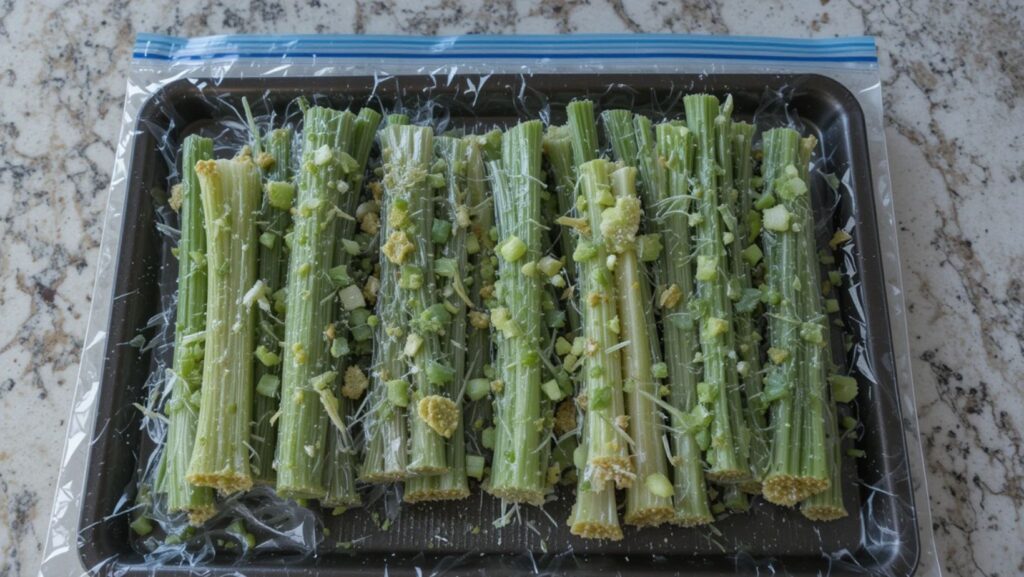
Would you want to know if you can freeze celery? According to my experience, celery can be frozen, although part of its flavor and crispness will be lost.
If you want to utilize celery in casseroles, stocks, stews, soups, and sauces, freezing is an excellent alternative. One easy method to cut down on food waste in the kitchen is to freeze celery.
Adding frozen celery to your favorite dishes only requires a little work.
However, that is not all; I will provide additional information on the topic as you continue reading.
Now, let’s get started
What is The best way to prepare and freeze celery
Place the celery flat on a baking sheet and freeze. Before separating into separate containers or bags, place the entire sheet pan in the freezer and let it freeze for a few hours.
If you maintain your freezer cool and the bag is sealed, you may keep it for up to 18 months in freezer-safe bags.
It is crucial to begin freezing celery with a fresh bunch that you have just purchased from the shop.
Celery may be kept crisp in the refrigerator, but it will stay fresher the sooner it is frozen. Wash your celery stalks well to get rid of any dirt that could have gotten into the folds.
For this phase, a vegetable brush such as the Joie Scrub Brush works well.
Cut off the green, whitish, and discolored portions after washing. Before moving on to the following phases, it can then be divided into parts or tiny fragments.
This is the time to blanch the celery, which prevents the enzymes that break it down and kill bacteria. Blanching is really simple, and we strongly advise against avoiding it.
Blanching involves boiling celery stalks for two to three minutes and then stopping the cooking process by throwing them in an ice bath.
Make sure the celery pieces are dehydrated after the ice bath, then arrange them equally on a baking pan and put them in the freezer.
To prevent the pieces from clumping together, first place them on a tray and freeze them.
Thawing your frozen celery before cooking is not necessary when you’re ready to utilize it. But if you do need to defrost it, just put the container in the refrigerator and let it be there all night.
What are The Problem With Freezing Celery
For the simple reason that celery is a physical vegetable, freezing it isn’t the best technique to preserve it.
Celery, in contrast to many root vegetables, is primarily composed of water, which contributes to its sharp snap and refreshing flavor.
However, both of these items are destroyed in the freezer. Ice is created when anything is frozen, mainly when it contains a lot of water.
The water starts to disintegrate the celery stalks’ cell walls when it freezes because it occupies a greater volume in the same area.
Because the cellulose has been broken down by the frozen water, frozen celery never has the same sharpness as fresh celery; instead, it is stringy rather than snappy.
Another issue is removing it from the freezer itself.
When celery defrosts, the water molecules trapped in the cellulose are unable to be held in by the now-broken cell walls, causing the water to melt and leak out of the celery.
Because of this, defrosted celery will appear to be melting and float in a pool of water.
Although there are some issues with freezing celery, it is still possible, but you won’t get any of its crunchy crunch. What can you do with it, then?
Why do you need to flash-freeze celery
Due to the process of flash freezing, it is possible to preserve a large quantity of celery sticks in a container without their adhering to one another.
The process of flash freezing involves placing all of the items on a baking sheet and freezing them for a little amount of time.
Then, once they have reached the desired level of freezing, you move them to a container that is airtight for storage.
Believe me when I say that you do not want to be forced to attempt to separate chunks of frozen chopped celery. The use of flash freezing is unquestionably the best option.
What are the Pros and Cons of Freezing Celery
Knowing how to freeze celery is beneficial for a number of reasons, the most obvious of which is that it significantly improves the shelf life of the vegetable.
This innovative technique will prove to be really useful, particularly in the event that you do not anticipate making use of the veggie in the near future.
But keep in mind that celery has a high percentage of water. This causes the celery to become mushy when it is frozen, just like it does with other frozen vegetables.
There is a possibility that the stalks may get limp, and much of their flavor may be lost.
When it comes to recipes that call for fresh ingredients, it is recommended to avoid using frozen celery to the greatest extent possible.
The finest foods that you can create with it are stews, soups, pasta, smoothies, and stuffing and stock. Other dishes that you can make with it include smoothies.
If you want to utilize it for making healthy vegetable juice, you are more than free to do so!
What to do with frozen celery
Adding frozen celery directly to your preferred soup, stew, casserole, or sauce recipes is the finest way to use it.
The following recipes might benefit significantly from the inclusion of celery:
A thick, filling stew that melts on your tongue is venison stew. Add the frozen chopped celery and allow it to simmer alongside the remaining ingredients.
Chopped celery is an essential component in cottage pie, a traditional British meal.
Super green smoothie: a tasty, nutritious beverage that would be enhanced by a few frozen celery sticks for added flavor.
Another delectable smoothie with a fantastic combination of fruit and vegetable tastes is the pineapple and avocado smoothie.
Another filling stew that is slow-cooked for optimal flavor is oxtail stew with beans and red wine.
Try Game Pie if you’re craving something a little unusual. This traditional pasta dish is a terrific way to use up your celery, and this Bolognese pasta bake is tasty.
There’s no need to defrost; toss it in and cook it completely.
A delicious Italian stew that will entice your taste senses is beef ossobuco.
Final thought
Now that we have established that you can freeze celery, Due to the fact that celery loses moisture when it is frozen, it is not often crisp and ready to eat whether it is taken immediately from the freezer or when it has been thawed.
In spite of this, it is an excellent ingredient for cooking and adding to dishes, and it does not need to be thawed.
You will be able to utilize your frozen celery in a wide variety of dishes when the time comes, including casseroles, casseroles, and soups and stews that are delicious and soothing.