
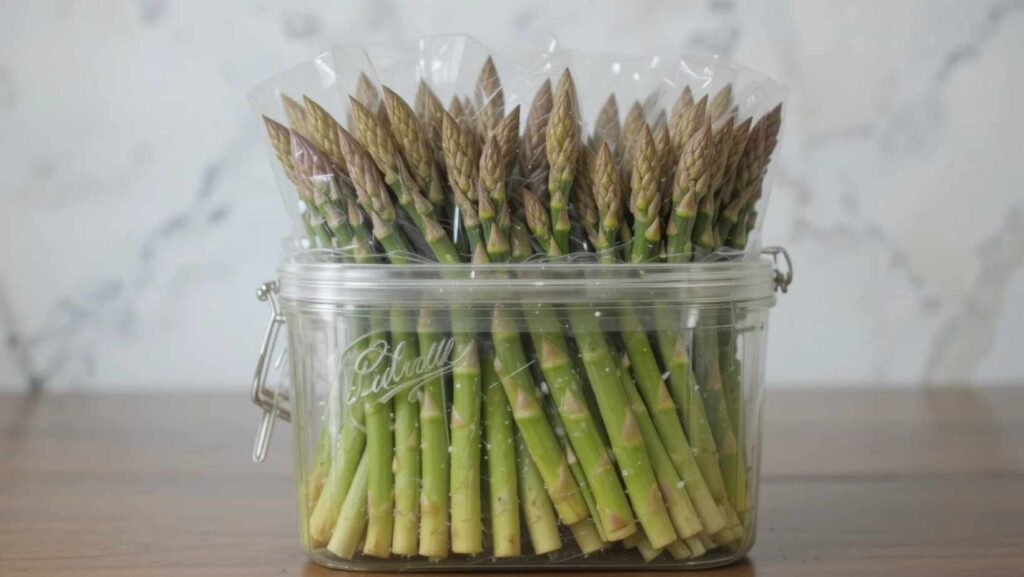
Would you want to know the Best containers for storing asparagus properly? I have found that storing asparagus in an upright position in a glass jar or container with a tiny quantity of water, covering it loosely with a plastic bag, and
Placing it in the refrigerator is the most effective way to maintain its freshness for the longest period.
For those who purchase asparagus on a regular basis, investing in a container specifically designed for asparagus preservation will be a worthwhile purchase.
However, you should take comfort in the fact that a simple plastic bag with a zip-top and a few paper towels will suffice to maintain the quality of your food for at least two weeks.
However, that is not all; as you continue to read, I will provide you with further information on the subject topic.
Now, let’s get started
What are the Best containers for storing asparagus properly
Place fresh asparagus in the refrigerator, ideally in the vegetable drawer, in an airtight container or a perforated plastic bag after wrapping it in a damp cloth or paper towel.
This will ensure that the asparagus is stored in optimal condition.
A more in-depth explanation is as follows:
The asparagus should be wrapped in a wet cloth:
As a result, an adequate amount of humidity is maintained, which helps prevent drying out.
Please place them in a plastic bag with perforations or airtight containers. This will help protect the asparagus from the air and ensure it remains fresh for a longer period.
They should be stored in the refrigerator:
The decrease in temperature causes the ripening and deterioration process of asparagus to go more slowly.
The veggie drawer is an excellent location for:
Because of its properties, asparagus thrives at the high humidity level that the crisper drawer is intended to maintain.
Are jarred asparagus good
It is true that jarred asparagus, whether canned or pickled, maybe a fantastic alternative. It provides a distinct flavor profile compared to fresh asparagus, and it is also more convenient.
Additionally, it still offers nutritional benefits, including vitamins and minerals.
The following is a detailed examination of the advantages and disadvantages of jarred asparagus:
The advantages of one’s diet:
Regarding vitamins and minerals, asparagus is a great source of potassium, iron, and the vitamins K, C, and folate, whether it is fresh or kept in a jar.
There are a lot of antioxidants in asparagus, that protects your body from free radical damage.
Fiber: Asparagus is an excellent source of fiber, which is essential for maintaining healthy digestive gut function.
In situations where fresh asparagus is unavailable or out of season, preserving it in a can or pickling it can be an effective method of keeping the vegetable.
How to preserve fresh asparagus in jars
There are two ways to accomplish this:
Packaging in its Raw Form: When packing raw asparagus into hot jars, ensure a headspace of one inch.
If you’d like, you can add one teaspoon of salt to each jar or half a teaspoon to each pint.
Fill the jars with boiling water or cooking liquid, making sure to leave a one-inch headspace.
Get rid of any air bubbles and adjust the headspace as needed.
After wiping the jar rims with a fresh paper towel, replace the lids and mix the ingredients (for the proper processing times).
The method of hot packing: Cover the asparagus and cover with boiling water. Spend two or three minutes warming up.
After putting the hot asparagus in heated jars, fill the jars with boiling water or cooking liquid, leaving an inch of headspace.
If adding salt, use one teaspoon for each quart and half a teaspoon for each pint. Once the air bubbles have been eliminated, make any required adjustments to the headspace.
Make any required adjustments to the lids and use a paper towel to wipe the jar rims.
What are The Very Best Ways to Store Asparagus
The simplest method for storing raw asparagus is to follow these easy steps:
First, trim the ends.
There is a natural “breaking point” for asparagus at the woody portion of the stem.
You can use a knife to cut off the white ends of the asparagus or break them by hand at this stage to trim the ends. Throw away the white ends.
Step 2: Fill a Jar with Asparagus
If the asparagus has thick stems, I recommend using a glass jar with a large mouth, such a Weck or Mason jar. Trim the asparagus and put it in the jar upright.
Step 3: Add Water. Pour approximately 1 inch of cold water into the jar, just enough so that the stalks’ bottoms may sit in it and absorb it.
It will also consume that water. Therefore, I advise monitoring the water level every few days and replenishing it as necessary.
Step 4: Put in the fridge
Arrange the asparagus in the front of the refrigerator (if there is space, the door works nicely). It’s crucial to keep the asparagus in the proper location in the fridge.
Since these are the coldest areas and can cause the asparagus to freeze, keep it away from the back of the refrigerator and the ice maker (if it’s inside).
We used a plastic bag and a rubber band to secure the asparagus in the jar, much like we did with the cilantro and other fresh herbs and green onions.
How to Store Asparagus in Detail
1. In the refrigerator, getting ready
Trimming the ends of your asparagus is the first step. The cut end of an asparagus stalk scabs over to shield the stalk from more harm after it is severed during harvest.
Because of this, if you put the stalks in your vase as is, they won’t absorb any water and will quickly wilt.
As soon as you arrive home, trim off approximately ½ inch of the bottom of the stalks.
Avoid washing or rinsing the stalks after clipping. The asparagus stems should never be washed before storage; they should only be washed before use. The asparagus will deteriorate more quickly if you do.
Keeping
The first thing you’ll need is a storage container big enough to hold the bunch of asparagus. Typically, a jelly jar or a large mason jar will suffice.
You can use a tall glass or an empty vase if you don’t have either one.
Using opaque containers is not advised. Use only glass or transparent plastic containers. This is because you will need to periodically check the water in the container and replace it if it becomes cloudy or murky.
Pour one inch of water into your preferred container.
Add your asparagus bunch. Ensure that all cut ends of the stalks are completely submerged.
Using a plastic bag, seal the container and add the asparagus. If you don’t use a plastic bag, your asparagus will absorb the scent and flavor of everything you put in the fridge.
The vase will last approximately a week if kept in the refrigerator. For optimal freshness, we recommend finishing it within five days.
2. In bags made of plastic
This approach is simpler and will use less refrigerator space overall.
Continue preparing your asparagus as before. Now, however, wrap the stems in damp paper towels rather than putting them in a vase.
The asparagus stems will stay hydrated thanks to the damp paper towels.
Once the asparagus has been wrapped, put it in a plastic bag and refrigerate it. You should consume the asparagus within three to five days.
3. How to Keep Prepared Asparagus Fresh
You should not discard any leftover asparagus that you have already cooked. They can be saved somehow.
After cooking the asparagus, store it in an airtight container. You can use a plastic food box with a lid that fits properly.
Put the package in the refrigerator. Although cooked asparagus can be stored for up to a week, it is recommended to use it within 5 days.
Final thought
Now that we have established the best containers for storing asparagus properly, Fresh asparagus should be removed from its plastic bag before being brought home from the grocery store.
This should be done as soon as possible.
Additionally, you need to remove the rubber band (if present) to prepare it for washing with water.
The woody end is removed by snapping the ends, which causes it to break apart and fall away naturally.
After washing the rest of the stalk, I throw away the end of the stalk.
In a large bowl, wash the asparagus with cool water and add ¼ cup of distilled white vinegar at a concentration of 5%.
Soak the asparagus in the water for 2 minutes after adding it. When the two minutes have passed, remove the asparagus from the basin and place it on a clean towel to dry.